
 E-Paper



Lucknow-Kanpur Expressway set for April roll-out
Regular traffic on the Lucknow–Kanpur Expressway is set to begin in early April, reducing travel time to 30-35 minutes and boosting regional growth.


Now “nearly complete”, regular traffic movement on the Lucknow–Kanpur Expressway (NE-6) is likely to begin in the first week of April, officials said.
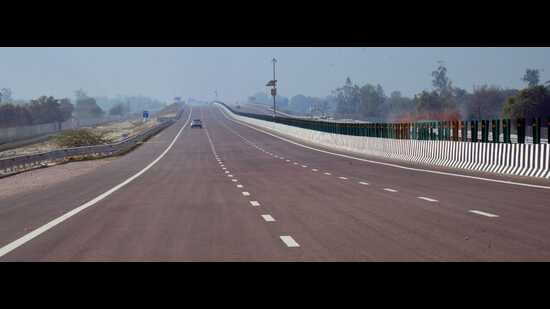
National Highways Authority of India (NHAI) officials, who inspected the upcoming expressway on Friday, confirmed this. They, however, said the work on a narrow stretch in Lucknow’s Sarojini Nagar was still pending due to the ongoing shifting of power lines there.
Once inaugurated, the 62.7-km high-speed corridor is expected to compress a two-three hour journey into just 30 to 35 minutes and also prove key to further industrial growth of the state capital region.
NHAI regional officer Gautam Vishal said: “Traffic movement on the expressway will be allowed from April first week, and its impact on economy and society will be felt soon. The expressway will help decongest Kanpur, and help traffic become three times faster there, according to our study.”
The expressway will connect the Lucknow Outer Ring Road to the Kanpur Outer Ring Road, which means people commuting to Ghatampur, Hamirpur, Kannauj, Jhansi and Prayagraj from here will not be required to enter Kanpur. Similarly, commuters travelling from the Kanpur side and wanting to go to Barabanki and Ayodhya would not be required to enter Lucknow.
It will have 18 km of elevated roadway and 45 km of greenfield construction — bypassing congested settlements and urban choke points altogether.
Speed, safety, and scale
Designed as a fully access-controlled expressway, NE-6 will initially operate with six lanes, which can be expanded to eight as per the traffic needs. Vehicles will be permitted to commute at speeds of up to 125 km/h.
‘Video detection incident system’ cameras will be installed on the stretch to detect any mishap on the road. In case of an accident, an ambulance would reach the needy in ten minutes, said project director Nakul Varma.
Engineering, tech-driven construction
NE-6 will have three major and 28 minor bridges, 38 underpasses and multiple flyovers, and five toll plazas with controlled access ramps. It will also have dedicated rest areas and a trauma care centre, including a 10-bed hospital and on-call ambulance service.
A phone will be installed every two kilometres to assist commuters in need. All one needs to do is press a button, and the commuter will be connected to an operator.
Also, two-wheelers and autorickshaws will be restricted from commuting on the stretch. This, officials said, will significantly reduce accident risks by separating slow and fast-moving traffic.
The officials said it was the first time in the country that such extensive use of AI-enabled and machine-guided construction and GPS-linked 3D systems were made for the development of a greenfield stretch to ensure its millimetre-level precision, better surface durability and long-term maintenance efficiency.
While the NHAI has not released an official material audit, industry estimates suggested that the project mobilised extraordinary resources—about 80 lakh tonnes of cement and 10 lakh tonnes of steel.
Also, the project is expected to cut freight transit time between industrial clusters, encourage new manufacturing and warehousing hubs in Unnao, expand daily commuting possibilities between Lucknow and Kanpur, generate long-term employment and appreciate the value of land along the corridor.


