E-Paper



Man-tiger peaceful co-existence: Pilibhit district administration coaxes farmers to switch from cane to other cash crops
There appears to be a shift taking place in Pilibhit district of Uttar Pradesh, where humans and tigers can coexist peacefully in their defined territories after decades of bloody conflict

 Prefer HTon Google


Slowly, silently but surely, Pilibhit, a district in the terai region of Uttar Pradesh, appears to be finally moving towards an environment where tigers and humans can co-exist peacefully in their defined territories, after being in a bloody conflict for decades together.
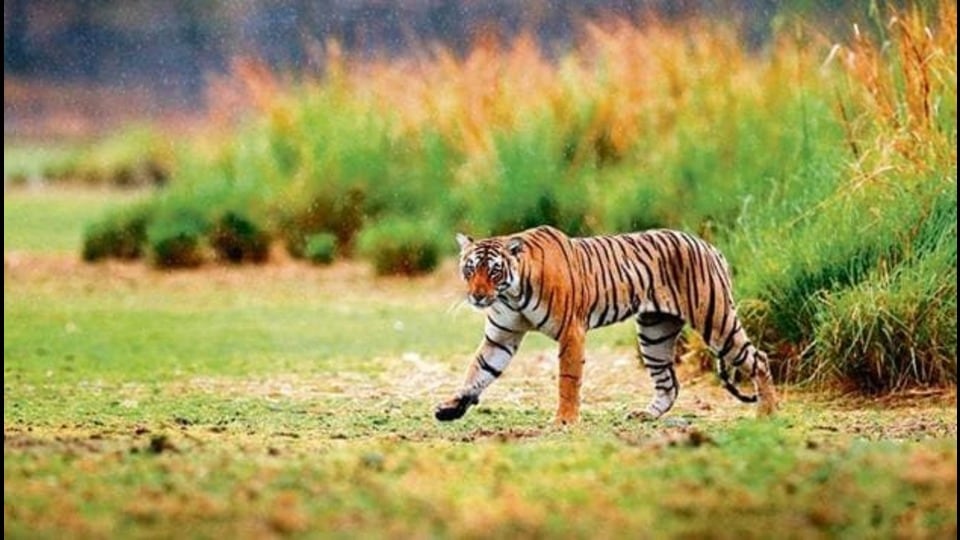
Courtesy the ambitious mission ‘crop diversification with a life-saving purpose’ that Pilibhit district administration launched a year ago and which still continues, farmers living in the villages around the jungle now look to enhance their income while retaining peace of mind.
“Since tigers can easily hide in sugarcane fields, they provide the big cats with a semblance of their natural habitat. However, the tigers attack and kill farmers in an encounter in the fields. We launched an intensive campaign to persuade cane farmers to shift to equally remunerative alternative crops that are agro-climatically suited to the terai environment,” said Pulkit Khare, district magistrate, Pilibhit, who is leading the campaign from the front.
Many farmers, according to him, told tales of spending fearful nights in their cane fields guarding their crops or moving in a group with mashaals while harvesting the crop.
“After several rounds of discussions with progressive farmers and experts, crops like haldi, laahi, sarson, matar, chana, soyabean, mentha, lemon etc, were identified as equally remunerative alternatives to conventional sugar cane plantation,” he revealed.
Reduced cane area
And the campaign has already started yielding the desired results. “As per the annual GPS survey for 2020-21 conducted by the cane department, the cane coverage was 1,04,213 hectares. But that got reduced to 1,02,114 hectares when the same GPS survey was carried out for the year 2021-22,” Khare said.
“Thus, a reduction or rather diversification of around 2,099 hectares (3.5%) of cane area took place in these villages as a result of this intensive campaign to motivate and train farmers for alternative ‘safer’ crops which would reduce man-animal conflict incidents in the times to come,” he added.
Amandeep Singh, of village Purva Bhoora, is one such farmer who has started growing vegetables instead of sugarcane in the fields near the jungle. “Inspired by the district administration’s relentless campaign, I have stopped growing sugarcane in the field near the forest area from where tigers often crept into the cane field,” he said, adding, “Instead, I have started growing vegetables in two of the seven acres of the land that I possess,” he said.
Like Amandeep, Gurumangat Singh Cheema of Haripur village, has also switched to an alternative to sugarcane. “After the officials’ persuasion last year, I have begun growing mentha and potato in place of cane on the four acres of land and get equally good returns without any fear of encountering tigers that would easily hide in dense cane fields,” he said.
Man-tiger conflict commonplace
Pilibhit, located in the terai landscape of Uttar Pradesh, is home to Pilibhit Tiger Reserve which has rich flora and fauna. As part of the Upper Gangetic Plain, its characteristic sal forests, tall grasslands and swamps host species like Indian leopard, swamp deer, hispid hare, floricans and an estimated 65 Royal Bengal Tigers.
Stories of man- animal conflict are commonplace in these habitations. Incidents of tigers straying into the village to either snatch away livestock or have direct confrontation with villagers had been increasing.
“In the last five years, 15 humans were injured and 21 lives were lost in such conflicts. Fencing the entire perimeter of the reserve is a mammoth project which moves only a few notches each year as per the availability of budget with the department,” said Khare, a young 2010 IAS officer, whose videos of raiding government paddy procurement centres in the same district a year ago, went viral.
Though several efforts by the forest department like asking villagers to resort to haanka (lighting the fire, beating drums and dhols) to scare away the animal, moving in groups to their fields for irrigation or manuring or identifying the signs of tiger’s presence nearby are carried out intensively in these villages, nothing was of much help.
This forced the administration to intervene, analyse and make other efforts to reduce such occurrences considering an increasing number of man-tiger conflicts in the district.
“Data analysis of the region of such occurrences showed a high percentage of such man-animal conflicts taking place in the sugarcane fields adjoining the jungle in these villages. (12 out of 21 deaths in the last 5 years were in sugarcane fields of farmers who went for irrigation or harvesting the crop,” the DM said referring to ‘The Sugarcane Tigers of Pilibhit by Sanctuary Asia’ (Vol.41 Aug 2021).
‘Sugarcane tigers’ are those that stray out of the reserve and adopt sugarcane fields as their habitat. This includes the sub-adults pushed out of the forest by dominant male tigers and tigresses and cubs who find it congenial to take refuge in cane farms when the crop is ripe. “Cane fields also provide a semblance of the forest ecosystem with long canes often providing hiding places for herbivores, which attract the tiger as prey to these fields,” he further pointed out.