
 E-Paper



Moon-like craters on earth need to be transformed into geo-tourism sites, say scientists
Birbal Sahni Institute of Palaeosciences (BSIP), Lucknow, plans to work with Rajasthan government to develop Ramgarh crater as a geo-tourist attraction


LUCKNOW Latest pictures of the moon’s surface taken by Chandrayaan-III show many small and big impact craters, which according to scientists, are the result of bombardment of meteoroids. The earth also has 210 identified craters, which were formed in a similar way. Most of these are in bad shape and need to be developed as protected geo-tourism sites to prevent depletion, they said.
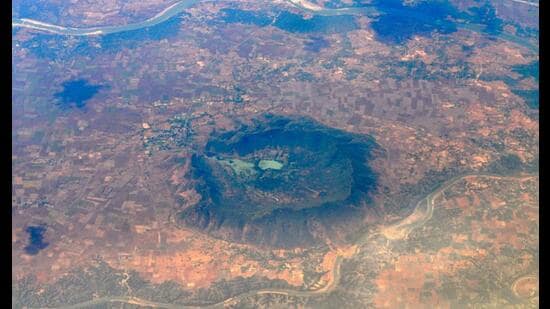
Of these 210 craters, three confirmed impact structures are in India - Lonar in Maharashtra, the first one in the country, Dhala in Bundelkhand region and the largest and latest – the Ramgarh crater in Rajasthan.
The Centre for Promotion of Geoheritage and Geotourism (CPGG), which is the country’s first nodal agency to promote geoparks under Birbal Sahni Institute of Palaeosciences (BSIP), Lucknow, is planning to work jointly with the government of Rajasthan to develop the Ramgarh crater as a protected geo-tourism site so that it can be protected from depletion, said Prof Mahesh Thakkar, director, BSIP.
“Our aim is to provide scientific and technical oversight for conserving the Ramgarh impact crater and develop it as a geotourism and knowledge destination,” said Satish Tripathi, Dy DG (retired), Geological Survey of India and advisor, CPGG.
“There are many such geological heritage sites of international significance, which need to be developed as global geoparks, and Ramgarh is one of the best known and studied impact craters in India,” he added.
Tripathi is supported by two other professors working in the same domain and is a key person behind proving the Ramgarh cup-like depression as a crater like those present on the moon’s surface.
HOW MOON-LIKE CRATERS ARE FORMED
“Hundreds of meteorites enter the earth’s atmosphere every year, most of which burn up in the atmosphere due to friction to form the fireball. However, when larger meteorites with high frequency hit the surface, the explosion forms an impact crater, with approximately circular depression, both on the moon and earth,” explained Amar Agarwal, assistant professor, department of earth sciences, IIT-Kanpur, who scientifically proved Ramgarh as impact crater.
He added, “Impact craters on the moon or Mars are well preserved. But on the Earth, they are constantly damaged and eliminated by the geological system.”
INDIA’S THREE CRATERS
“A total of 210 impact craters have been identified on the earth. In India, there are three. Lonar in Maharashtra was the first to be proven in 1973, followed by Dhala in Madhya Pradesh in 2008, and most recently, Ramgarh in Rajasthan in 2020,” said Agarwal.
Manoj Pandit, a former professor of Rajasthan University, who published papers on Ramgarh, and was one of the key people to identify it as an impact crater, explains about the three craters in India.
•Lonar impact structure (crater), the first confirmed meteorite impact structure from India, is a bowl-shaped, 1.83 km diameter, water-filled circular depression (Lonar Lake), in the Buldhana district of Maharashtra.
•The Dhala impact structure in the Shivpuri district of Madhya Pradesh, the second confirmed impact structure from India is hosted within the Archean age granitic rocks of Bundelkhand Craton in north-central India. It is an 11-km diameter, poorly preserved, complex impact structure.
•Ramgarh crater is a well-preserved complex crater with an approximate diameter of 10 km. The crater is considered 165 ± 1.3 million years old, i.e., of Middle Jurassic age.


