E-Paper



Union MoS Pankaj Chaudhary set to be new Uttar Pradesh BJP president
BJP to appoint Pankaj Chaudhary as Uttar Pradesh president, aiming to consolidate OBC support ahead of upcoming elections after losses in 2024.

 Prefer HTon Google


Living up to its reputation for throwing last-minute surprises and ending all speculation, the Bharatiya Janata Party (BJP) is set to appoint Union minister of state for finance Pankaj Chaudhary as its next Uttar Pradesh president.
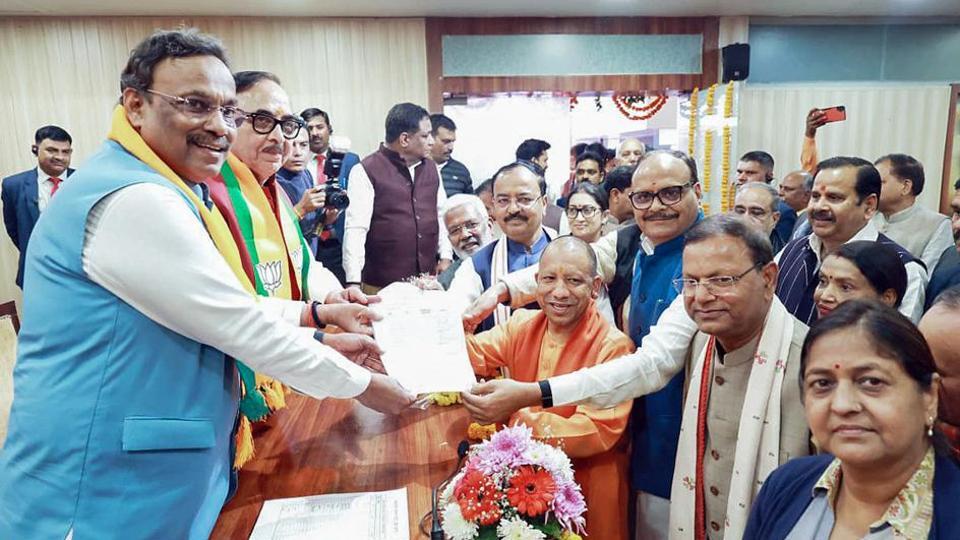
Chaudhary emerged as the lone candidate to file his nomination on Saturday, making his elevation a foregone conclusion despite the formalities still remaining.
The party is scheduled to make a formal announcement at its state convention here on Sunday in the presence of Union minister Piyush Goyal, who is the presidential election incharge for UP.
Half-a-dozen names that had been doing the rounds for months after being shortlisted by the state leadership and sent to the Centre for a final call simply evaporated as the party zeroed in on Chaudhary, a seven-time Maharajganj
MP and a prominent OBC leader from eastern Uttar Pradesh.
Other names that got widely circulated included Dinesh Sharma, Harish Dwivedi, Dharampal Singh, BL Verma, Rama Shankar Katheria, and Vidya Sagar Sonkar, two each from the upper castes, OBCs and Scheduled Castes (SC), respectively.
The party, however, sought to project a united front during the nomination process, with leaders closing ranks to signal complete unanimity around the name.
FROM A CORPORATOR TO A UNION MINISTER
Chaudhary, 61, is a leader from the influential Kurmi community, one of the most dominant OBC groups in Uttar Pradesh. He is currently serving as minister of state for finance in the Modi government.
During his long political innings, he has defeated political heavyweights like Hari Shankar Tiwari, Virendra Shahi, Akhilesh Singh and Harshvardhan Singh.
An alumnus of Gorakhpur University, Chaudhary entered public life through local politics, winning the election to the Gorakhpur Municipal Corporation in 1989 and later rising to the post of deputy mayor.
Beyond politics, he is also associated with the corporate sector and serves on the board of an ayurvedic manufacturing firm.
PROXIMITY TO PM MODI
A seven-time MP from Maharajganj in eastern UP, he is considered close to Prime Minister Narendra Modi. A glimpse of this was seen in Gorakhpur on July 7, 2023, during the centenary celebrations of the Gita Press, when the prime minister, without any prior schedule, took time out to visit Chaudhary’s residence.
As the lane leading to Chaudhary’s house in Harivansh Gali near Ghantaghar in Gorakhpur is narrow, the prime minister’s vehicle stopped about 200 metres away. From there, Modi, accompanied by governor Anandiben Patel and chief minister Yogi Adityanath, walked to Chaudhary’s house.
Pankaj Chaudhary will succeed Bhupendra Singh Chaudhary, a veteran Jat leader from western Uttar Pradesh, who was appointed the state BJP president in August 2022 in view of the farmers’ protests in the region against the Centre’s now-repealed farm laws. His elevation was widely viewed as an attempt to assuage Jat sentiment, particularly among farming communities agitating at the time.
WHY A KURMI LEADER THIS TIME?
If the party’s decision in 2022 to install a Jat leader from western Uttar Pradesh was guided by the intensity of the farmers’ agitation, the current choice appears driven by the setback the BJP suffered, particularly in eastern UP, in the 2024 Lok Sabha elections and its growing concern ahead of the assembly polls due in early 2027 and also the three-tier panchayat polls in the middle of the next year, prompting the leadership to rely on an OBC Kurmi face from the region.
While the actual name was not known to anyone, it had been widely speculated over the past few days that the party’s next state president would be drawn either from the Kurmi community or from the Brahmin fold.
“For the BJP, OBC support remains indispensable in Uttar Pradesh,” said a senior party leader, adding, “The party’s grand comeback to power in 2017—after a 14-year gap — is widely credited to the unwavering backing it received from OBC voters under Keshav Prasad Maurya’s leadership as the state BJP chief.”
Though the party later experimented with Brahmin faces, the setback in the 2024 Lok Sabha elections, where a section of non-Yadav OBCs drifted away and dented its Uttar Pradesh tally that came down to just 33 from 62 in 2019, forced a strategic rethink.
With the high-stakes 2027 assembly battle barely a year away, the BJP has chosen not to take chances and has once again placed its bet on an OBC face for the state president’s post, aiming to consolidate a bloc crucial to its electoral arithmetic.
Within OBCs, the party relied on a Kurmi face. Forming 7-8% of the state’s total population, Kurmis are the second largest and most influential OBC group after Yadavs in Uttar Pradesh. They are largely present in eastern UP. The prominent districts with a sizable Kurmi population include Mirzapur, Varanasi, Chandauli, Bhadohi, Sonbhadra, Prayagraj, Kaushambi, Pratapgarh, Bareilly, Kanpur, Unnao and Barabanki.
BJP insiders say the drift of Kurmi voters played a key role in the party’s losses in eastern Uttar Pradesh, prompting a course correction ahead of the 2027 assembly polls. By moving to appoint Pankaj Chaudhary as the new state president, the party hopes to rebuild its OBC base, with a particular focus on Kurmis.
“The elevation of an experienced OBC leader like Pankaj Chaudhary will significantly help re-consolidate OBC support, including Kurmis, across the state,” a senior BJP leader said.
A BREAK FROM TRADITION
Breaking from tradition, the BJP ignored regional balance in selecting Pankaj Chaudhary as its state president. This is perhaps the first time that both the head of the state government and the head of the party will hail from the same closely located region. While chief minister Yogi Adityanath is from Gorakhpur, Pankaj Chaudhary comes from the neighbouring Maharajganj, which falls under the Gorakhpur division.