
 E-Paper



‘Vehicular movement, drop in temp behind smog blanket over Lucknow’
As a thick layer of smog enveloped the city on Sunday, experts said since the temperature was going down, particulate matters were suspended in air and low wind speed was not allowing the dust to disperse.

 Prefer HTon Google


Lucknow Post Diwali and Bhai dooj, a thick layer of smog enveloped the state capital, reducing visibility. Experts said vehicular movement was on its peak due to the festival season and the weather conditions were favourable for a spike in air pollutants.
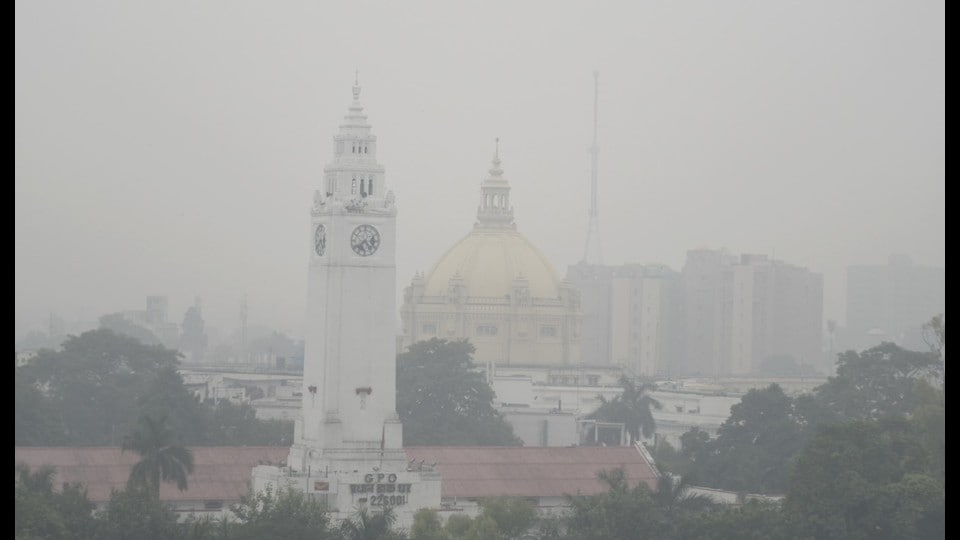
According to experts, since the temperature is going down, particulate matters are suspended in air and low wind speed is not allowing the dust to disperse. They say increased vehicular pollution and drop in temperature has led to this situation which is now becoming common in this season, especially in north India.
Professor Venkatesh Dutta of Babasaheb Bhimrao Ambedkar University, Lucknow said, “The changing temperature and slow and stable winds trap soot,dust and fine particulate matter. The particulate matter is present in a variety of sizes ranging from coarse and fine to ultrafine.”
“Most important to note are PM2.5 (particles with a size less than 2.5 micrometres). These particles are emitted by various sources like industrial exhausts, vehicular emissions, rapid construction, stubble burning and burning of waste material etc. They are considered to be the most dangerous because they can stay in the atmosphere longer due to light weight and small size, thereby increasing the chances of humans and animals inhaling them which and eventually leads to respiratory and cardio-vascular disorders,” he said.
Prof Datta adds, “The road conditions are not good and lead to a lot of dust emissions during traffic hours. These emissions also hang around the air at breathing heights, causing severe health hazards.”
Former director, Geological Survey of India, VK Joshi said, “Being a geologist by training and profession, I am a firm believer in the dictum ‘Present is a key to the past and past is a window of the future.’ Around 5.4 million years ago there was unprecedented Global Warming, leading to intense heat and climate change somewhat similar to the present, but temperatures, rainfall and cardon dioxide content of the atmosphere were much more. Alas, we were not there to take the blame!”
“Around 40% of the problem during this time and the ensuing winter is caused by us, while 60% of the misdeed is done by nature. We believe that we are the sole rulers of the planet. It is not so. There are several others too controlling our climate.The pollution by firecrackers is a municipal problem and should be sorted out accordingly. But there are other issues too which need the attention of the local bodies,” he said.


