E-Paper



Women dhakis from Bengal beat stereotypes, find rhythm of empowerment
The troupe has travelled from different parts of Bengal to add a distinct flavour to the Sanatkada Festival in Lucknow

 Prefer HTon Google


Women dhakis from Bengal have beaten mockery and discouragement hollow, striking positive notes on their journey of empowerment, creative satisfaction and personal fulfilment to emerge as beacons of change in a male preserve.
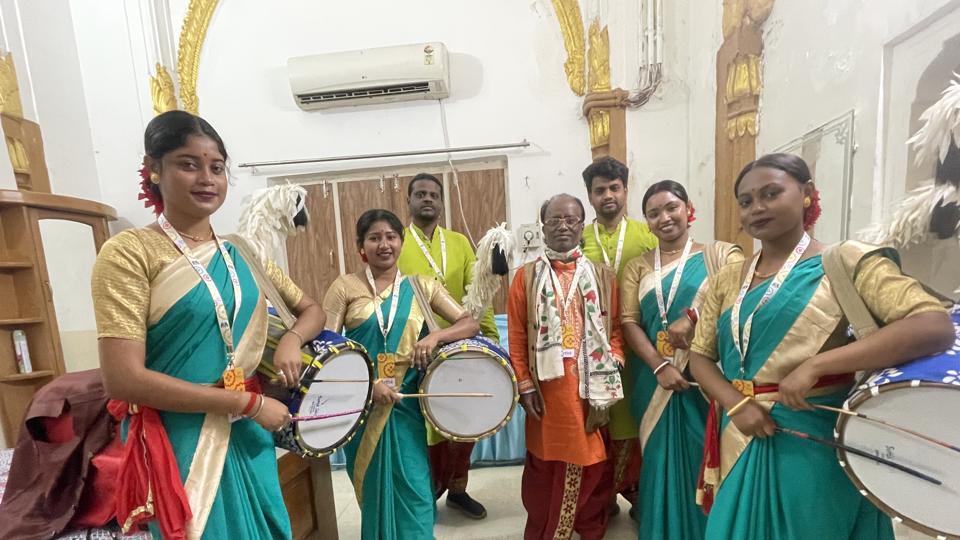
A major attraction at the ongoing Sanatkada Festival in Lucknow, the all-women dhaki troupe has carved out an identity for itself, gained financial independence and turned the tables on past critics who now applaud and admire their skills as they perform under the renowned percussionist and Padma Shri awardee Gokul Chandra Das.
“Earlier people criticised us, mocked us and even looked down upon us. Today, the same people come and tell us they saw us on TV or read about us in newspapers and that they are extremely proud of us,” said 20-year-old Rumpa Sarkar, one of the women dhakis.
The troupe, comprising young women mostly in their early twenties and some as young as 18, has travelled from different parts of Bengal to add a distinct flavour to the Sanatkada Festival, which has the theme ‘Raabta: Lucknow–Calcutta Ka’ this year as it celebrates cultural ties between the two cities.
“This profession has not only given us a different identity and recognition but also a better income, something we may not have achieved in a typical 9-to-5 job,” said 23-year-old Anita Das.
“We also get opportunities to travel across the country and sometimes the world, which very few professions offer.”
Rumpa, who comes from a family of musicians, said rhythm and taal were part of her childhood.
“After marriage, I wanted to continue performing, but people in my neighbourhood judged me constantly. Today, the same people tell their daughters to follow my path,” she said.
Kolkata resident Barnali Biswas, 25, said she joined the troupe after discovering it on social media.
“After graduation, I was exploring options when I came across Gokul Da’s post about forming a women’s dhaki group. That’s when I realised, why can’t women be dhakis?” she said.
“I didn’t want a fixed-income job. This profession gives me financial independence and exposure. Those who once criticised us now pat our backs.”
Eighteen-year-old Paromita Mondal from Barasat, currently preparing for her higher secondary (Class 12) examinations, calls dhak her passion.
“I come from a family of dhakis, but earlier it was considered a taboo for women to take this up,” she said.
Padma Shri awardee Gokul Chandra Das, 58, who leads the troupe, currently mentors around 150 dhakis, of whom nearly 90 are women.
Son of the noted dhaki Motilal Das, he learnt the art in childhood and has performed internationally, including in the United States and the United Kingdom. He received the Padma Shri in 2025 and has shared the stage with maestros such as Pandit Ravi Shankar, Ustad Zakir Hussain and Tanmay Bose.
“I introduced women dhakis into my troupe in 2010, starting with just six women. Today, many of them have formed their own all-women dhaki groups, which gives me immense satisfaction,” said Das, a resident of North 24 Parganas district.
“Some of these women, who once struggled for small amounts of money, are now financially supporting their families.”