
 E-Paper



World Environment Day at observed at CSIR-NBRI
‘Human activities and climate change are affecting insect populations, which in turn is affecting fruit formation and quality, which is affecting yield of plants, resulting in a food crisis’


“Climate change is having an ever-increasing impact on our environment. These effects are so widespread that the consequences of an event occurring in one location can be seen thousands of kilometres away. Furthermore, these environmental effects have an impact on ecosystems and their primary components,” said Prof Renee M Borges, Centre for Ecological Sciences, Indian Institute of Science, Bengaluru.
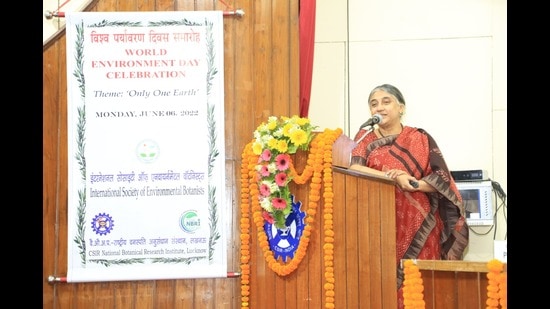
Prof Borges was speaking as chief guest at a lecture organised by the CSIR-NBRI, Lucknow and the International Society of Environmental Botanists (ISEB), as the two bodies jointly celebrated World Environment Day on Monday.
She further said that human activities and climate change are affecting insect populations and activities, including pollination, which is a crucial component of the ecosystem that affects the lifecycle of the organism, fruit formation and quality. This reduces the yield of plants, particularly those used as food, resulting in a food crisis. She went on to say that different insects play different roles in plant pollination but due to human activities and climate change, the population of insects has begun to decline.
Earlier, Prof SK Barik, director, CSIR-NBRI and president, ISEB, discussed the importance of Environment Day and highlighted this year’s theme ‘Only One Earth’. He said that it’s important to “recognise what we’ve accomplished, conserve what we have, and replenish what has been lost. We are working on the identification of such plants which are pollution-tolerant so that they can be planted in such places where pollutants are in abundance. It is necessary to study the required climate for these plants so that the correct information about the plants suitable for the particular place can be obtained,” he informed.
Dr RD Tripathi, secretary, ISEB, welcomed the chief guest and informed them that NBRI and ISEB have worked on environmental protection and climate change for more than two decades. Dr Vivek Pandey, chief scientist and joint secretary, ISEB, proposed the vote of thanks.


