
 E-Paper



Art festival dives into city’s connect to sea
Founded and curated by the non-profit St+art India, the exhibition aims to make the sea visible to the larger public, whose engagement with it has become increasingly limited as Mumbai expands, often at the cost of indigenous communities that have protected the shore for sustenance.


Mumbai: At the Mumbai Urban Art Festival (MUAF), currently underway at the 144-year-old Sassoon Dock in Colaba, a recurring theme underlies the exhibits on display, namely the city’s relation to the sea, the coast and the communities that eke out a living in the peripheral space between land and water.
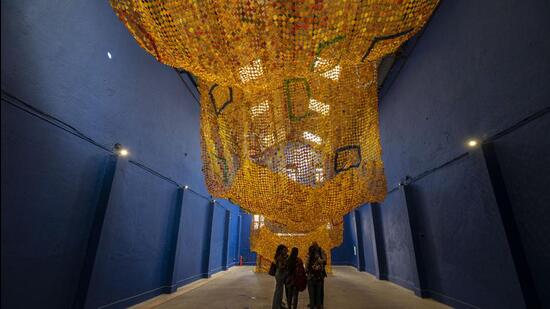
Founded and curated by the non-profit St+art India, the exhibition aims to make the sea visible to the larger public, whose engagement with it has become increasingly limited as Mumbai expands, often at the cost of indigenous communities that have protected the shore for sustenance.
One of the exhibits – ‘Water Has Memory’ – by Mumbai-based artist Meera Devidayal is rooted in her own engagement with the ocean. The artist realised she could view reflections of the sea in the large glass windows of buildings surrounding her husband’s office near Nariman Point but the sea itself could not be seen directly. This lead her to create a video installation, where she worked with images of the open ocean alongside the concrete structures, to capture the dissonance of her experience.
“The sea is represented in its specular contrast to the medium that supports its reflection, the buildings themselves. The (work) explores the contradiction played by the urban landscape: it only brings the image of sea, its reflection, but the sea itself is ‘nowhere’,” states an accompanying note to Devidayal’s installation.
Another notable installation titled ‘Vitamin Sea’ by sculptor Parag Tandel –the only person of Koli lineage to be featured on MUAF’s bill of over 60 Indian and international artists – “dives deep into the myths of his community by revisiting underwater creatures” which are cast in a translucent, amber resin to “reflect the suffering of marine life and biology due to chemical pollutants from the city”.
Tandel, who describes himself as an “auto-ethnographer”, said, “The sculptures more directly represent food which is consumed by whale sharks, whom my ancestors revered as ‘Bahiridev’, so I worked with forms like jellyfish and plankton. There is another layer to this idea of food. My people, the Kolis, came to the seven islands of Mumbai in search of food, but now that very same abundance, found in a periphery of three kilometres from the coast, has been destroyed and continues to be under threat from projects like the Coastal Road.”
It is in this vein that MUAF encourages visitors to revisit and broaden their own idea of the ocean. “Before we settled on our theme ‘Between the City and the Sea’, we toyed with the broader idea of seeing the city as a large marketplace. After a lot of debate internally, there was an overwhelming consensus that the festival must have a strong relationship with the place where it is being held,” said Hanif Kureshi, co-founder and artistic director, MUAF.
“For many Mumbaikars, their engagement with the sea is no more than an occasional visit to Chowpatty,” added Kureshi. “Many people, even those living in Colaba, have never visited Sassoon Docks, perhaps because they thought they couldn’t go there. That’s really the first barrier we’re trying to break. And then the art itself reveals how the sea shapes public life in Mumbai much more than we may realise.”
Stay updated with all the Breaking News and Latest News from Mumbai. Click here for comprehensive coverage of top Cities including Bengaluru, Delhi, Hyderabad, and more across India along with Stay informed on the latest happenings in World News.


