
 E-Paper



Bhiwandi building collapse survivor: ‘My children’s education is at stake now’
His three children are enrolled in a private English school, which has stretched the family’s finances. Their eldest daughter Komal, a Class 9 student at Romeo English High School, dreams of becoming an engineer. “He has only one dream that we study hard and succeed in our life,” said Komal

 Prefer HTon Google


Forty-year-old Arvind Shah’s family has been rendered more than homeless by the collapse of the building in which they lived.
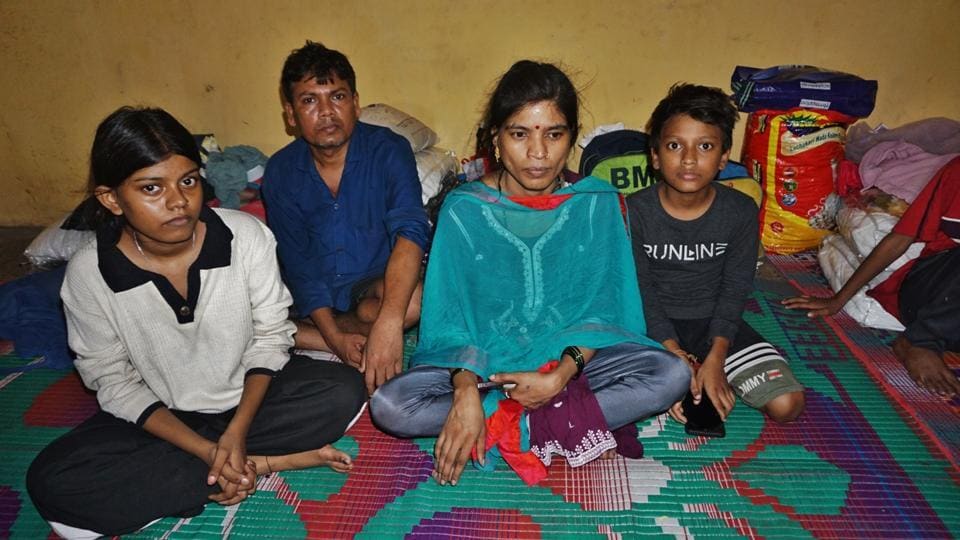
“It has threatened the one dream I had spent my entire working life trying to protect – that my children should never have to live the life I did,” said Shah. An orphan since birth, Shah came to Mumbai from Bihar at the age of 17 and has worked as a power loom worker ever since.
Shah, who lived in the Kohinoor Building for nearly 11 years, said a significant part of his home had collapsed. He said that all the years of hard labour taught him one lesson – the cycle of poverty can only be broken through education. But Friday’s tragedy has thrown his children’s education into uncertainty.
His three children are enrolled in a private English school, which has stretched the family’s finances. Their eldest daughter Komal, a Class 9 student at Romeo English High School, dreams of becoming an engineer. “He has only one dream that we study hard and succeed in our life,” said Komal.
His wife Sunita Devi, 31, said she cares less about their lost possessions than the road ahead. Without a home and with little money to spare, she fears they may no longer be able to afford to keep their children in school. “We have lost our home and our belongings. We don’t know what will happen now. My children won’t be able to go to school for some months. We have to start from scratch,” she said.
When the building collapsed, they escaped but nearly half of the family’s belongings like jewellery and important documents remain trapped beneath the debris.
“I hope my children won’t not spend their lives working at power looms like me or doing manual labour,” said Shah.
‘This was the best place to live in’
Harihar Patel, 40, has spent the last 11 years living in a rented flat in the portion of B-wing of the Kohinoor Building that still remains standing, along with his wife, Chandrakala, 38, and their daughter, paying a monthly rent of ₹3,100.
A worker at a textile factory in Bhiwandi, Patel keeps record of fabric scraps generated during the making of bedsheets. He said life in the Kohinoor Building had been comfortable despite their modest means. “There was never a water shortage or power outage. It was peaceful, calm and affordable. We thought this was the best place to live,” he said.
Unlike residents whose homes were crushed in the collapse, their place is intact. “All our belongings are still inside, untouched—provided they are not stolen,” Chandrakala said nervously. But the building has been sealed and residents have been barred from entering to retrieve their possessions. “So our problem is different from the others. We are stuck,” she said.
What worries her is starting life in another rented house without the belongings that make a home habitable. “How do we move into another place when our clothes, utensils, bedding and everything we own are locked inside?” she asked.
Nearly two days after the collapse, the indignity of displacement had begun to weigh heavily on Chandrakala. “I haven’t been able to change my clothes or bathe,” she said.
For Patel and his family, their tragedy is that everything they own “is visible yet inaccessible”.
‘After carrying my son’s coffin, I have to carry his belongings’
Standing at the entrance of the A-Wing on Saturday, Rasool Shaikh, 65, watched as workers and relatives emptied the flat that had belonged to his 34-year-old son, Miraj. After municipal authorities allowed residents of the adjoining building to briefly enter and retrieve their essential belongings, Rasool decided to pack up the home of its owner – his son, a power loom worker who died on Thursday.
According to the family, Miraj had gone to inspect the work being carried out inside the B-Wing, where cement had been removed from pillars by the contractor, when the building came crashing down on him. Holding back tears, Rasool stood in the rain trying to shield the salvaged belongings from becoming drenched as relatives hurriedly loaded them into tempos. The downpour soaked mattresses, clothes, household items and furniture before they could be covered. “Everything we managed to retrieve got drenched. I feel so overwhelmed. I carried his coffin yesterday, and today I have to carry his things,” he said. Yet, amid the grief, Rasool said, there is a ray of optimism. Miraj’s wife and their three children have found shelter with him instead of running from pillar to post like others. “At least they have a place to stay,” he said. “I will take care of them.”
‘Rents have suddenly shot up’
The biggest challenge for 54-year-old Gurvijay Yadav is to find another rental accommodation. A resident of A-Wing and a power loom supervisor, Yadav spent Saturday carrying out furniture and household items from his flat after authorities briefly allowed residents to retrieve their belongings. But as cupboards, beds and utensils were loaded onto tempos, he wondered where any of it would go.
“All this furniture is of no use unless we have a house. For now, we plan to keep it in the tempo, but we can’t afford it beyond two days,” he said.
Yadav said his family owns two small rooms in a nearby chawl. Since Thursday night, relatives have repeatedly urged him to ask the existing tenants to vacate so that his family could move in immediately. But he refused. “Should I make someone else homeless during monsoon because I have become homeless?” he asked. “Is that fair?” Instead, he chose to continue staying at the nearby temple that has been sheltering dozens of displaced residents.
Another shock that Yadav is facing is the sudden spike in rental rates in the vicinity, since the building collapsed. “I have seen nearly two dozen houses since yesterday. Everywhere I go, people are quoting whatever price comes to their mind,” he said.
The sharp increase, he believes, is driven by the sudden demand from hundreds of displaced families looking for accommodation at the same time. “The room that I have given on rent in the chawl for ₹3,000 a month, could fetch me ₹7,000 now, I was told,” he said.
“I am not well off. If I don’t find an affordable space, I may have to ask my tenants to vacate,” he said.
For now, the temple remains his refuge.

Stay updated with all the Breaking News and Latest News from Mumbai. Click here for comprehensive coverage of top Cities including Bengaluru, Delhi, Hyderabad, and more across India along with Stay informed on the latest happenings in World News.


