
 E-Paper



Central team to assess losses in 32,823 drought-affected villages
MUMBAI: With 73% of Maharashtra’s villages facing severe drought, the state government on Tuesday fast-tracked damage assessments to expedite central relief funds for farmers

 Prefer HTon Google


MUMBAI: With 73% of Maharashtra’s villages facing severe drought, the state government on Tuesday fast-tracked damage assessments to expedite central relief funds for farmers. Chief minister Devendra Fadnavis said that a central government team will begin field evaluations from Wednesday till Sunday to assess the crisis. Recorded by a state team, the crisis impacts 32,823 of the state’s 44,911 villages and is expected to worsen in the coming days.
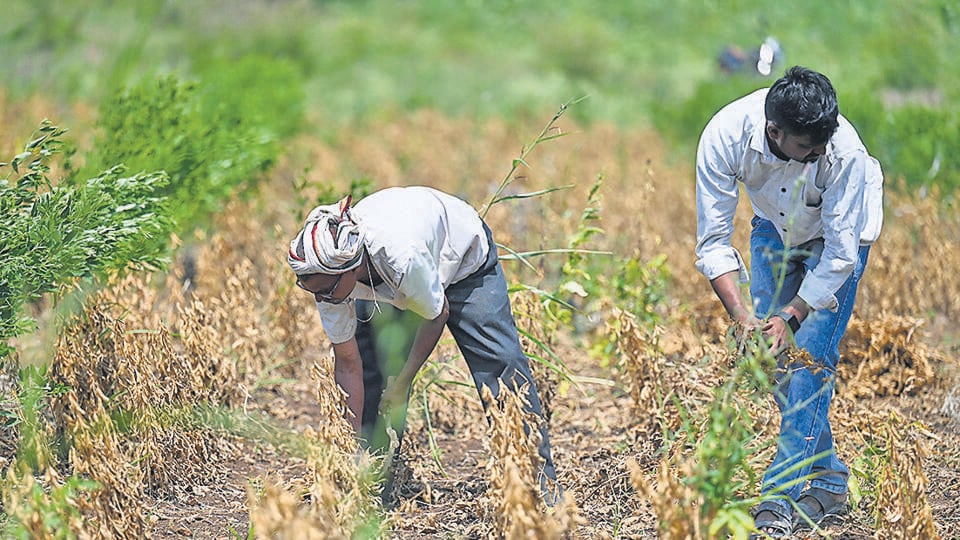
The state government recently announced the drought in 265 of 358 talukas of the state subsequent to a weak monsoon this year. Last week, it sent a proposal to the Centre for interim financial relief of ₹13,000 crore for the loss of crops and ₹4500 crore for fodder. “This is on the basis of preliminary assessment of the losses which will be revised once the complete assessment is done,” said an official from Mantralaya, adding that the government has promised to disburse the fund to affected farmers before Diwali.
Alongside, the government has also directed the administration to prioritise the use of water and is likely to put restrictions on its use for construction activities – a government resolution (GR) to this effect will be released soon.
In its weekly cabinet meeting on Tuesday, therefore, the government decided to store available water in the dams and reservoirs so that the stock for the purposes of drinking and livestock lasts till next August. Any decision on the supply for industrial and agricultural use, said Fadnavis, will be made according to necessity. “District-level committees could approach cabinet sub-committees if exceptions need to be made. An appropriate decision will be taken after that,” said Fadnavis.
On the state-appointed team engaged in on-ground assessment in the drought-hit villages, Fadnavis said, “We are working to complete the process in record time to meet the Centre’s requirements and secure financial assistance for drought relief.”
Soon after the cabinet meeting, a cabinet sub-committee meeting, helmed by revenue minister Chandrashekhar Bawankule, reviewed water storage, crop losses and crop surveys done by the state team. “The government has prohibited the use of potable or treated drinking water for construction. Only treated water from sewage treatment plants will be permitted for construction activities,” said Bawankule.
At the meeting, it was also decided to take action against banks and private financiers harassing farmers for repayment of loans, address fodder shortages and expedite crop-loss assessments. Bawankule said 45% of crop-loss panchnamas had been completed and directed officials to speed up the remaining work. He added that three separate teams from the Centre will assess the drought situation in Beed-Dharashiv, Yavatmal-Washim and Ahilyanagar-Solapur districts.
“Banks have been directed not to repeatedly demand documents from farmers who had availed of crop loans. Nationalised and private banks, as well as private financiers, would face strict action if they contacted farmers for loan repayment during drought. District-level meetings under the chairmanship of collectors and discussions at the chief secretary’s level will be held to resolve the issue,” said the minister.
Some ministers also demanded that more tehsils, which have not indicated Trigger-1 parameters (an essential gauge for an area to be declared drought-affected) but are facing scarcity, be also included in the drought-affected list.
As part of the drought mitigation steps, the state government has constituted a 12-member high-level study group under the chairmanship of additional chief secretary of the revenue department to recommend immediate and long-term measures to tackle the shortage. Additional chief and principal secretaries of various departments will be a part of the group. Its key responsibility is to assess existing fodder availability, potential production and future requirements, and prepare a plan to meet the fodder needs of livestock, following which it will submit concrete steps to be followed for immediate and long-term measures to the state government.


Stay updated with all the Breaking News and Latest News from Mumbai. Click here for comprehensive coverage of top Cities including Bengaluru, Delhi, Hyderabad, and more across India along with Stay informed on the latest happenings in World News.


