
 E-Paper



Collateral Damage: Lives lost to Mumbai’s construction boom
After construction site accidents claim lives, what follows is a murky mix of private settlements, weak oversight, and little justice for victims left behind

 Prefer HTon Google


MUMBAI: Asif Shaikh was working at his sewing machine when he heard that 22-year-old Sanskruti Amin had been crushed to death by a concrete slab that fell on her as she walked past an under-construction site, nearby, on October 8. As the news sank in, his blood ran cold. The 37-year-old tailor in Jogeshwari east was transported back to a moment more than two years ago, when his wife and daughter met a similar fate.
“My wife Shama had picked up our nine-year-old daughter, Aayat, from school, and they were returning home in an autorickshaw when an iron rod from a partially constructed building, AIM Paradise, fell on them. My wife died instantly, and Aayat died hours later,” recalled Shaikh.
Were Shama, Aayat and Amin merely in the wrong place at the wrong time?
Falling debris, plunging iron rebars and toppling cranes are killing passersby near construction sites with alarming regularity – not because Mumbai is caught in a redevelopment frenzy, but because many builders believe they are beyond the law.
In February 2023, friends and colleagues Imran Khan, 30, and Sabir Ali, 36, both migrant workers employed at a zari design unit in Worli, were sipping tea at a roadside stall during their evening break, when a concrete block from a crane at the Four Seasons Residency Project plunged to the street from the 42nd floor. It was instant death for Imran and Sabir.
What followed was an all-too-familiar routine in cases where members of the public die due to builders’ negligence: an out-of-court settlement, no charges pressed, and when cases are filed, they vanish into the paperwork buried in magistrate court registers.
“We camped outside the Worli police station for three days, refusing to claim the bodies because the police wouldn’t file charges,” recalled Imran’s cousin, Ashadujjaman Khan. “Finally, the builder was brought in, and the police asked us how much money we wanted. Imran was the sole breadwinner for two elderly parents with heart ailments, a wife, and two children.”
Eventually, after senior politicians intervened, compensation was settled swiftly – ₹27 lakh from the builder and another ₹4 lakh from their employer for Imran. Sabir’s family also received a payout, says Khan.
“When fair compensation is on the table, it’s sensible to accept it,” he reasoned. “How long could we fight? Sooner or later, the builder would go scot-free, so it was only practical to take it,” he said, adding that it still took six months for the money to come through.
Shaikh, the tailor whose wife and daughter were killed in Jogeshwari east, said it was only prudent to look ahead rather than fight for justice. “Nothing could bring back the lives I’d lost,” he said. “Instead, I had a son who was four years old then, and I was thinking of his future. Through the intervention of political leaders, including the then local MLA, it was decided that my boy would receive a ₹35-lakh fixed deposit, a flat, and that the builder would bear all expenses for his education and healthcare until he turned 20. They also gave me ₹4 lakh.”
Who’s negligent?
Justice, it seems, is not tilted in favour of survivors or victims’ families, prompting many to take a “practical” approach. In cases like these, builders are rarely booked, while their site supervisors or contractors are charged under Section 106 of the BNS (earlier 304A of the IPC), with “death by negligence”. Punishment is either imprisonment up to five years, or a fine, or both.
Not only is a developer unlikely to be convicted, these cases rarely reach the conviction stage. In Jogeshwari, for instance, charges are yet to be framed in court, more than two years later. It’s a familiar pattern.
YP Singh, a former IPS officer-turned-lawyer activist, said, “Builders usually receive the ‘cooperation’ of the police and prosecution, and the burden on the courts works in their favour. These cases are either disposed of because of absent or hostile witnesses, or, after years, the builder confesses and is let off with minimal punishment,” Singh says.
What about safety rules and their enforcement by the Brihanmumbai Municipal Corporation (BMC)? On paper, there are regulations meant to prevent such accidents but enforcement is weak as leniency is, unofficially, heavily incentivised among the civic administration. When an accident does take place, the settlement doesn’t go only to victims; it is shared with the authorities who look the other way, and by those who broker these deals.
“At the point of issuing construction permissions, the BMC issues safety instructions, which include that the site be entirely cordoned off to prevent any mishaps on passersby,” said Bhushan Gagrani, the municipal commissioner. “This is, admittedly, not always followed. But the matter of enforcement by the BMC falls in murky territory. It is not practical to frequently monitor all the thousands of ongoing construction projects. Even if it is done, it can create grounds for harassment on construction sites and hamper the ease of doing business. However, whenever any complaints are received, the BMC does the checks,” Gagrani added.
There’s a laundry list of safety rules that builders must observe, besides submitting a safety plan before permissions are given. More often than not, they remain on paper. When accidents do occur, a stop-work notice is issued to the builder but is eventually lifted – for a price that suits civic officials. After that, it’s business as usual.
Singh makes another powerful argument. He says a government and BMC administration that allows high-rises to be erected without adequate open space around them, clearly places profit above human life.
New safety regulations
In 2023, the Lokhandwala Residency Towers CHS filed a writ petition in the Bombay High Court soon after the Worli accident that claimed the lives of Imran and Sabir. The boom from the crane that dropped the slab on them from the Four Seasons Residency Project was positioned above their CHS, which alarmed the residents. Advocate Mridul Sharma, representing the CHS, says, “The court ordered an expert committee to recommend safety measures particularly for high rises.”
The recommendations were submitted over a year ago but resurrected only in August this year, when an accident in Bhiwandi made headline news – an iron rod from a metro site accidentally pierced the skull of a 20-year-old travelling in an autorickshaw.
“On the court’s directions, the Maharashtra government turned the recommendations into a government resolution,” said Sharma. The safety regulations now require a safety officer to be present at each site, regular checks by the BMC’s building proposals department, safety shades to be erected at construction sites, among other things. The onus for any breach is on the builder, safety officer and the BMC. At the very least, the regulations are a tool in the arsenal of those with the stamina to fight for justice, Sharma remarked.
Gearing up for battle
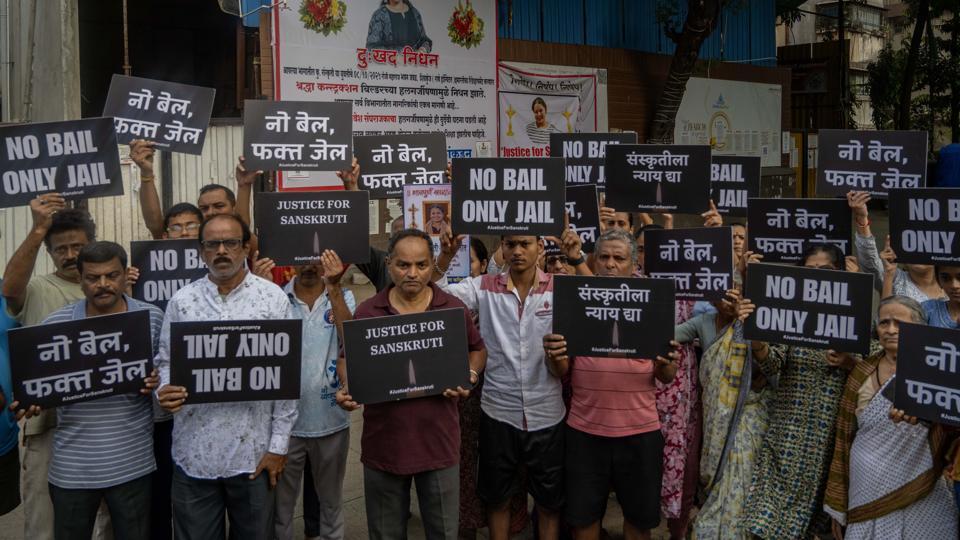
These tools will bolster the lawsuit Sanskruti Amin’s family plans to file. The 22-year-old died after she was hit by a falling concrete slab from Shivkunj building on October 8. “We want the builder to be held accountable,” said Arun Kotain, Amin’s uncle. The family is gearing up for a legal battle – posters are still pasted at the construction site and other places, calling for justice.
Amin’s family has already won an early victory, having managed to get the police to include Section 105 of the Bharatiya Nyaya Sanhita – “culpable homicide not amounting to murder” – in the First Information Report.
“This was possible as the Maharaj Bhuvan slum, where Sanskruti lived, had earlier complained about falling objects from Shivkunj building,” says Ninad Muzumdar, the Amin family’s lawyer. “We will raise this in a writ petition we plan to file in the high court.”
For now, the Amins are busy with a more immediate battle; opposing the builder’s plea for anticipatory bail. Muzumdar says, “It won’t be long before the legal battle begins.”

Stay updated with all the Breaking News and Latest News from Mumbai. Click here for comprehensive coverage of top Cities including Bengaluru, Delhi, Hyderabad, and more across India along with Stay informed on the latest happenings in World News.


