
 E-Paper



First-of-its kind $1.2bn NASA-Isro earth observation satellite to launch on July 30
The first joint Earth observation satellite by the two space agencies will lift off on Isro’s GSLV-F16 at 5:40pm from the Satish Dhawan Space Centre, Sriharikota

 Prefer HTon Google


After more than a decade of collaboration between Isro and NASA, the NASA Isro Synthetic Aperture Radar (NISAR), to study the Earth’s ecosystems and natural hazards will be launched on July 30, the Indian space agency said on Monday.
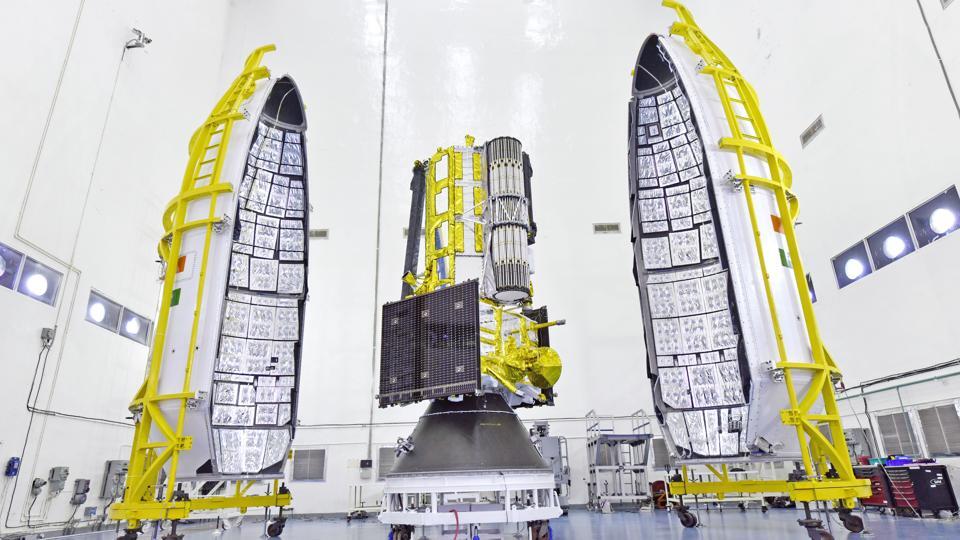
The first joint Earth observation satellite by the two space agencies will lift off on Isro’s GSLV-F16 at 5:40pm from the Satish Dhawan Space Centre, Sriharikota, and placed into a 743km sun-synchronous orbit.
According to NASA, $1.2bn is the budget for NISAR with roughly a 50-50 partnership with Isro. It will be the first satellite mission to use two different radar frequencies to measure changes in the Earth’s surface less than a centimeter across.
“The satellite will scan the entire globe and provide all weather, day & night data at 12-day interval and enable a wide range of applications. NISAR can detect even small changes in the Earth’s surface such as ground deformation, ice sheet movement and vegetation dynamics,” a statement from Isro read.
NISAR, which features NASA’s L-band (1.25 GHz) and ISRO’s S-band (3.2 GHz) radars, is the world’s first dual-frequency radar imaging satellite to observe the earth.
Weighing 2,392 kg, NISAR will use both NASA’s 12m unfurlable mesh reflector antenna, integrated to Isro’s modified I3K satellite bus. The satellite will observe earth over an area of 242km and in high spatial resolution using SweepSAR technology for the first time.
Its further applications include sea ice classification, ship detection, shoreline monitoring, storm characterization, changes in soil moisture, mapping & monitoring of surface water resources and disaster response.
Isro said the launch of the low earth orbit observatory is the result of strong cooperation between its and NASA/JPL’s technical teams for more than a decade.
“Both bands have longer wavelengths than others, for instance the C band. The two frequencies (L and S bands) together allow for newer applications such as precision measurement of deformation of the earth’s surface before a landslide or early signatures of an earthquake. NISAR will be able to see through and record data on Himalayan glaciers especially during cloudy conditions as well as quantify biomass of forests,” an official in the know speaking under condition of anonymity, said.
In February, Prime Minister Narendra Modi had announced that NISAR would be launched soon following talks with US President Donald Trump at the White House. “The ‘NISAR’ satellite, built in collaboration with ‘ISRO’ and ‘NASA’, will soon fly into space on the Indian launch vehicle,” PM Modi had said while addressing the media.
On September 30, 2014, NASA and Isro signed a partnership to collaborate on and launch NISAR. NASA is providing the L-band synthetic aperture radar, which is a high-rate communication subsystem for science data, GPS receivers, a solid-state recorder and payload data subsystem, while Isro is providing the spacecraft bus, the S-band radar, the launch vehicle and associated launch services.
NISAR was scheduled for launch in 2024 but was delayed. Last year, union minister Jitendra Singh informed the Indian parliament that NASA scientists had found that its 12-metre reflector antenna needed some corrective action and had to be taken to the US for rectification.
According to NASA, the concept of the mission and the resulting partnership are in response to the National Academy of Science’s 2007 survey of Earth observational priorities for the next decade, known as the decadal survey. “One of the top priorities identified in this survey was to gain data and insight in three Earth science domains: ecosystems, deformation of Earth’s crust and cryospheric sciences,” said the US space agency on its portal.


Stay updated with all the Breaking News and Latest News from Mumbai. Click here for comprehensive coverage of top Cities including Bengaluru, Delhi, Hyderabad, and more across India along with Stay informed on the latest happenings in World News.


