
 E-Paper



For redemption and renewal, the Sena needs to look at Prabodhankar Thackeray
Mumbai: As the Shiv Sena slugs it out with the Eknath Shinde faction and the Bharatiya Janata Party (BJP) over who the true legatee of Hindutva is, they may do well to revisit a Navratri pandal in Dadar

 Prefer HTon Google


Mumbai: As the Shiv Sena slugs it out with the Eknath Shinde faction and the Bharatiya Janata Party (BJP) over who the true legatee of Hindutva is, they may do well to revisit a Navratri pandal in Dadar. It is from here the Thackeray family’s association with subaltern Hindutva began in 1926.
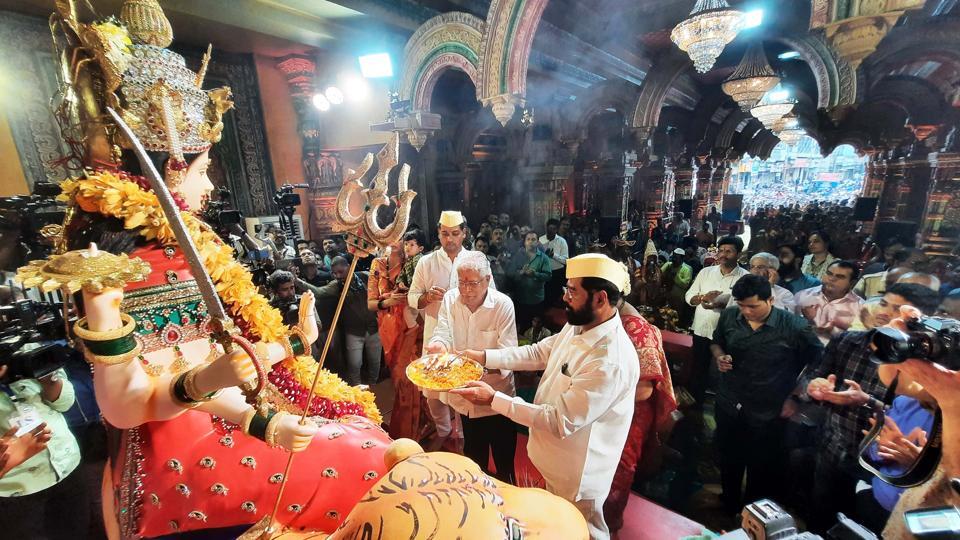
The Navratri celebrations at Khandke Building near Sena Bhavan at Dadar were started among others by Bal Thackeray’s father ‘Prabodhankar’ Keshav Thackeray as part of a larger counter-cultural pushback against the sway of the upper-castes over Hinduism at that time. Thackeray and others began the public celebrations of Navratri at Dadar to counter the Ganesh utsav, which was then dominated by the Brahmins.
Babasaheb Ambedkar’s biographer Changdeo Khairmode recounts an instance from around 1925 when the organising committee of a Ganesh utsav in Dadar invited Babasaheb to speak but were opposed by other caste Hindus who felt his presence would ‘defile’ the idol. Death threats were issued against Ambedkar and he was warned against entering the pandal.
Ambedkar chose not to pay heed and decided to go to the pandal with a loaded gun hidden in his coat pocket. “Saheb (Ambedkar) said, ‘one has to die someday or the other. Then, why shouldn’t one die fighting’?” writes Khairmode in his biography. Ambedkar’s personal bodyguard Balram Mane summoned 10-15 Mahar wrestlers from the nearby akharas who ring-fenced him and ensured his safety.
In 1926, non-Brahmin activists like Ambedkar, Prabodhankar Thackeray and Rao Bahadur S.K. Bole demanded that erstwhile ‘untouchables’ be allowed to worship the idol of Lord Ganesha during these celebrations as a routine practise. A standoff ensued which was later resolved rather tortuously—a Dalit devotee would hand over a bunch of flowers to the priest wo would then offer it to be offered to the Lord. These radical ideas rattled the orthodoxy and the Ganesh utsav was shut down.
In his autobiography, Prabodhankar Thackeray recounts how they countered that. Navratri was celebrated across Maharashtra from the times of Chhatrapati Shivaji Maharaj. The Ganesh utsav became a bigger festival much later during the reign of the Peshwas. To revive this tradition, the ‘Lokahitawadi Sangha’ was established by Prabodhankar and Bole and it began celebrating the ‘Shri Shivbhawani Navratri Mahotsava’ with devotees cutting across caste. At the 1926 celebrations, a Dalit unfurled the saffron flag and another Dalit couple performed the pooja for ‘ghatasthapana’ which marks the first day of Navratri. On Dussehra day, a massive procession was organised. Ambedkar also spoke on the occasion. The public celebration of Navratri continues to this day at the Khandke building in Dadar.
Though Prabodhankar was seen as an exponent of Hindutva, he represented the reformist, subaltern strain. He was among the first to begin reconversions to Hinduism in 1918—the precursor to modern-day ‘gharwapasi’ with his associate Gajananrao Vaidya and also launched a movement against dowry, when these ideas were anathema to several Hindus, including upper-castes.
But despite his positions against upper-caste orthodoxy, when anti-Brahmin riots began in Maharashtra after Nathuram Godse assassinated Mahatma Gandhi in 1948, Prabodhankar prevented an incensed mob from attacking the Brahmin households near his house at Ranade Road near Shivaji Park.
Prabodhankar’s ‘Bahujan’ Hindutva played a key role in the formation of the Shiv Sena in 1966 and its subsequent social expansion. However, since then the Sena has drifted away from his reformist ideas. The party has opposed reformist legislations against black magic and human sacrifices; it also ranged against the ‘Namantar’ (renaming) movement (1978–94) that sought to rename the Marathwada university after Ambedkar.
Maharashtra is also the only state where two major parties compete for the same (Hindutva) catchment, and the Shiv Sena’s presence is seen as hindering the BJP’s social expansion in Maharashtra. Going back to Prabodhankar’s legacy may help the Shiv Sena create a broader coalition of Hindus to counter the BJP.
For instance, the Shiv Sena has a strong base in the other backward classes (OBCs), but the BJP-led union government has refused to concede the demand for a caste-based census, which is resented by backward class groups. Hindu Dalits like the Charmakars and Dhors, who are traditional saffron voters, are also at the receiving end of the ban on the slaughter of the progeny of cows (bulls and oxen) and cow vigilantism that has affected the leather industry.
The creeping “vegetarian fundamentalism” in Mumbai is also a cause of worry for most blue-blooded Maharashtrians who love their fried fish and mutton curries. These cultural impositions like the opposition to the sale and consumption of meat and related products in traditional Maharashtrian-dominated areas are a sore point for many as is the gradual mushrooming of ‘vegetarian only’ housing complexes in Marathi working-class areas like Parel and Lalbaug.
Of course, the role of Shiv Sena functionaries in this gradual social, cultural and economic transition cannot be overlooked—it is rumoured that many of these leaders have stakes in these real-estate projects. Senior Shiv Sena leaders admit that perhaps a decade from now, these constituencies may slip out of their hands due to the changing demographic profile, bringing to mind the story of the woodcutter, who cut the branch of the tree he was sitting on.
Though the BJP is no longer a ‘Brahmin- Baniya’ party today due to its horizontal and vertical expansion that has seen it encompass Dalits, tribals, middle-castes and backwards in its fold, it still retains the image of an upper-caste outfit. These contradictions in the praxis of its Hindutva and idea of organised religion may provide a ballast to the Shiv Sena. All they have to do is to look at the legacy of Prabodhankar Thackeray.


