
 E-Paper



How the Koli community in Bandra romanced the sea before reclamation
Pioneer Hall in Bandra hosted ‘reClamation,’ an exhibition reflecting on the lost coastal heritage of the local fishing community due to reclamation.

 Prefer HTon Google


MUMBAI The Pioneer Hall, an erstwhile cigarette factory, is now a space where events are hosted. Situated in the Mount Mary area, in Bandra, there was a time when foamy waves lashed against its walls. The sea also touched the fringes of Bazaar Road, Chapel Road and St John Baptist Road. It was a time when high rises did not block the view of Mahim Fort from here.
The geographical advantage along with the livelihood of a large section of people – the kolis – were snatched away in the 1970s by the spectre of reclamation.
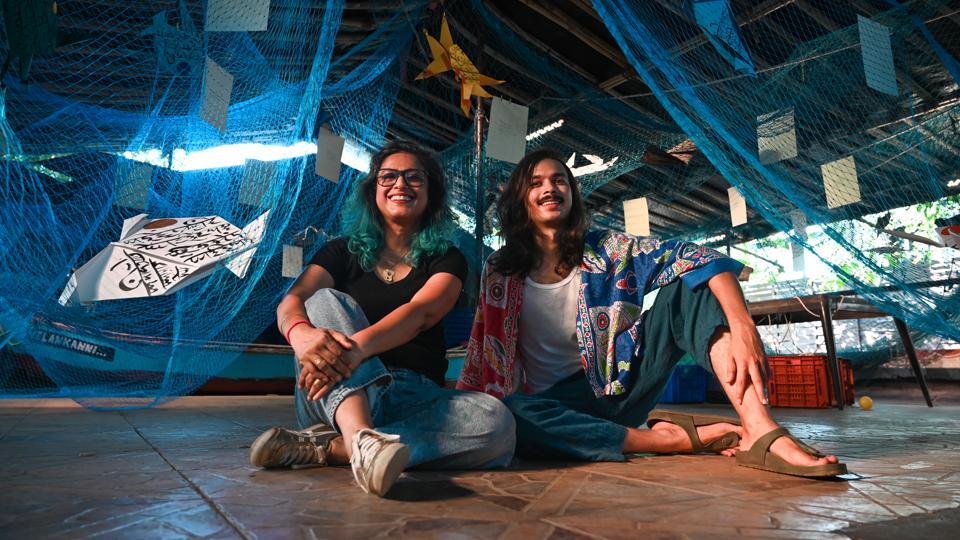
The ripple effect of this change informed a day-long exhibition titled, ‘reClamation’ hosted at Pioneer Hall, on Saturday. Part of the exhibition was an extract from the family album of graphic artist Gary Curzai from the early 1900s. Curzai, a Bandra resident, comes from a line of East Indian kolis whose family owns the Pioneer Hall. The collection from the family album, belonging to his grandfather, depicts a time gone by.
Shormistha Mukherjee, who runs the oral history blog ‘Memory Keepers of Bandra’ and Instagram page ‘Houses of Bandra’, collaborated with him in documentation of the project.
“The sea was stolen from the fishermen who were previously a stone’s throw away from it,” said Mukherjee. “The community was promised a lot of things with the reclamation, which was done to create more land, including exclusive rights to fish, government jobs, etc. But none of this materialised.” She underscored that what they were left with was a laborious way to reach the new shoreline – they would now have to cross the entire reclaimed portion and navigate around the new buildings that came up in between.
Over time, certain members of the community diversified – some turned to making hooch, others opened shops while some went into carpentry.
The first section of the exhibition, titled ‘Net of Memories’ took a sweeping view of this time. Fishermen’s nets were slung across the space, holding in them marine animals crafted through origami. The commentary was in the Modi script – used for writing Marathi from the 1700s to the 1950s. Interspersing the space were also sections of interviews which Mukherjee had conducted in the past, with members of the community living on Chapel Road, Bazaar Road, St John Baptist Road and at the mosque on SV Road.
“No one from the present generation now depends on fishing for their livelihood, especially as commercial fishing and the new coastal road has impacted the catch near the sea,” she said.
Some, like Curzai’s family, however indulged in fishing only for recreation in their backyard. “They would swim and host barbeques,” said Curzai. “But by the time my brother and I were born, the sea was far away and we had no opportunity to inherit our ancestral heritage.”
Tucky Curzai, Gary’s father said, “After our sea was reclaimed, I continued fishing and joined the fishermen at Chimbai. But now, at almost 70, I have not ventured out for a while.”
The centrepiece of the exhibition is occupied by these chance outings. Curzai pulled out old black and white photos of family members lounging on the beach and in the waters, from the family album. A large painting of crashing waves done on a blue piece of metal found on construction sites, with a QR code alongside led to Tucky’s story and his dalliance with the sea, documented by Mukherjee.
Alongside, on a large table old official documents dating back to 1848 were spread out. The construction of the Mahim Causeway a few years before that created a rift between the Bandra and Mahim fishermen. “The Mahim fishermen did not want to be monopolised by their counterparts in Bandra, merely because of the accidental circumstances of the archways in the Causeway,” said the Collector’s report.
Also exhibited was a letter from 1912 expressing thanks to a company for letting fishermen from Chimbai fish for an annual payment of ₹10; a lease document of a fishing stake in Mahim causeway given to Bandra fishermen for ₹900; the Bombay Suburban Collector of the Bombay Suburban District announcing his intent to sell their ancient fishing rights in the Bandra creek by a public auction in 1933, and more.
The essence of the exhibition, said Mukherjee, was also the way a father and son view their legacy: “Tucky is pragmatic, while Gary is nostalgic for a romanticised past,” she said.


