
 E-Paper



Mangrove Foundation of Maharashtra spent 7.5% of earnings last financial year
The Mangrove Foundation, a registered society under the Maharashtra forest department’s mangrove cell, spent 7.5% of its earnings in FY20-21 on research, security, capacity building, asset procurement and other allied tasks for protection of mangroves in Maharashtra’s coastal districts.


The Mangrove Foundation, a registered society under the state forest department’s mangrove cell, spent 7.5% of its earnings in FY20-21 on research, security, capacity building, asset procurement and other allied tasks for protection of mangroves in Maharashtra’s coastal districts. This comes to a total of ₹15.66 crore, as opposed to the total earnings for the year of ₹211 crore, as per the Foundation’s recently published annual report 2020-21.
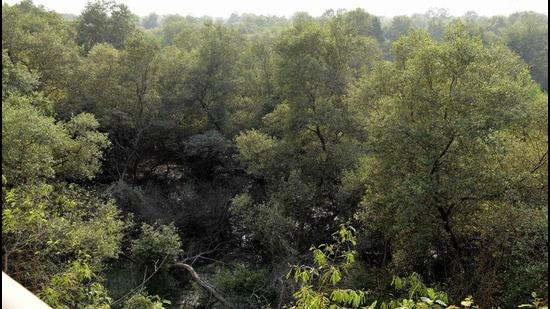
After being registered in 2015 with a corpus fund of ₹115.7 crore, the Mangrove Foundation’s capital has increased over the years to ₹525 crore at the end of March 2021, with mitigation costs from projects like Coastal Road, Trans Harbour Link and Bullet train contributing large sums. However, the majority of this money remains unspent due to the foundation’s decision to use only the interest accrued to carry out its activities.
“The Mangrove Foundation was registered with a... mandate to run its operations from the interest income generated by keeping its corpus funds in fixed deposits. Additionally, it receives project/activity specific funds from various government departments and agencies and CSR funds from various corporate organisations,” the foundation’s annual report stated. The foundation also received non-corpus funds to the tune of ₹2.3 crore in the last financial year.
Neenu Somraj, deputy conservator of forest (DCF), mangrove cell, clarified that the Foundation is not bound by law to retain its corpus funds, but has made this decision keeping in mind “longevity”. “We have to think about running the foundation for a good length of time in the future. There was a period of three years before 2018 when the corpus did not grow at all. If we simply spend all the money now, it may cause a crunch in the future. So the decision to use only the interest is a considered step that will help sustain the organisation,” said Somraj. At a conservative interest rate of about 6%, the mangrove foundation can hope to generate about ₹30 crore of usable revenue from its current corpus which, officials said, would exceed the total expenditure of FY20-21 by a large margin. “As the corpus grows, we will of course have more funds to scale up our current activities,” Somraj added.
Of the ₹15.66 crore utilised in FY20-21, the largest expense of ₹4.7 crore has been made under the head of a “Mangrove Protection Framework”, which includes compensatory mangrove plantation, security and encroachment removal. Of this, ₹3.22 crore were spent on hiring 185 security personnel from the Maharashtra State Security Corporation to keep a watch on sensitive mangrove areas. The remainder was spent on carrying out compensatory afforestation and other “protection measures” which include office development and payment of legal fees to advocates. Another ₹2.32 crore were spent on eco-tourism and livelihood activities such as aquaculture and mangrove tours.
The majority of expenses, however, have been administrative in nature. Under multiple heads, ₹6.6 crore together were spent on staff fees, procurement of vehicles, office maintenance, electronic gadgets, office rent and others. In comparison, only ₹94 lakh were spent under the research and capacity building heads, while another ₹79 lakh was spent toward conservation of coastal and marine species.
“This pattern of expenditure does not reflect a coherent or unified vision for protection of mangroves. A very large part of the money is being spent only on administrative works, and only a small amount has gone towards dedicated ecological studies and gathering actionable data through field work. A question arises as to whether the foundation is sustaining itself while leaving conservation wanting,” said Debi Goenka, executive trustee of the Conservation Action Trust (CAT). Goenka’s petition as a member of the Bombay Environment Action Group had led to the Bombay high court’s (HC) September 2018 judgment on mangrove protection.
Though environmentalists agreed that use of these funds must be judicious, they also claimed no money has so far been spent on restoration of damaged mangroves, complaints of which are placed before a HC-appointed committee from time to time.
Stalin D, director of NGO Vanashakti which is currently fighting a public interest litigation in the Bombay HC for compliance with the HC’s September 2018 judgement on transfer of mangroves to the forest department for safekeeping, said, “The mangrove foundation is a cash rich body now. As per their mandate, they must spend a portion of this money on restoration of degraded mangroves. But so far, not a single instance of mangrove destruction has led to restorative action.”
HT was the first to report last month that, since its inception in 2018, the Bombay high court (HC)-appointed Mangrove Protection and Conservation Committee (MPCC) has received an estimated 142 complaints regarding the destruction of mangroves in the state’s coastal districts. Of these, about 88 complaints have been resolved, with a few transferred to the Maharashtra Coastal Zone Management Authority (MCZMA) for consideration. Another 54 odd complaints are pending resolution, according to committee members. However, committee members (including officials in the forest department’s mangrove cell) confirmed to HT that not a single complaint has so far resulted in the restoration of damaged mangroves, which is part of the mandate given to the committee by HC in its final judgement from September 2018.
Responding to this claim, Somraj said the primary responsibility for restoration lies with various municipal corporations and land-owning agencies. “It can be prohibitively expensive for us to do this work. It is for ULBs to conduct the initial clean up and their cost, only after that can be step in to afforest the affected places,” Somraj said.
Virendra Tiwari, additional principal chief conservator of forest, mangrove cell, could not be reached for a comment. However, speaking to HT on the issue of restoration last month, Tiwari had said, “We have kept funds for this task but cannot proceed with it until the various municipal corporations or land-owning agencies clean up the debris first. The restoration will be done by the forest department but cleaning up the area is their responsibility.”
Stay updated with all the Breaking News and Latest News from Mumbai. Click here for comprehensive coverage of top Cities including Bengaluru, Delhi, Hyderabad, and more across India along with Stay informed on the latest happenings in World News.


