
 E-Paper



Mumbai coastline crisis: Koliwada residents face loss of livelihood
The coastal city of Mumbai is in crisis. There’s plastic in its ocean and its beaches. The Koliwada residents living along its coastline are losing access to fishing commons and livelihoods. Urban flooding, related as much to the monsoon as to the tide, is a leading cause of a host of health conditions. Private vehicles and mass transit systems like buses jostle for space on narrow roads, ensuring longer hours for commuters travelling the length of the city. In a multi-part series, Hindustan Times asks you to take a clear, hard look at the unfolding crisis and our role in it

 Prefer HTon Google


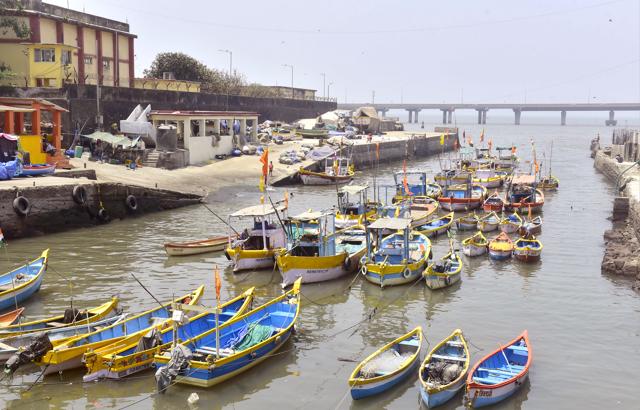
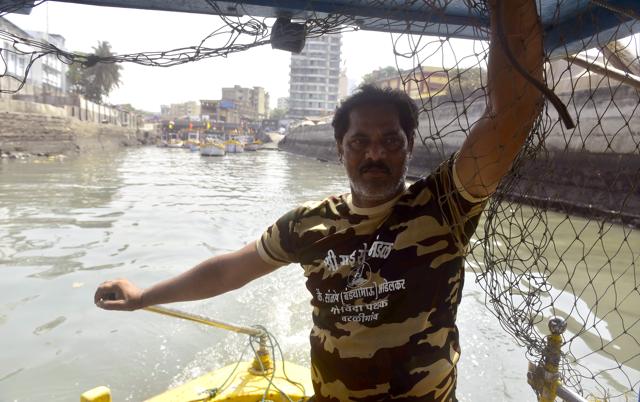
In Mahim Koliwada, a fishing colony metres from the city’s coastline, the day starts at 3 am for 47-year-old Bhushan Nijai. It started just as early for his father Yeshwant (72), and deceased grandfather Pandav, who have been fishing in the sane waters for the past 90 years. Nijai’s children — three girls aged 6 to 22 years — however, don’t wake up at the crack of dawn like their father. Unlike Nijai, who joined his family’s occupation as a fisher immediately after completing his Class 12, they don’t have anything to do with the trade.
The Nijais aren’t the only family in the hamlet whose youngest generation has veered away from the century-old work. Their neighbour, Nitin Vaidya, has two young children, a girl aged 10 years and a boy aged six, neither of whom will be taking up the trade.
Most of the fishers — all men — from the 5,000-resident strong Mahim village who take their boats out each morning are above 35. For them, catching, selling and eating fishing is their “astitva” (identity), they say.
Nijhai’s oldest, Raksha, who is a commerce graduate, aspires for an office job. “I have seen my parents work very hard. My mother (Smita) also wakes up around 3am and goes to buy fish at Sassoon Docks, which she sells at a fish market in Dadar. They work long hours but our family’s debts have only increased. I know how to clean and buy fish, but if our situation has to improve I can’t continue in this line,” she said.
Smita Nijai does not sell the fish that her husband catches; her business — and earnings — are separate. Depending on the day’s catch, Nijai sells the fish to wholesalers or small hotels.
Fishing communities that have, by most historical accounts, lived along the Mumbai coastline since the 15th century, are increasingly finding their occupation unviable.
More than a trade
In 2003, Maharashtra’s department of fisheries estimated that 37,695 people in Greater Mumbai are completely reliant on small-scale fishing activities [or as it is called, artisan fishing, marked by small capital, short fishing trips closer to shore, use of small fishing vessels and local consumption].
In 2010, state-run Central Marine Fisheries Research Institute estimated that there were 40,953 small-scale fishers across the Greater Mumbai region, residing in 30 fishing villages. With an average family size of 4.4, that’s about 9,307 families — in a city of over 20 million — who are dependent on fishing and allied activities that includes everything from cold storage to boat repairs, net making and mending to selling fish.
“The number of people, at least within Greater Mumbai, who are opting to fish full time, is only a small portion of our larger community,” said Devendra Tandel (40), who heads the state’s largest fisherfolk society, Akhil Maharashtra Machimaar Kruti Samiti. Tandel now has a full time job in a private bank.
“Commercial trawling, overfishing, the cost of fuel and other operating capital is increasing, and there is an influx of migrant workers who now dominate the sale and distribution of fish,” Tandel said listing the issues that the fisherfolk community contends are problems that threaten them.
“I have friends from the community who are doing jobs in IT and software and finance. Fishing can always be a backup for us, but it is not first choice.”
“I am the last generation of my household that will stick to this occupation. In our line of work, we struggle to make ends meet and I don’t want the same fate for them,” Nijai said.
Development story
But the community is currently dealing with another, more pressing concern. The city’s landscape is undergoing changes and the kolis are on the edge.
In 2011, a Joint Technical Committee of the Brihanmumbai Municipal Corporation (BMC) proposed a radical alteration to the city’s coastline that would connect the city’s southernmost tip to the suburbs of Vasai-Virar 70km away. In its current format, the Mumbai Coastal Road project includes a network of under-sea tunnels, elevated roads and several interchanges, most of which will be created over the sea and partly over reclaimed land.
There is also the Mumbai Trans Harbour Link, off the eastern seafront, which promises to be the longest sea-bridge in the country. Add to this a range of beautification projects involving the reclamation of near-shore areas (comprising mangroves and sandy beaches) in Cuffe Parade and Versova.
In 2018, the Mumbai Port Trust (MbPT) was appointed the special planning authority (SPA) for beautifying 966.30 hectares along the city’s 28-km eastern seafront. The plan also proposes public parks, plazas, promenades, walking trails and marinas apart from restaurants and cafés.
The Union ministry for environment and climate change recently gave its nod to the Coastal Zone Management Plans (CZMPs) for Mumbai city and suburban districts, thus allowing construction up to 50m from the city’s high-tide line. This follows a 2019 amendment to the Coastal Regulatory Zone (CRZ) rules which, up until then, had prevented development up to 500m from the city’s high-tide line.
With the easing of this norm, existing coastal properties would be allowed to develop at least two and a half times their existing floor space. Liases Foras, a real estate research firm, estimates that around 10,000 old buildings in Mumbai will benefit from this.
And now, the effect
Work on the first phase of the Coastal Road project began in 2018 and since then, fishing communities have attempted to direct the attention of the city municipality and the state government to the impact of this project on fishing commons —the shore and intertidal areas that are collectively used by the community without title.
At Cleveland Bunder, a fishing port in Worli koliwada (fishing village), two connecting bridges will come up between the coastal road at Worli and the Bandra Worli Sea Link (BWSL) to allow seamless flow of traffic. Fisherfolk said this interchange will severely constrict the only navigational route available to their boats venturing out to the open sea.
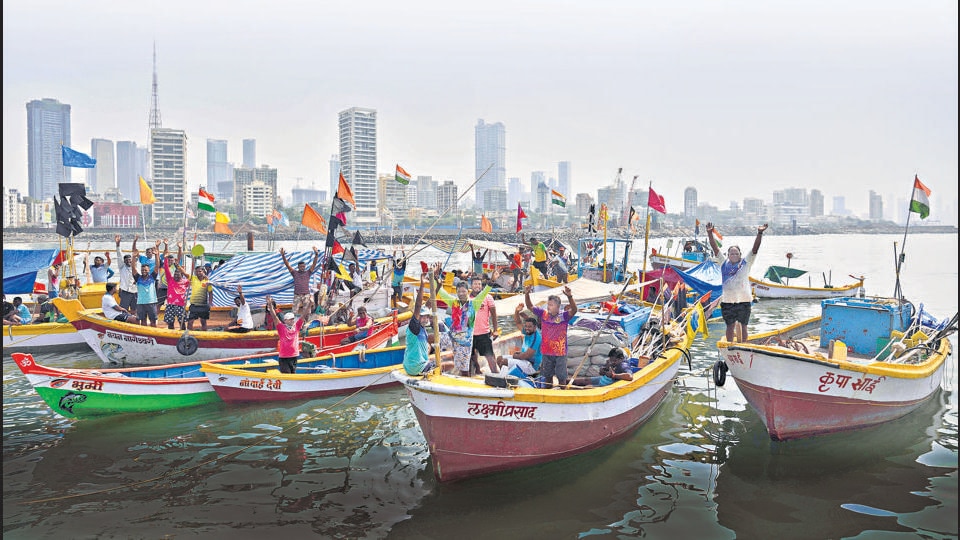
Since October 30, residents of the village have been staging a protest at sea at the site of this upcoming interchange: fishers in 100 boats have dropped anchors near a construction site in Worli, where an interchange is slated to come up and, which the fisherfolk say, will prevent safe passage to fishing commons. Municipal commissioner Iqbal Chahal has agreed to an independent review of their demands for a re-design of the interchange.
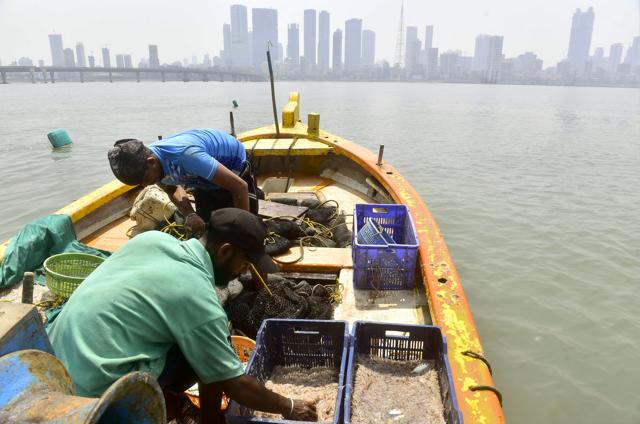
Other fishers along the South Mumbai coast from Priyadarshini Park to Worli too, have begun to report declining fish stocks — in this particular stretch, land has been reclaimed and a connecting bridge is coming up at Haji Ali — as space for small-scale fishers on non-motorised boats and fisherwomen to pick oysters and shellfish has reduced.
This comes at a time when the state’s fish stocks are showing a drastic decline. In 2019-20, fish landings reported their lowest harvest in 45 years, while reports show a decreasing, year-on-year trend since 2017.
Fisher communities who stay on the eastern coastline in places like Sewri, Mazagaon, and Wadala fear that beautification projects like the one being planned by MbPT, would recast indigenous land use to a public space for larger citizenry that would eventually nudge them out.
Fisherfolk are also caught in the net of other development projects.
For instance, in Bandra’s Chimbai village, the fisheries department is building a jetty and construction material now occupies the grounds used by fisherfolk to sort and dry fish. Although the land is owned by the BMC, its own Development Plan 2034 for Mumbai has classified this area as “a fish and net drying yard.” (The civic body can affect a change in the land use, but there is a process for it to do so.)
In September, in response to a petition by the Mariyayi Macchimar Sahakari Sanstha Maryadit, a society of fishers in and around Thane creek, the Bombay high court instituted a committee to create a fisherfolk rehabilitation policy for the state that would devise a standard operating procedure to gauge the impact of development projects undertaken by the government that affect fisher communities.
Saving a way of life
One of the things that fisherfolk are demanding is freehold possession of their commons (land on which they park their boats, or dry fish, for example) because there is no public document available that delineates what land belongs to them, and what can be rightfully used by the state.
“All the koliwadas in Mumbai are supposed to be mapped and demarcated in the coastal zone management plan (CZMP). This is a provision of the CRZ 2019 as well. In Mumbai, the koliwadas have been mapped, but the plans have not been released for public scrutiny, revised and accordingly incorporated in the CZMP. It leaves us completely in the dark about which lands around our villages are going to be opened up for development,” Tandel said.
The community has tried to adapt, of course, with some assistance from the fisheries department that has provided critical infrastructure like fish landing centres in Mumbai’s koliwadas and diesel subsidies. Others have tried supplementing their traditional livelihoods with more aspirational jobs.
Nijhai estimates that in his own lifetime, the income from fishing has shrunk by three quarters. The pandemic only sped up the process. “It is really the poorest of the poor who are left to fend for themselves on fishing. Our practice won’t die out, but the struggle will get harder,” he said.
Sanjay Wategaonkar, Assistant commissioner of fisheries department, Mumbai district
We are committed to helping small scale fishers... We are pushing for starting a credit scheme similar to the Central government’s Kisan Credit Card. As for impact of infra projects, we provide NOCs only if the project proponent commits to not disrupting fisherfolk livelihoods
Bhushan Nijai, Fisher, Mahim Koliwada
“I am the last generation of my household that will stick to this occupation. In our line of work, we struggle to make ends meet and I don’t want the same fate for them.


