
 E-Paper



Scientist who loved cricket and tennis with equal passion
Dr. Rajagopala Chidambaram, a key figure in India's nuclear program, passed away on Jan 4, 2025, leaving behind a legacy of scientific advancement and mentorship.


MUMBAI: In the demise of Dr Rajagopala Chidambaram, India has lost one of its most accomplished sons. He breathed his last in the early hours on January 4, 2025 after an illness for about two months.
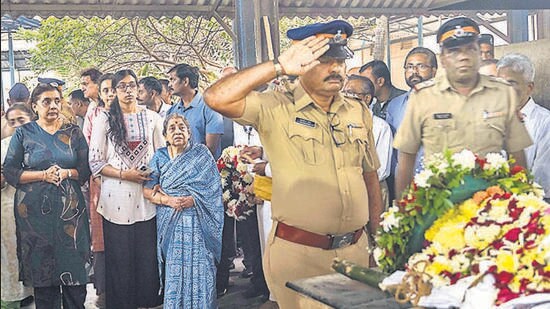
He was very aptly called the doyen of physics and nuclear power, and the nuclear weapons programme in India. After superannuating from DAE, as principal scientific advisor to Government of India, he became a champion of applying science and technology for strengthening and developing the country and uplifting the quality of life of its people.
He is one of the few who were involved in both the nuclear tests in 1974 and 1998. For the Operation Smiling Buddha of 1974, the Peaceful Nuclear Experiment (PNE), he had personally escorted the fissile material (plutonium) during its transportation in absolute secrecy from BARC, Mumbai, to the explosion site at Pokhran, in Rajasthan. Of course, he was totally responsible for the physics of the entire device.
As chairman, Atomic Energy Commission, and secretary, Department of Atomic Energy, Government of India, he was the overall leader of the nuclear component of the historical series of five nuclear weapon tests of 1998 (on May 11 and 13), after which the then prime minister Atal Bihari Vajpayee declared India as a nuclear weapons state much to the agony of many countries around the world.
As AEC chairman, he gave a lot of importance for the Indian nuclear power programme and non-power applications of nuclear energy in areas of healthcare, agriculture and food, industry, water resource management, research, etc. He also served as the chairman of the Board of Governors of International Atomic Energy Agency (IAEA) during 1994-95. Thanks to his initiative, wooden murals depicting scenes from the Ramayana and Mahabharata were installed at the IAEA headquarters at Vienna.
Dr Chidambaram initiated and nurtured the development of indigenous super computers and gave the concept of national knowledge network connecting the R&D and academic institutions across the country. He also championed the rural technology group (RuTAG) for empowering rural population through demand driven science and technology interventions.
Dr Chidambaram was very humane and a very jovial person. I vividly recall him asking me once to meet him frequently as he wanted to enjoy the fragrance of the betel leaf I used to eat. He did not want to spoil his own teeth.
He was an ardent cricket fan. At the function to dedicate the Kaiga Generating Station to the nation by the then Prime Minister Shri Atal Bihari Vajpayee in 1999, after the PM left, he immediately demanded to be taken to a place having a TV connection as he wanted to see the telecast of an international cricket match in which India was playing.
He was well-known in the DAE circle for his love for and indulgence in lawn tennis. He played actively till about a decade ago. Today, while visiting his residence to pay my tributes to him, I met some of his neighbours, who told me he used to play carrom with them in the club till about two months ago. The last time I met him briefly was in March 2024 during a lecture delivered by my friend Suresh Gangotra (co-author of his autobiography – ‘India Rising’) at Indian Nuclear Society office. I also met him about two years ago in his office at BARC on his invitation. The meeting, scheduled for half an hour, went on for more than two hours as he excitedly narrated the events of his life. The meeting was for a future video interaction with him which unfortunately could not happen.
Dr Chidambaram was proficient in Hindi and used to encourage his colleagues to speak to him in the language. During his days at BARC, he used to be the patron for the Rajbhasha activities of the Centre. With his sad demise, I have lost a mentor, a senior friend, philosopher and guide.
(Swapnesh Kumar Malhotra is Dr R Chidambaram’s former colleague and head of public awareness department, DAE. He also played a crucial role in public awareness campaign during the Indo-US nuclear deal. Suresh Gangotra, who co-authored Dr Chidambaram’s autobiography ‘India Rising: Memoir of a Scientist’, provided valuable inputs to Malhotra for this write-up.)
Stay updated with all the Breaking News and Latest News from Mumbai. Click here for comprehensive coverage of top Cities including Bengaluru, Delhi, Hyderabad, and more across India along with Stay informed on the latest happenings in World News.


