
 E-Paper



The delightful maze that is Bhuleshwar, in the heart of SoBo
On the day that architect Mehta and I walk the maze in a daze at its energy, I have just returned from Panvel where someone from Chandigarh was saying what a well-planned city it is. And indeed Chandigarh is beautifully planned and completely logical.

 Prefer HTon Google


Mumbai: If Bhuleshwar is a maze, I have an Ariadne by my side in the form of its historian, architect Kaiwan Mehta, author of the now iconic ‘Alice in Bhuleshwar’. If Bhuleshwar is a maze, its heart is not a bull but several cows, poking their heads over the wall of a pinjrapole. If Bhuleshwar is a maze, it is a beautiful walkable maze.
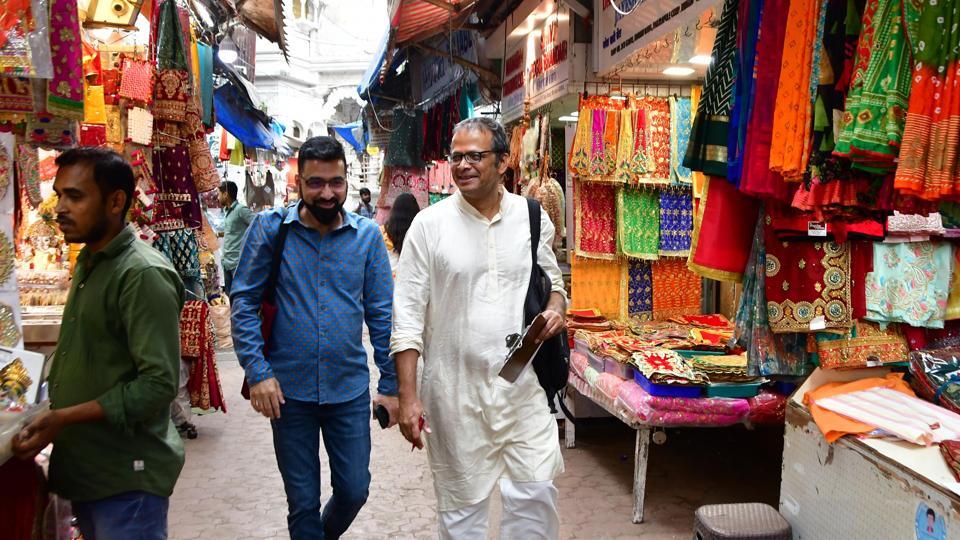
On the day that architect Mehta and I walk the maze in a daze at its energy, I have just returned from Panvel where someone from Chandigarh was saying what a well-planned city it is. And indeed Chandigarh is beautifully planned and completely logical. It was built by a modernist who assumed, I believe, that this was to be a city meant for people who would traverse it in cars. Bhuleshwar, with its curving roads and swerving alleys was never planned; it was built by use, it was built for use and its wild commercial and spiritual energy shows that the plan may not pan out.
“I think I grew interested in the area when I was in the fourth year of college. We were given this area to study,” says Mehta as we stand and count animals on the façade of Hira Baug which was built as a Jain dharamshala and which has Gothic elements in it design. “I think being a Parsi also helped because I speak Gujarati and that’s very much the language of the area.”
But it was not only the buildings and the build landscape that caught Mehta’s imagination. It was the way in which life and architecture fed off each other. We stand at the edge of the Hira Baug and peer into a quiet courtyard, a few metres away from the honk and squawk of the traffic. “You see how the idea of the commercial and the community work so closely with each other? This was obviously a place where there were many areas which were marked off by communities but there was a buffer zone created by the architecture where the shops turn outward to the street and the homes turn inward to the chowk. There was a way in which Bombay’s various communities coexisted with each other which is missing in gated communities now.”
We walk towards the iconic Madhav Baug, and once again, the energy changes. We are in the middle of a small zone where near life-size elephants salute us and temples loom everywhere. You can buy everything here from eyes for the goddess to wooden toys made in Uttar Pradesh. Mehta describes buildings you can no longer see because they seem to be swathed in jute and bamboo. He talks about a U-shaped Palladian building with Lakshmi taking the place of Nike on the pediment. “The colours also come from the old cloth merchant labels you would see on garments sold in the area,” he remarks.
Madhav Baug may have been one of the spots where the call for Swadeshi was given just as Hira Baug may have been the place where Munshi Premchand spent a night en route to Chennai.
Bhuleshwar’s churning energy has not left its spaces unmarked. Mehta, who frequents the area, is startled by the changes he has seen in a few months. The temples too are changing. “Most of the temples in this area are house-form,” he says, pointing to a typology that seems common to the area. We stop in front of a Jain temple that is being built. “This was a small temple, which didn’t even look like a temple. It was a room and there was a bhojanalaya and a space for washing to one side. Now every Jain temple seeks to out-Ranakpur Ranakpur and every one of them must look the same: white marble, lots of carving.”
We pass a Vishnu temple that seems to have a Star of David motif. “A-ha, that’s your seeing of it. Actually the lines of the star cross over each other, making that a Shree Yantra.” I stand duly corrected.
Mehta announces that he is no fan of nostalgia. “Cities will change. It is what cities do. But what I do find difficult is the arrogance and the savagery of the change.”
We stop in front of what was once the Cotton Exchange Building which had a series of panels which described the journey of cotton from farm to frock, as it were. The building has now been taken over by a jewellery conglomerate. Mehta points to a display board that has been tacked on to the front of the building. “I have never seen it display anything but it has been brutally bolted on to the panel. Why would you do that? If you have something beautiful on a building you own, wouldn’t you want to show it off?”
(Keep those letters coming. Answers in the New Year as I am travelling madly. Meanwhile: Oonche neeche raaste aur manzil teri duur/Raahon pe raahi rukh na jaana hokar tu majboor.)
Blurb:
Bhuleshwar, with its curving roads and swerving alleys, was never planned; it was built by use, it was built for use and its wild commercial and spiritual energy shows that the plan may not pan out.


