
 E-Paper



Why an Elkunchwar play waited 20 years to be staged
Among actors and directors in Marathi theatre, Mahesh Elkunchwar’s ‘Eka Natacha Mrityu’ acquired an almost mythical status: the playwright’s “unstageable” work

 Prefer HTon Google


MUMBAI:
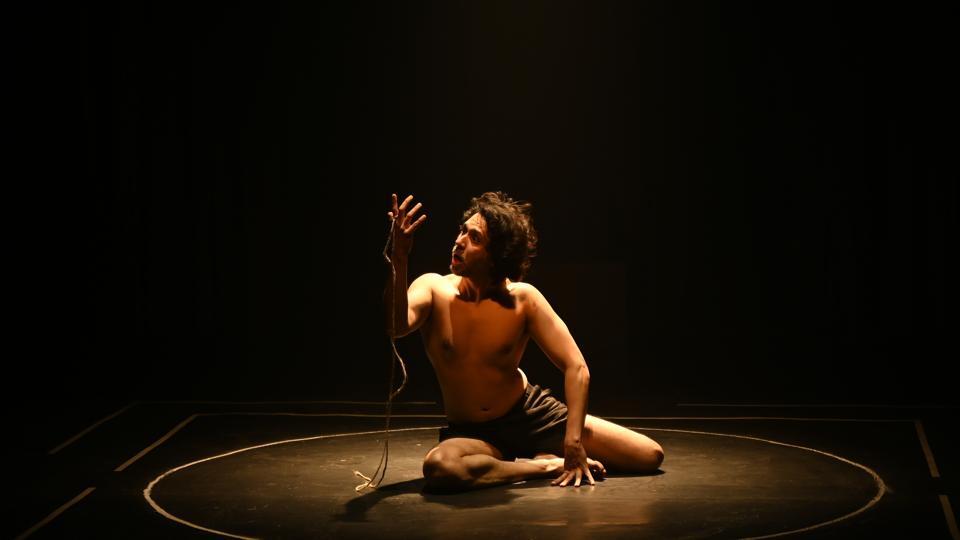
For two decades, it existed more as rumour than theatre.
Among actors and directors in Marathi theatre, Mahesh Elkunchwar’s ‘Eka Natacha Mrityu’ (‘ENM, An Actor Exits’) acquired an almost mythical status: the great playwright’s “unstageable” work. Written in 2005, it was admired, discussed and quietly abandoned by generations of practitioners who found its demands overwhelming. There was no conventional plot, no dramatic twists, no ensemble cast to distribute the burden. Instead, a single actor was carrying an entire metaphysical universe on his shoulders.
Now, after 20 years, one of India’s greatest living playwrights is finally seeing what many believed would never happen.
The creative process
Veteran director Atul Pethe has mounted the first-ever production of ‘ENM’, with actor Abhay Mahajan performing the demanding solo role. Before its public premiere, the production travelled to Nagpur for a private rehearsal before Elkunchwar himself. His verdict was unequivocal.
“I was happy and amazed at the way Atul has handled the text,” the playwright says. “Abhay Mahajan deserves all superlatives.”
For Elkunchwar, widely regarded as one of the defining voices of post-Independence Indian theatre, the production represents something approaching a farewell. “I am more than happy that my swan song is pretty melodious,” he says.
The play unfolds in a liminal space borrowed from Tibetan Buddhist philosophy: the Bardo, the intermediate realm between death and rebirth. An accomplished actor, caught between worlds, attempts to reconstruct his life from fragments of memory while confronting the many selves hidden beneath the masks he performed for audiences and for himself.
Questions of mortality, vanity, identity and artistic legacy become inseparable as the character struggles towards absolution.
“There’s only Abhay on stage,” says Pethe. “We give him as minimalist a set as possible and almost no props. The play speaks one-to-one to every member of the audience.”
That intimacy is deliberate. Rather than opening in a large proscenium theatre, the production premiered in a 120-seat venue in Pune last week, where the actor performs within touching distance of spectators. “The audience journeys inwards,” Pethe says. The Mumbai plans for the play are yet to be finalised.
For a director whose four-decade career has included acclaimed productions of ‘Waiting for Godot’ and some of Marathi theatre’s most influential experimental works, the attraction lay precisely in the text’s refusal to behave like conventional drama. “It has no typical plot,” he says. “Its abstractions take you on a journey within into spaces you didn’t know existed or were too afraid to go.”
But Pethe admits another obstacle delayed the production for years. “I was trying to find the right actor. It couldn’t be just anyone.” And he found him in Abhay Mahajan, a founding member of Pune’s Natak Company whose career has moved fluently between experimental theatre, independent cinema and India’s streaming boom.
But that was only the beginning – instead of rehearsing to a conventional theatre schedule, Pethe and Mahajan withdrew to the outskirts of Pune for months, transforming rehearsals into something closer to an artists’ residency. Their days stretched from early morning until evening, alternating between textual analysis, physical exploration, philosophical debate and the ordinary rituals of shared meals. “We were eating together, joking, arguing, discussing what the play was saying about our own lives,” Pethe recalls. “I am the director, not a dictator. I want disagreements.”
The rehearsal process became an extension of the play itself.
For Mahajan, whose own solo work ‘Asymptomatic’ first convinced Pethe he had found his actor, the rehearsal process demanded precisely the kind of physical and emotional excavation that has shaped his career. Trained at Bengaluru’s Attakkalari Centre for Movement Arts and influenced by contemporary dance, martial arts and contact improvisation, he describes the role as “not simply about remembering lines but finding the space between them.”
The challenge is amplified by Elkunchwar’s writing, whose references range across Sanskrit texts, European classics and philosophical traditions while remaining rooted in Marathi literary culture.
Unlike conventional solo performances, ‘ENM’ never breaks into clearly defined scenes. The actor remains on stage throughout, moving through shifting emotional and psychological landscapes without respite. “I have to surrender completely,” explains Mahajan. “The play demands I expose my whole vulnerable self.”
Theatre at the cross-roads
The production also arrives at an intriguing moment for Marathi theatre. While commercial productions increasingly compete with streaming platforms and shrinking attention spans, Pethe has chosen to stage perhaps the least commercial play imaginable: a densely philosophical meditation on death.
It is also an unusual reminder that some works resist the pressures of immediacy. In an era where plays are often developed quickly before moving through festivals and digital adaptations, ‘ENM’ waited two decades until its makers believed the conditions were right.
Pethe insists the timing matters. “I am 52 now,” he points out. “At my age, abstraction attracts me more. I want a deeper philosophical engagement.”
Whether or not ‘ENM’ reshapes Indian theatre remains to be seen. But after two decades as its most celebrated unseen play, its arrival feels quietly momentous. In an age that prizes speed over stillness, what Elkunchwar has called his “swan song” asks audiences not merely to watch, but to reckon with themselves. Perhaps some plays can only arrive when the world is finally ready to listen.
.
Stay updated with all the Breaking News and Latest News from Mumbai. Click here for comprehensive coverage of top Cities including Bengaluru, Delhi, Hyderabad, and more across India along with Stay informed on the latest happenings in World News.


