
 E-Paper



Why Mumbai is battling such haze
In most cities, AQI does not vary drastically across nearby locations. But Mumbai is an exception.

 Prefer HTon Google


MUMBAI: Mumbai has long been protected by nature thanks to its coastal location. During the day, when emissions peak, cool sea breeze sweeps in from the ocean and flushes pollutants out of the city. At night, the land breeze blows from the city toward the sea; although this can deteriorate air quality, night-time emissions are usually low, keeping overall pollution in check.

This natural ventilation system has traditionally helped Mumbai maintain better AQI levels, while cities like Delhi, deprived of such natural advantage, remain highly polluted during winter.
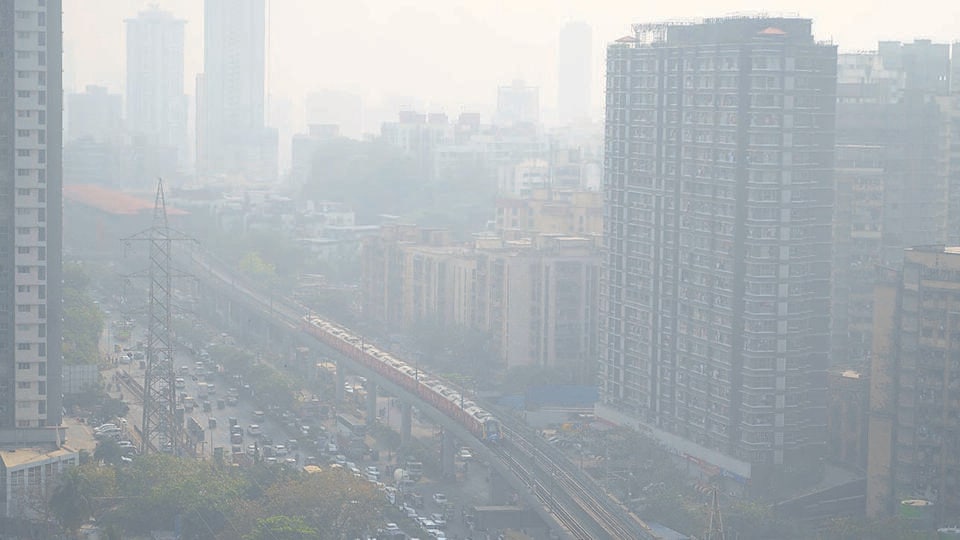
But in recent years, Mumbai has been witnessing a worrying rise in winter air pollution. The last notably troubled winter was in 2022. Then, on 25th November 2025, the city saw one of its worst mysterious hazy days. Visibility plummeted, the sky turned grey, and residents reported burning eyes and throat irritation. Yet, despite this muddied appearance of the sky, the AQI readings did not align with the visual conditions – unlike Delhi, where such skies are a near-certain sign of Severe or Very Poor AQI. Several parts of the city slipped into the ‘poor’ and ‘very poor’ categories this week. Both, the sudden air discomfort and the feel of discrepancy, left Mumbaikars puzzled and confused. Let’s unfold both science and visible mismatch.
Science
In most cities, AQI does not vary drastically across nearby locations. But Mumbai is an exception. Its coastal setting and rapidly changing micrometeorological conditions cause AQI to swing sharply from one location to another as observed this week—from very poor in areas like Mazgaon, Deonar, and Chakala to moderate around Navy Nagar. As a result, residents experience air quality very differently across the city.
SAFAR research also shows that the toxicity of PM2.5 in Mumbai is higher than in other metros such as Delhi or Pune. This means even relatively lower PM2.5 levels in Mumbai can be more harmful and deserves serious redressal.
Findings from National Institute of Advanced Studies (NIAS) in a paper authored by this writer show that climate change and La Niña disturbed Mumbai’s natural atmospheric system in winter 2022–23, unusually worsening air quality across peninsular India. Therefore, the return of La Niña in September 2025 was an early warning of deteriorating air quality for Mumbai. La Niña–driven changes in large-scale circulation slowed local wind speeds, allowing pollutants to accumulate and pushing AQI into the unhealthy range.
While Mumbai’s usual emission sources—transport, biofuels, industries, dust, power generation—remain steady, a sudden spike in pollution typically requires an additional trigger. In 2022, it was excavation and construction dust from the Western Corridor and Metro. In 2025, the exact trigger remained unclear. Although volcanic plumes generally rise above 15 km and rarely affect surface air quality, satellite imagery showed that the Hayli Gubbi volcanic eruption released sulphur dioxide and fine particles whose clouds are seen over northern India when vertical gusts were still weak. Under favourable transport winds, a brief intrusion towards Mumbai cannot be ruled out, providing just enough external input to worsen pollution in stagnant conditions. Hence, the primary driver of Mumbai’s poor air this season remains persistently low wind speeds combined with high humidity, which trap pollutants and create recurring haze. With La Niña active, such conditions are expected to trouble Mumbai intermittently through the winter.
Management and Policy
Two pressing issues demand urgent attention concerning air-quality management guidelines and policy interventions. To begin with, even a conservative baseline of SAFAR suggests that a city of 10 million people needs at least 10 monitoring stations, with one additional unit per million population, to produce a credible AQI. The deeper question is what AQI should be a representative of Mumbai?
The choice of location and density of stations is crucial to reflect the true air quality of a city. International norms, particularly those of the World Meteorological Organization, framed when the author was part of it, are unambiguous: an AQI network must capture all key microenvironments in proportion to the city’s landscape. This includes everything from clean background zones to traffic-heavy junctions, downtown corridors, residential and industrial belts, and both upwind and downwind regions. Only a balanced average across these zones can reflect the real state of a city’s AQI status.
India lacks such harmonised guidelines. As a result, stations are often installed based on convenience rather than scientific need. In a network of just ten stations, the addition or removal of even two extreme-value stations can flip a city’s AQI category from Poor to Very Poor or vice versa. This distorts public understanding and weakens policy responses.
The second problem is the micro-location of stations. Central Pollution Control Board (CPCB) guidelines advise siting stations at least 20 metres away from nearby trees and several times further away from unpaved roads. In densely-populated Indian cities like Mumbai or Delhi, it’s hard to get such a place, keeping implementers at bay and even if we get it, this can lead to stations being tucked deep inside parks or green pockets—pleasant for aesthetics, but scientifically counterproductive.
Measuring clean air in a leafy corner tells us little about the exposure people face in the city’s actual hotspots. If citizens spend large parts of their day in crowded transit hubs, busy markets, or high-traffic stretches—shouldn’t we measure AQI where we are largely breathing and exposure is highest? These gaps between scientific intent, practical difficulty and implementation, calls for serious and balanced retrospection.
In summary, Mumbai now needs science-backed, stronger air-quality management, aligned with frameworks like the National Air Quality Resource Framework of India model proposed by NIAS. Regardless of whether the recent haze originated from a distant volcanic plume or local emissions, the city must target high-impact sectors, transitioning faster from fossil fuel transport to cleaner source like EV, cut emission decisively for finer particles like PM2.5 rather than concentrating on coarser particles, and enforce precise, standardised monitoring using scientifically standardised norms for station placement and spatial coverage. Updating these management guidelines is no longer optional; it is overdue.
Most importantly, we must confront a hard truth: extreme and unusual pollution events are increasingly tied—directly or indirectly—to climate change. Such episodes are likely to grow in both frequency and intensity. Without a sustained, science backed long-term strategy, Mumbai will find itself confronting more foul air-quality shocks in the years ahead.
The writer is Chair Professor, National Institute of Advanced Studies, IISC-Campus and Founder Project Director, SAFAR

Stay updated with all the Breaking News and Latest News from Mumbai. Click here for comprehensive coverage of top Cities including Bengaluru, Delhi, Hyderabad, and more across India along with Stay informed on the latest happenings in World News.


