
 E-Paper



Why Mumbai is choking
After days of poor AQI, HT visited five government project sites and found routine breaches of pollution-control norms


Mumbai: The city witnessed several days of smog-like conditions recently as temperatures steadily dipped, reducing visibility and making breathing difficult for many residents.
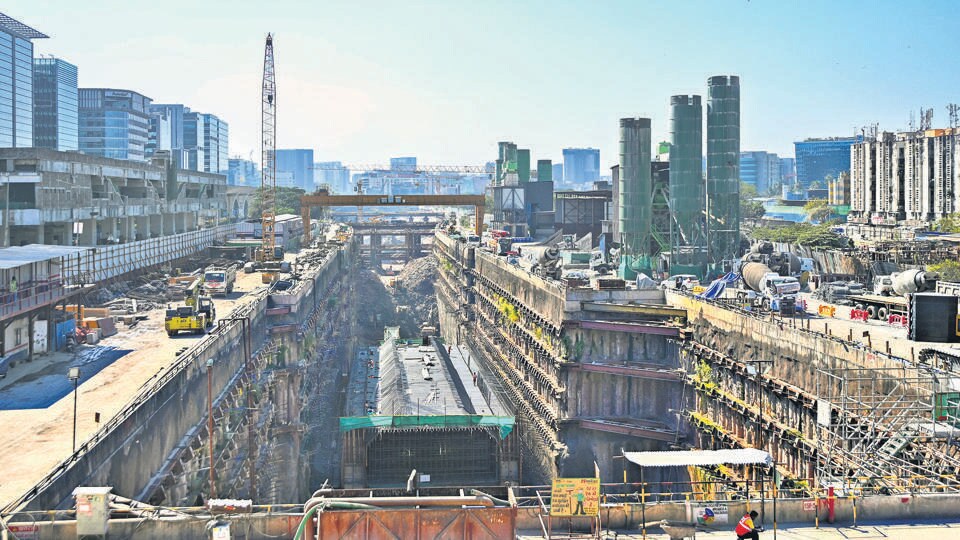
While the overall Air Quality Index (AQI) has remained in the “moderate” range through the past week, mid-November saw pollution levels slide into the “poor” and “very poor” categories in several areas, including Deonar, Bandra-Kurla Complex, Colaba and Worli. Experts attributed the decline to a sharp rise in PM10 levels due to construction dust, further compounded by vehicular emissions driving up PM2.5 concentrations.
Amid worsening air quality and growing public concern, the Bombay High Court on November 28 set up a five-member committee to inspect construction sites and ensure the enforcement of pollution-control norms. The panel, comprising officials from the Brihanmumbai Municipal Corporation (BMC), Maharashtra Pollution Control Board (MPCB) and the state public health department, has been directed to audit compliance and submit its report by December 15. In parallel, the BMC has deployed 95 flying squads across Mumbai to monitor construction sites and curb violations.

To gauge ground-level compliance, HT visited five government-led construction and demolition sites across the city to assess whether they were following dust-mitigation rules laid out by the Central Pollution Control Board and the BMC.
Bhagwan Kesbhat, founder of the NGO Waatavaran, said, “While private players have started following norms partly, government agencies, which outsource projects to contractors, need to pay much more attention to the guidelines. Major projects are in areas with high citizen movement, and if government agencies themselves are not following norms, how will they ensure others follow them?”
A senior BMC official told HT, “We have issued notices to all government implementing agencies, and our squads are regularly monitoring the regions. However, there are multiple large projects, and sometimes we might have missed them. We will now strengthen our action. We will send stop-work notices to any government agency violating pollution control norms.”
A senior MPCB official told HT, “We have given the BMC a 28-point guideline to follow, which the project agencies must implement. Ensuring compliance comes under the BMC’s purview.”
Debris, dust violations mar new HC project
Spread across 30 acres, construction of the new Bombay High Court complex in Bandra East is yet to begin, even as the demolition of 370 old, dilapidated buildings on the plot is nearly complete.
On November 5, former Chief Justice of India BR Gavai laid the foundation stone for the ₹3,700-crore high court complex, which has a proposed built-up area of over 6 million sqft. Demolition work has been underway since 2024.
When HT visited the site on Tuesday, demolition debris was scattered across the plot, with several trees crushed in the process. Multiple violations of pollution control norms were observed, including torn green mesh nets meant to contain demolition dust, uncleared debris, and the absence of water sprinklers typically required during demolition.
The rules require that demolition sites be enclosed with tall tin or metal wind-breaking sheets covered with green cloth or tarpaulin. Water fogging should be carried out regularly, on-site crushing of waste must be avoided, and construction and demolition debris should be transported only to designated dumping sites.
Instead, debris was piled across the stretch, while a cleared patch was used as a parking space during the bhoomi pujan. The site is situated adjacent to residential buildings and commercial establishments, and residents said the dust has severely affected them.
A shopkeeper next to the site said, “Last month, we had to shut shop for the entire day because of excessive demolition dust. There was no scaffolding. They water the road once a day and continue work. Even the trucks carrying debris do not have covers. We were unable to breathe through most of the demolition period.”
HT did not spot AQI monitors at the site, even as dust and silt were visibly blowing across the road. A worker at the site said, “We only raise scaffolding when officials come for inspection. We water only when concrete is being set, otherwise we do not.”
Officials from the state public works department (PWD), overseeing the project, said, “Demolition work is complete, and debris has been cleared. Since we have now been informed that debris remains, we will send a team for inspection.”
Dust lapses at BKC bullet train site despite BMC notice
The upcoming bullet train terminal near Bandra-Kurla Complex, one of the city’s biggest ongoing infrastructure projects, received a show-cause notice from the Brihanmumbai Municipal Corporation (BMC) on December 1 for violating air quality norms. Yet, several lapses were noticed during a site visit by HT on Monday.
There was inadequate scaffolding on one stretch, and tin sheets with no green cloth on another. There were no air quality monitors on display, and construction debris was dumped along the banks of an adjoining canal. A thick layer of dust coated the surrounding area, including most vehicles parked nearby.
Arif Sheikh, a cab driver waiting for a passenger near the site, said, “I have severe breathing issues when I come to this location. I parked the car here for two hours, and it was covered extensively in dust. My skin was irritated and my eyes were also watering.”
Another auto driver, requesting anonymity, added, “Workers regularly carry construction material in and out, but there’s no covering on the trucks. Dust flies everywhere. They hardly water the area outside; no sprinklers are present. They just pour the debris out, and we have to breathe the dust in.” A worker at the site also confirmed that no water sprinklers were currently operating.
Responding to queries, a National High Speed Rail Corporation Limited (NHSRCL) official said, “All the guidelines issued by local authorities are being complied with, and we will make sure that all dust mitigation measures like mist guns and air quality measures are being used at the construction site.”
Heritage crime branch razed, dust norms too
The 117-year-old stone building that once housed the Mumbai Police crime branch at Crawford Market was demolished last week, drawing not just nostalgia for its heritage but also concerns over dust-control violations during the process. The demolition is being undertaken by the public works department (PWD), but residents said dust mitigation guidelines were poorly adhered to.
Residents and shopkeepers said that during the demolition, no green cloth or tin-sheet scaffolding was used, and no water sprinklers were employed. When HT visited the site on Tuesday, a section of the site had been newly covered with a green cloth, and an AQI monitor was installed. However, debris was being transported in uncovered trucks, and rubble had been lying at the site for days. No mist guns or sprinklers, both of which are mandatory under CPCB and BMC norms, were in use.
A police officer posted at the entrance said, “We work here on shifts. There has been no watering done today, and there is a lot of dust. The debris has been lying around the site. We were having breathing difficulties today.”
When contacted, a PWD official said, requesting anonymity, “We had visited the site one month ago, and there was some scaffolding present. Now, I will personally visit and inspect the site.”
Environmental activist Gyan Chaddha, present during HT’s visit, said, “There are guidelines including tin sheets, water spraying, proper scaffolding, AQI and PM10 monitoring. They have not done that. If government authorities violate norms, how will they enforce them on private sites?”
Elphinstone Bridge demolition chokes daily commuters
Demolition of the 112-year-old Elphinstone Bridge has been underway since September 12, but much of the work has been conducted with little adherence to dust-control norms.
Over the past three months, HT has observed minimal or no scaffolding using tin sheets or green cloth, no misting guns or water tankers, and debris and old stone blocks scattered along the roadside, despite the area seeing heavy daily footfall from railway commuters and office-goers.
During a visit on Wednesday, scaffolding had finally been put up, but only partially. Piles of rubble still lay around, the road was dusty, and loud demolition noise continued. No AQI monitors were visible.
A shopkeeper near the site said, “During demolition work, they water the road once in the morning only. Every day, we inhale a thick cloud of dust as work continues into the night. Everything in the shop is covered in dust. The scaffolding is hardly enough, as dust flies over it. They need large tarpaulin covers instead.”
An office-goer who frequently passes the area added, “This scaffolding came up after so many days. If we come out for a break, we are met with noise and dust, and go back coughing. Breathing becomes difficult. We have to cover our faces and walk past debris.”
Residents also said that debris is being transported in uncovered trucks. MMRDA, which is executing the project, did not respond to calls or messages from HT.
Govandi gasps due to road construction work
While mega infrastructure projects dominate pollution conversations, smaller local works are quietly choking neighbourhoods daily. At Baiganwadi in Govandi, a 30-metre road project undertaken by the BMC has been ongoing for nearly two months, with multiple dust mitigation norms visibly flouted.
During HT’s visit on Wednesday, there were no scaffolding sheets or barricades, no AQI monitors, and no project information board displayed. Excavated debris lay scattered along the roadside, with no misting or water sprinklers operating, causing fine dust to settle inside homes and shops.
A resident, requesting anonymity, said, “I have been suffering from severe breathing issues, as the area is heavily polluted most of the time. Since the construction began, dust has been entering our houses and settling on the floors every day. We breathe it in; it is on our utensils, and I can hardly take a deep breath anymore.”
Faiyaz Alam Shaikh, convenor of the Govandi Citizens Welfare Forum, said, “Deonar and Govandi already suffer from heavily polluted air. Most residents here have respiratory issues. This is the region where authorities must practice maximum caution, but they take it for granted.”
Responding to the complaints, a senior BMC official, requesting anonymity, said, “As we are receiving complaints, we are also visiting sites and stopping work as well. Our flying squads are working on ensuring that both government and private agencies comply with dust mitigation norms.”

Stay updated with all the Breaking News and Latest News from Mumbai. Click here for comprehensive coverage of top Cities including Bengaluru, Delhi, Hyderabad, and more across India along with Stay informed on the latest happenings in World News.


