
 E-Paper



Why Mumbai’s monorail, that stalled amid heavy rain, continues to ail
Transport experts have called for India’s only such railway system, plagued by frequent breakdowns, to be scrapped and its civil structure upgraded

 Prefer HTon Google


Mumbai: A day after as many as 1,148 passengers had to be rescued when two overcrowded monorail trains on elevated tracks got stuck between stations amid torrential rain, transport experts have called for India’s only such railway system, plagued by frequent breakdowns in its 11-year history, to be scrapped and its civil structure upgraded for alternative solutions.
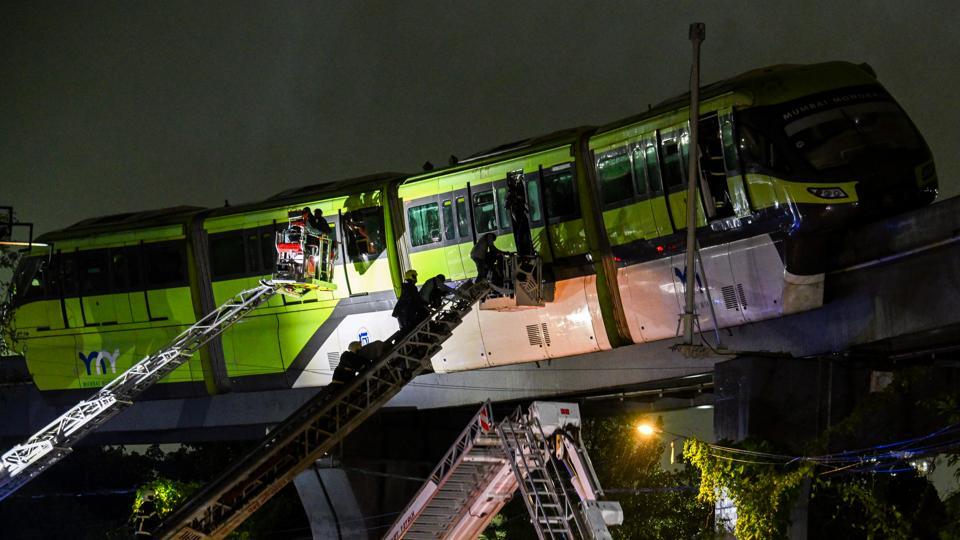
In both incidents on Tuesday evening, the monorail system experienced power failures. The Mumbai Metropolitan Region Development Authority (MMRDA) attributed the problem to overloading in the case of the train that was stranded near Mysore Colony in Chembur, but maintained silence regarding the one at Antop Hill.

According to MMRDA officials, here’s what happened in the first case: when the overcrowded monorail train went around a curve near the Mysore Colony station, its coaches tilted to one side. While a slight tilt is normal for the monorail, due to the increased passenger load, one side of the coaches rose above the rail beyond 3 cm, which disconnected the power supply and brought the train to a grinding halt (see graphic).
“The passenger load exceeded, and the tilted coach could not touch the current connector. The backup batteries too lost power, which were recharged once the rake reached Wadala depot,” said an MMRDA official, requesting anonymity. Current connectors supply power to the monorail coaches from a 750V electricity line laid on the tracks.
While MMRDA attributed the issue to overcrowding, the math does not add up. The Mumbai Monorail has been designed to carry 562 passengers per four-car train. There were 582 and 566 passengers in the two trains that got stuck on Tuesday, which is 20 and four passengers beyond capacity, respectively. According to senior MMRDA officials, the train at Mysore Colony weighed 109 tonnes, exceeding its 104-tonne limit. In other words, an extra 20 passengers resulted in the train weighing 5 tonnes or 5,000 kg more.
Nevertheless, the two incidents highlighted a failure in crowd management. According to officials, the monorail staff is trained to slow down ticket issuance to prevent too many people from entering platforms, which was not followed on Tuesday. The control centre responsible for overall operation was supposed to direct the station masters to keep a check on the crowd, but a surge in commuter demand overwhelmed the system as Central Railway’s Harbour Line services were suspended owing to heavy rainfall.
The monorail is a low-capacity transit system intended to serve specific corridors. It is not designed for sudden high-volume loads, like suburban railways or metro systems.
“Proper disaster management is required. In the latest case, passengers contacted the fire department, not the monorail’s operation control centre, which should have been the case,” said A V Shenoy, co-founder of Mumbai Mobility Forum. “There has to be a backup power to keep ventilation and air-conditioning systems running despite the disruption to prevent people from suffocating,” he added.
Glitches galore
Tuesday’s two power failures were also not aberrations. There have been numerous such instances in the past, including one with the same train (RST 4) that got stuck at Mysore Colony—on April 10, 2019, it was stranded for 44 minutes at Wadala Bridge. Back then, MMRDA had towed the train to take passengers to safety.
The other power failures were near Bhakti Park in March 2015 and August 2016, at Chembur in July 2017, and near Mysore Colony in September 2019, highlighting the monorail system’s deeper technical issues. In fact, the March 2015 and November 2017 incidents involved fire. In March 2015, a wheel of one of the coaches caught fire, while in November 2017 an empty train was charred and later junked.
Repeated service disruptions triggered MMRDA’s takeover of operations and maintenance of the Mumbai Monorail in December 2018 from a joint venture between Larsen & Toubro and Scomi Engineering, which built the transport system and launched it to much fanfare in 2014. While taking over, MMRDA cited “failure to perform and fulfil contractual obligations” and “failure to maintain the quality of Monorail services.”
Yet, despite this change of guard, service quality remains problematic, with breakdowns occurring even after four and a half years of management under MMRDA. There have been serious disruptions in April 2019, August 2019, September 2019, March and July 2025.
The Mumbai Monorail has also historically faced a shortage of trains, impacting service frequency and reliability. “There are just five monorail rakes that are operational, of which one undergoes routine maintenance. There are another three rakes that are undergoing upgradation,” said an MMRDA official.
The train that got stranded in Chembur has now been kept aside and won’t be in service for weeks to come because five windows were broken to rescue passengers, officials said, adding that consistent supply of materials for monorails has been an issue for months now.
If the existing eight old trains are unfit for operations, MMRDA could have pressed seven new trains it has acquired into service. Two of the new trains were delivered by Hyderabad-based Medha Servo Drives at the end of last year. However, they’re still awaiting safety clearance to ferry commuters. The goal of having a fleet of 18 trains by August has now been pushed back to the end of 2025.
“There is a problem with the regular supply of spares, leading to maintenance issues. The same situation may arise over the next 10-15 years, as Medha Servo Drives will not be manufacturing all the spares on a regular basis,” said Shenoy.
Costly white elephant
The decision to build a 20-km monorail network along the Chembur-Wadala-Jacob Circle route, as a light-weight transportation system in areas where road widening was not feasible, was made in September 2008. By November, MMRDA awarded the contract to a joint venture between Larsen & Toubro and Scomi Engineering. The project, originally intended to benefit a developer in Wadala, began partial (Wadala-Chembur) operations in February 2014. Over a decade later, the system continues to remain a white elephant.
The 19.54-km route was constructed for ₹2,696 crore. Later, in October 2021, an order was placed to procure 10 new trains for ₹590 crore. These are apart from several crores spent on overhauling the existing fleet by procuring spares from various vendors.
On average, MMRDA incurs a loss of over ₹550 crore annually on the monorail, owing to high operation and maintenance costs and low ridership—16,500 passengers daily. The unpopularity of the transport system also prevents MMRDA from exploiting non-fare revenue modes such as advertisement rights and retail stalls.
Transport experts feel the Mumbai Monorail should be scrapped for something far more reliable.
In July, the Moneylife Foundation, a Mumbai-based nonprofit, had prepared and submitted a memorandum regarding the monorail to MMRDA. The document recommended that, given the structural design and load-bearing capacity, the civil structure should be utilised for alternative infrastructure.
“A widely discussed possibility is converting the monorail viaduct into a Bus Rapid Transit System. While the idea may sound radical, the concept is not without precedent internationally. Elevated BRT corridors—like Jakarta’s Corridor 13—have been constructed to carry thousands of buses daily over traffic-choked streets,” the memorandum said. However, after the first meeting, the authorities have neither acted on the proposal nor scheduled follow-up meetings.
In the previous decade, the late architect Shirish Patel, who designed India’s first flyover at Kemps Corner, suggested converting the monorail into a pod taxi system or using it for light vehicles by constructing a slab over it.
However, for now, MMRDA has no choice but to keep the white elephant alive, as it will be the only link connecting three Mumbai Metro corridors: 3 (Aarey - BKC - Colaba), 2 (Dahisar East - BKC - Mankhurd) and 4 (Wadala - Thane - Ghodbunder Road).



Stay updated with all the Breaking News and Latest News from Mumbai. Click here for comprehensive coverage of top Cities including Bengaluru, Delhi, Hyderabad, and more across India along with Stay informed on the latest happenings in World News.


