
 E-Paper



After the flood, Ghaziabad families return to broken homes and few options
According to administration officials, 800-900 houses in Karhera were built on the Hindon floodplain, and the compensation amount may not be enough


Dheeraj Kunwar is one of those affected by the recent flooding in Ghaziabad’s Karhera and is struggling to rebuild his life after his house developed cracks in the floor and household items were damaged.
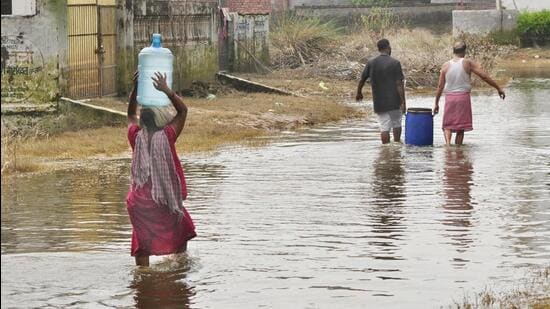
“When the river flooded, water came into the house through the back window, and I rushed out with my wife and two children, aged five and nine. When I returned home ten days later, the floor was cracked, and the household items were damaged by water. Even my house ownership documents had been damaged,” said Dheeraj, a compressor mechanic from Chapra in Bihar who settled in the outskirts of Karhera in 2016.
According to administration officials, approximately 800-900 houses in Karhera were built on the floodplain of the river Hindon, and the compensation amount may not be sufficient under the rules.
The maximum amount of compensation for flood-affected families ranges up to ₹2,500 for damage to clothes and utensils, ₹6,500 for damage to houses, and a maximum of ₹1.2 lakh if the entire house collapsed or was damaged, with no compensation for damage to items such as televisions and refrigerators.
Dheeraj, who bought his house for ₹11 lakh, of which ₹7 lakh was a loan, said, “My father died in June, and I am suffering from a hand fracture. I could not go to work for several days, and my children could not prepare for their exams. We’re staying in a rented house in Prahladgarhi, near Vasundhara.”
He said that many residents like him took out loans to build houses here and are no longer willing to stay but have no other means of livelihood.
Another resident, Gajendra Giri, 54, said he got a ₹15 lakh loan three years ago to build his dream house on the floodplain.
“I used my savings and borrowed money to buy this house. Before I purchased 60 square yards of land, people assured me there was no danger of flooding because it had not occurred in decades. My house’s walls have weakened due to stagnant water, and dampness persists. After returning from the shelter house after 10 days, the household items were damaged. Now that I’ve seen for myself, I realise that living here is risky. But I don’t have any other options,” Giri said.
Balwant Singh, 49, is among many residents who said that stagnant water remains inside their homes. Singh sent his wife and children to the home of a relative in Delhi.
“I stayed here in the shelter house just to keep an eye on my house because I was afraid of theft. Although the house was secure from theft, the floor developed cracks and items such as beds, refrigerators, and inverters were damaged. I purchased 50 square yards of land here six years ago, and many of us have taken out large loans to build our houses. Now I’ll have to renovate my house again, and the cost will be in lakhs of rupees, and I don’t have the funds to cover it,” Singh added.
Hundreds of families suffered similar losses when they returned home after the water in the Hindon began to recede over the weekend.
According to district administration officials, only 20-25 people remained in the temporary shelter in Karhera, and all efforts were being made to provide drinking water, medicines, and other necessities to affected families.
“We have issued an appeal to people not to stay in unsafe houses, and a survey to assess the damage and losses will be conducted soon. However, according to the rules, the compensation may not be enough for these families, as the maximum amount of ₹2,500 for damage to clothes and utensils, ₹6500 for house damage and ₹1.2 lakh if the entire house is damaged or collapses. In Karhera, at least 800-900 new settlements are on the floodplain,” said Vinay Kumar Singh, sub-divisional magistrate.
Not only do the houses exist in the area, but so do two major electricity transmission substations: 132kv Kanha Upvan and 220kv Morti. The Kanha Upvan station was closed for six days before the water was flushed out, and electricity was restored last Friday, while officials saved the Morti station from closure.
Similar settlements to Karhera have sprung up in other floodplain areas near Chijarsi, Behrampur, and Kanawani over the last two decades.

Stay updated with all the Breaking News and Latest News from Mumbai. Click here for comprehensive coverage of top Cities including Bengaluru, Delhi, Hyderabad, and more across India along with Stay informed on the latest happenings in World News.


