
 E-Paper



Civic body deploys teams as AQI rises after spell of rain in Ghaziabad
For the past one week, Ghaziabad city has been experiencing good air days, with the air quality index (AQI) remaining in the “good” zone since last Saturday. But once the rain stopped, it spiked to 167 on October 12 and 136 on October 13,both figures in the “moderate” category

 Prefer HTon Google


With air quality beginning to drop in Ghaziabad, after a week-long spell of continuous rain, the Ghaziabad municipal corporation has formed teams to contain the air pollution in its five zones, municipal officials said, adding that teams have been briefed about the work plan and have been directed to start work immediately.
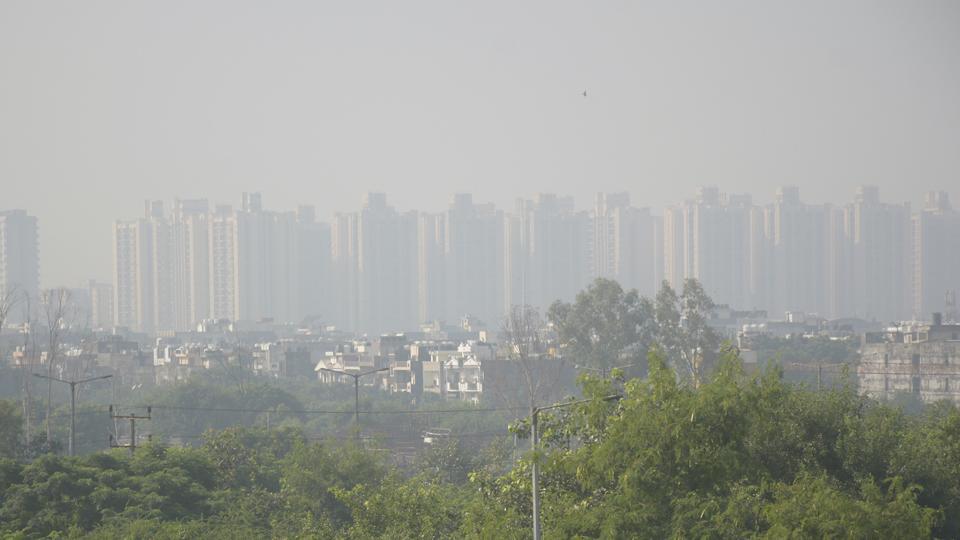
For the past one week, Ghaziabad city has been experiencing good air days, with the air quality index (AQI) remaining in the “good” zone since last Saturday. According to the Central Pollution Control Board data, the AQI in Ghaziabad from October 7 to 11 was 44, 26, 14, 19 and 40, respectively -- all figures in the “good” category of the AQI scale. But once the rain stopped, it spiked to 167 on October 12 and 136 on October 13,both figures in the “moderate” category.
An AQI between zero and 50 is considered “good”, 51 and 100 “satisfactory”, 101 and 200 “moderate”, 201 and 300 “poor”, 301 and 400 “very poor”, and 401 and 500 “severe”.
“Keeping in mind the guidelines under the revised graded response action plan (Grap), we have formed teams which will be headed by a nodal officer and four additional nodal officers have been deployed in each of the five zones. They will further be assisted by four other officials in each zone. The teams will conduct inspections and ensure compliance. Necessary directions have been given in this regard,” said Nitin Gaur, Ghaziabad municipal commissioner.
The five zones of the corporation are the city zone, Vijay Nagar, Mohan Nagar, Vasundhara and Kavi Nagar.
The teams have been directed to ensure that water sprinkling is done before the roads are swept; and residents have been encouraged to give away their daily solid waste to door-to-door collection vehicles. The teams will also ensure that no construction material/debris is lying in the open and the corporation should be informed for its lifting. Traders dealing in construction material will be penalised if they are found storing or selling material in the open, a senior civic official said, asking not to be named.
The officials of the Uttar Pradesh Pollution Control Board (UPPCB) said the rise in AQI is mainly due to local factors.
“The AQI was much better this October due to the continuous rain. Apart from the local factors, background factors such as geography also come into play. For example, Ghaziabad is located on the Indo-Gangetic plains where soil/dust pollution is prevalent,” said Utsav Sharma, regional officer, UPPCB.
The Commission for Air Quality Management (CAQM), which oversees air quality management in Delhi and the National Capital Region (NCR), in its directions on October 5, said measures under Phase 1 of the Grap -- comes into play when the air quality is “poor” (AQI between 201-300) -- is to be implemented in NCR.
These include 23 different action points such as stoppage of construction and demolition activities in projects with plot size equal to or more than 500 square metres, which have still not registered on the respective web portals of Uttar Pradesh, Haryana and Delhi governments; prohibition on open burning of biomass and municipal solid waste besides imposing heavy fine upon violators; deployment of traffic police for smooth traffic flow at all identified corridors with heavy traffic and congestion prone intersections; and strict penal action against non-compliant and illegal industrial units, besides strict enforcement against visible vehicular emission.
Ghaziabad is among the 16 “non-attainment” cities in the state of Uttar Pradesh and its pollution levels generally remain on the higher side during the onset of winter. Cities are declared “non-attainment” if they do not meet the national ambient air quality standards for particulate matter (PM10) or nitrogen dioxide (NO2) over a period of five years.
The figures from the Uttar Pradesh Pollution Control Board (UPPCB) indicate that the air quality in Ghaziabad deteriorates in the months of October, November and December.
The average AQI in the month of September in 2019, 2020 and 2021 was 93, 132 and 77, respectively. This shot up to 262, 281 and 211 during these years, respectively, in the month of October, and it further rose to 340, 351 and 378 in the month of November during the three respective years.
The month of December in 2019, 2020 and 2021 witnessed an average AQI of 367, 370 and 314, respectively.
“The city gets relief from bad air only when it rains or the wind direction changes. Otherwise, local factors continue to play their part and agencies each year seem clueless on controlling such sources. Grap-like enforcement is needed round the year in the city,” said Sushil Raghav, a city-based environmentalist.


