E-Paper



Edifice submits plan to manage debris from twin tower demolition
The report will now be submitted to the Uttar Pradesh Pollution Control Board (UPPCB), which will review and discuss the plan with the authority during a meeting scheduled for August 6

 Prefer HTon Google


Edifice Engineering, the company entrusted with the demolition of Supertech twin towers in Noida’s Sector 93A, on Thursday submitted a debris management plan to the Noida authority, outlining the way in which it will handle the waste resulting from the demolition of the 32 storeyed towers.
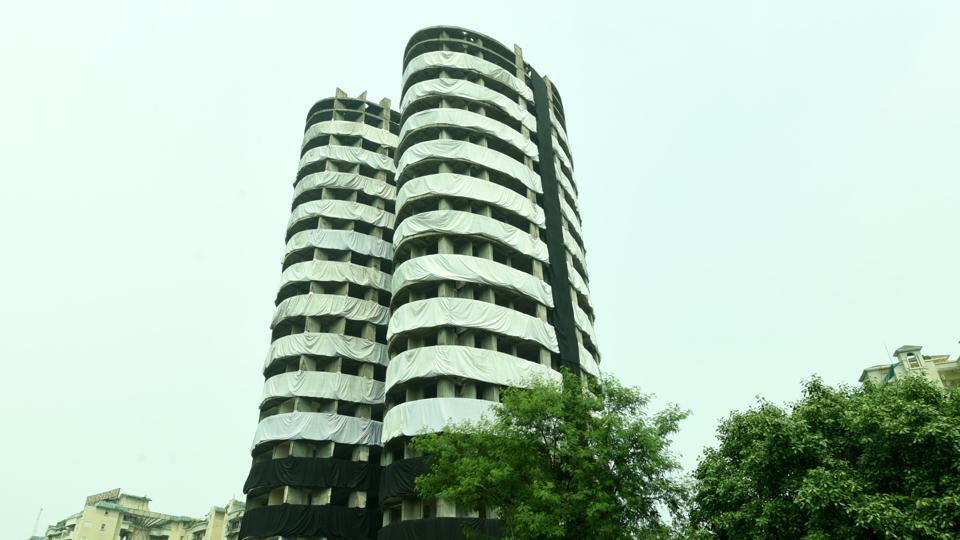
The report will now be submitted to the Uttar Pradesh Pollution Control Board (UPPCB), which will review and discuss the plan with the authority during a meeting scheduled for August 6 (Saturday). Meanwhile, other dust control measures, such as covering of the green areas of the two neighbouring societies, are still being discussed by the authority, said officials of Edifice Engineering.
The Supreme Court ordered demolition of the twin towers is scheduled for 2.30pm, August 21. However, with the charging process delayed from its planned schedule of August 2, the entire process is likely to take more time. The Supreme Court had earlier allowed time till August 28 for the demolition, though the extra week was kept as a buffer period by the Noida authority and Edifice Engineering.
The Gautam Budh Nagar police on Tuesday gave its nod for the demolition and a final go-ahead from the Central Building Research Institute (CBRI) is the only requirement to start the process of fixing explosives to the building, an exercise that is expected to take 18 days.
According to estimates by Edifice, the demolition of the 32 storey twin towers will generate around 55,000 tonnes of construction and demotion waste.
According to officials, the plan lists details of land identified by the company where the construction waste may be dumped to level it off. The nearly 4,000 tonnes of iron, mostly in the form of rebars, which will be recovered from the debris, will be salvaged and sold further by Edifice to recover a major part of the demolition cost, the plan stated.
The plan will be discussed in detail during the meeting at Noida authority on Saturday, Edifice officials said.
Noida authority officials refused comment on the matter saying the matter is sub judice.
“We are yet to receive the report. We will review it once we receive it and put forward our suggestions during the meeting on Saturday. The debris management plan relates to post-demolition issues, so it is unlikely to affect the blast timeline,” said Praveen Kumar, regional officer, UPPCB Noida.
The authority’s C&D waste management plant in Sector 80, with a capacity to recycle 300 tonnes a day, is not up to the task of processing the entire debris resulting from the two almost 100-metre tall buildings.
Meanwhile, the plan for putting up dust-control measures, including covering the green areas of the two neighbouring societies – Emerald Court and ATS Greens Village – is yet to be finalised by Edifice. It has to be done in consultation with the Noida authority, officials said.
A team of CBRI officials, reviewing the replies submitted by Edifice in response to their queries about blast design, use of explosives and ground vibration, among others, is camping in the town for the Saturday meeting.