E-Paper



100 days later, satellite-tagged whale shark circles back to Gujarat coast: WTI
Gujarat’s forest department along with WTI and Tata Chemicals launched the Save the Whale Shark Campaign in 2004.

 Prefer HTon Google


Ahmedabad: A 28-foot whale shark tagged with a tracker in December completed a 4,000-kilometre journey across the Arabian Sea over 100 days and circled back to the starting point off the Gujarat coast, people familiar with the matter said.
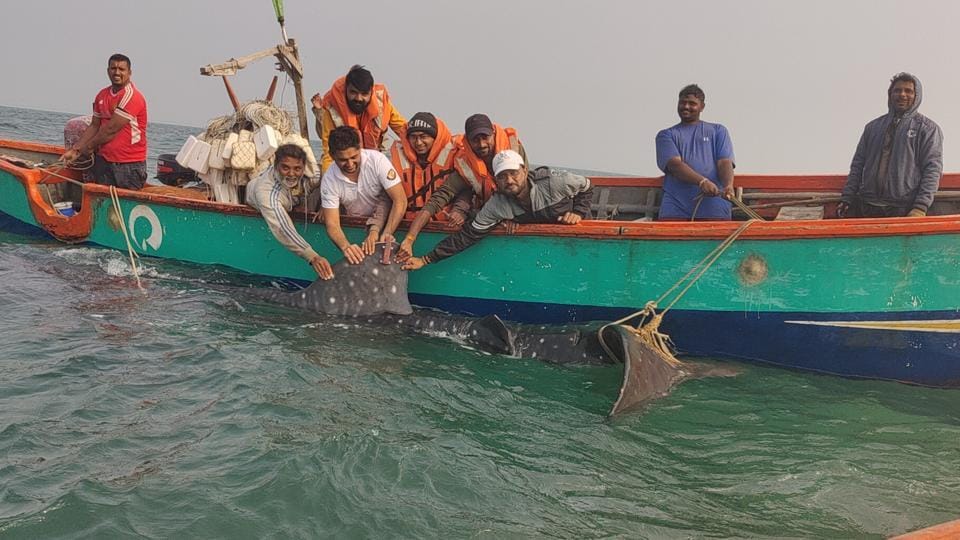
The whale shark, rescued from a fishing net, was satellite-tagged and released by the Wildlife Trust of India (WTI) in a collaborative operation with the Gujarat Forest Department.
It moved along India’s western coastline, Maharashtra, Goa, Karnataka and Kerala before reaching the Lakshadweep Islands, where it spent a week. The whale shark next ventured 700 kilometres from the Maharashtra coast to reach the Gulf of Oman, approached near Karachi, and ultimately returned to Veraval on April 4.
“This is the first time a whale shark tagged in India has returned to the coast. This supports our long-held theory that whale sharks in this region are residents of the Arabian Sea,” BC Choudhury, principal investigator of Aquatic Projects at WTI.
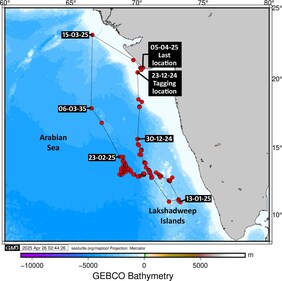
Researchers said the whale shark’s return to the Gujarat coast supports the idea that there was a unique group of whale sharks in the Arabian Sea.
“Previous tissue samples and genetic studies had suggested that whale sharks along the Indian coast may belong to a distinct group, and this tagged individual’s homecoming adds weight to that theory,” he added.
Choudhury said they needed to tag some more whale sharks for a longer duration before they could reach a firm conclusion. “The whale sharks are breeding and aggregating off the Gujarat coast near Veraval, migrating and breeding exclusively in the Arabian Sea. We need more oceanographic data. For instance, we need to know why they come up to the sea’s surface near Veraval. Is it due to the temperature?” according to Choudhury.
He added that while whale sharks are known for long-distance migrations, the confirmation of a distinct regional group raises important conservation concerns.
“If there is only one such population in this part of the ocean, it becomes more vulnerable to local extinction,” he said.
“Just as the pride of lions in Gir is protected to preserve that endemic lineage, this whale shark population in the Arabian Sea must be treated with similar care, as it may not be found elsewhere in the same genetic form.”
Jaipal Singh, principal chief conservator of forests (Wildlife), Gujarat, said the latest tagging showed that whale sharks have found a haven along the state’s coast. Singh said close to 1,000 whale sharks have been saved along the coastline, a sharp contrast to the situation till the 1990s when whale sharks, the world’s biggest fish, were killed for their fins and oil.
Mike Pandey’s 2000 documentary, Shores of Silence: Whale Sharks in India, exposed this crisis, winning the Wildscreen Panda Award and prompting action. In 2001, India listed whale sharks under Schedule I of the Wildlife (Protection) Act, 1972, banning hunting.
Gujarat’s forest department along with WTI and Tata Chemicals, launched the Save the Whale Shark Campaign in 2004. More than 950 whale sharks have been saved in Gujarat and the project, considered a model in community-led conservation, has since then been expanded to Kerala and Lakshadweep.
A research study published in Frontiers in Marine Science on July 6, 2021, conducted by marine researchers from India and Australia, including researchers from WTI, tracked eight whale sharks off Gujarat from 2011 to 2017. Most of them remained near the Gujarat and Maharashtra coast, while two moved into the Arabian Sea, following frontal zones with sea surface temperatures of 24–29°C for efficient plankton foraging.
“The satellite tracking reveals these whale sharks, while part of the broader Indo-Pacific population, remain largely within the Arabian Sea, moving between the African coast in the west and the Indian coast in the east,” said Sajan John, head of WTI’s Marine Projects.
He said that the return to the tagging location indicates the site fidelity of the whale shark. “Since whale sharks visiting the Gujarat coast exhibit site fidelity, it is very important to conserve these whale sharks because loss of these individuals over time period will be very detrimental,” he said.
John said the geo-spatial migration in the context of the sea surface temperature suggests that the whale shark prefers warmer waters in the range of 25-30°C. “Further, correlation with the global distribution of phytoplankton suggests the route through areas with high distribution of planktons, the main food for whale sharks,” he added.