E-Paper



20 years after serial Delhi blasts, scars refuse to fade
Twenty years after the 2005 Diwali blasts in Delhi, survivors and families reflect on the tragedy, loss, and enduring pain from that horrific day.

 Prefer HTon Google


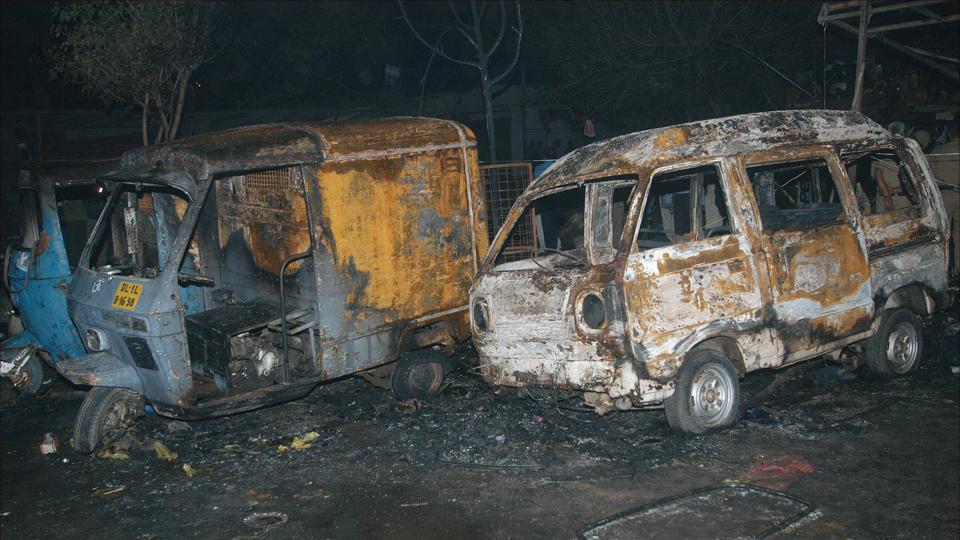
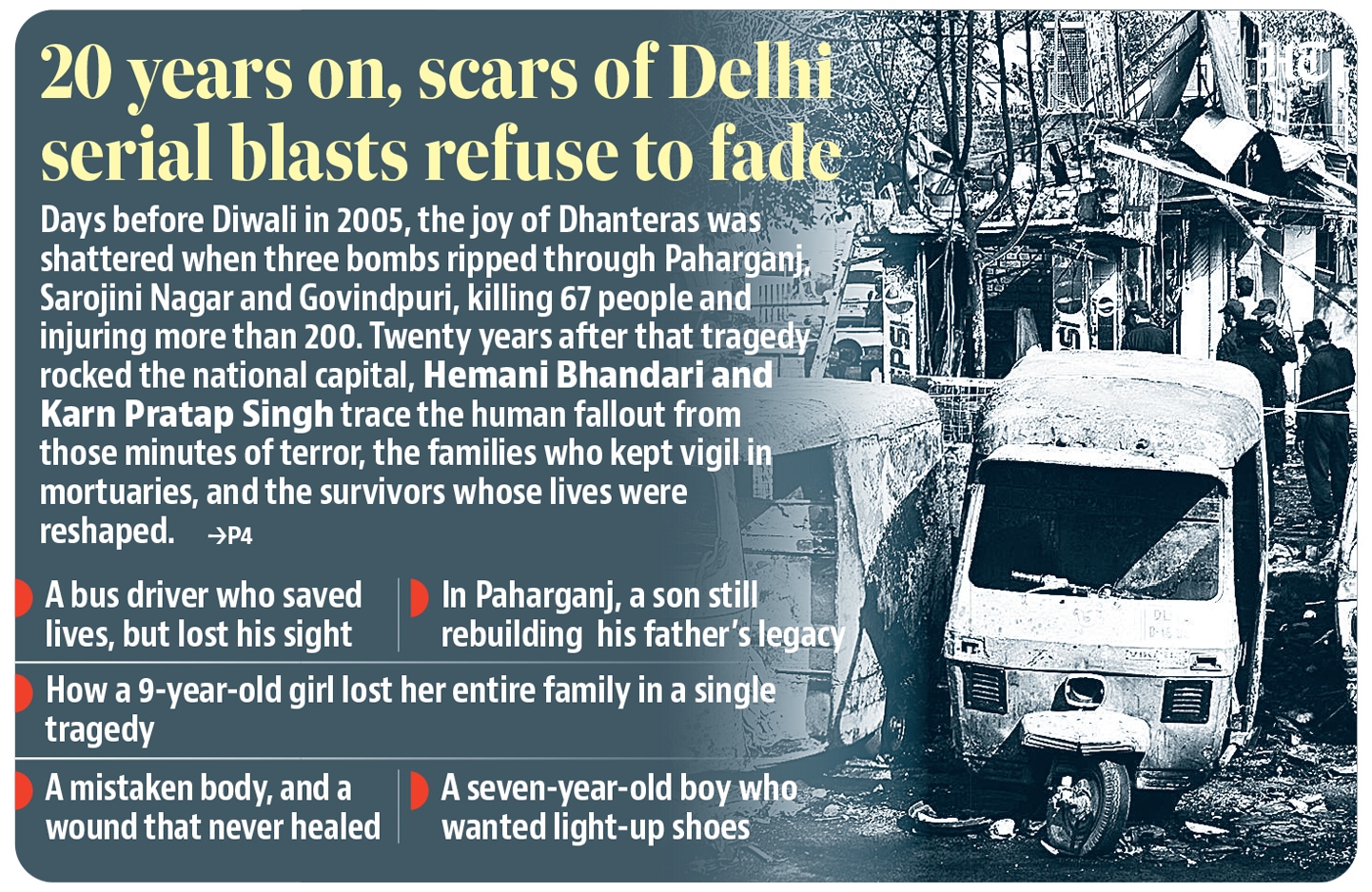
Days before Diwali in 2005, the joy of Dhanteras was shattered when three bombs ripped through Paharganj, Sarojini Nagar and Govindpuri, leaving 67 people dead and over 200 injured. Twenty years on, HTtraces the human fallout from those minutes of terror, the families who kept vigil in mortuaries, and the survivors whose lives were reshaped.
Kuldeep Singh: The bus driver who saved lives – and lost his sight
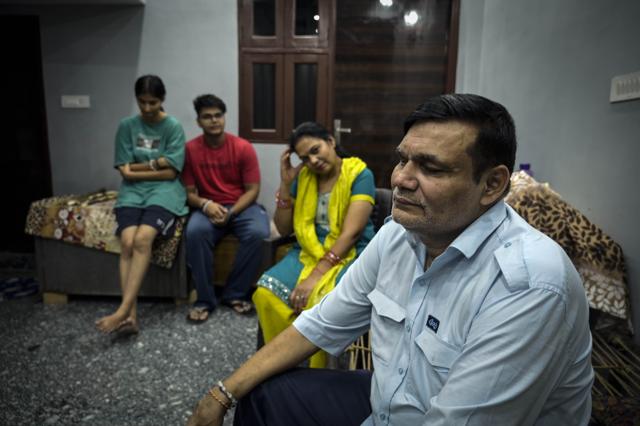
Had it not been for the alertness of DTC bus driver Kuldeep Singh and bus conductor Buddh Prakash, many other lives could have been lost on October 29, 2005. As Singh drove through the lanes of Delhi with at least 80 passengers on board, Prakash raised an alarm about a suspicious bag under a seat. Singh stopped the bus and asked all passengers to deboard. “There was a bag with red, yellow and green wires and a ticking sound – like the kind of bombs you see in Hindi films,” Singh recalled.
Even 20 years on, Singh doesn’t know what led him to pick up the ticking bomb, step out of the bus and place it under a tree. As he was walking back, it exploded. His quick thinking saved dozens of lives – but left him completely blind forever. After the blast, 33-year-old Singh was rushed to AIIMS, and later to Chennai’s Sankara Nethralaya and Hyderabad’s LV Prasad Eye Institute. “But I just couldn’t see,” said Singh, seated at the Shahdipur bus depot where he still works.
Two months after this, his wife Nigam gave birth to a baby boy, Deepak. “He turns 20 this year,” said Singh, who paused, and then added, “But I have never seen my own son’s face. That is my biggest regret.” Last year, the family moved from their government quarters at Shadipur to a new home in Najafgarh’s Golden Enclave. “It’s built with my hard-earned money, but I don’t know what it looks like – I touch the walls with my hands, people describe what the house looks like and that’s all I know.”
His act of bravery did not go unrecognised. A month later, he received an appointment letter – a permanent DTC posting. “I resumed work two years later as a vehicle examiner but I have not been promoted since,” he said.
Seated at the bus depot, Singh recalled the day 20 years ago, like it was yesterday. “I left home around noon and by 2.30pm, I had started driving. The bus was packed, it was festival season. Near Kalkaji, the suspicious bag came to the notice of some passengers… I was worried about the impact because it was a CNG bus and there were eight fuel cylinders, so I took the bomb outside,” he said.
Despite his personal loss, there’s pride in his voice. “If I hadn’t taken that bag out, 70-80 people in the bus, maybe more in the nearby market and mosque, would have died. I can’t see the world now, but I know I helped save it that day.”
Sunita, Michael and Elvin: Diwali shopping that took everything from a 9-year-old
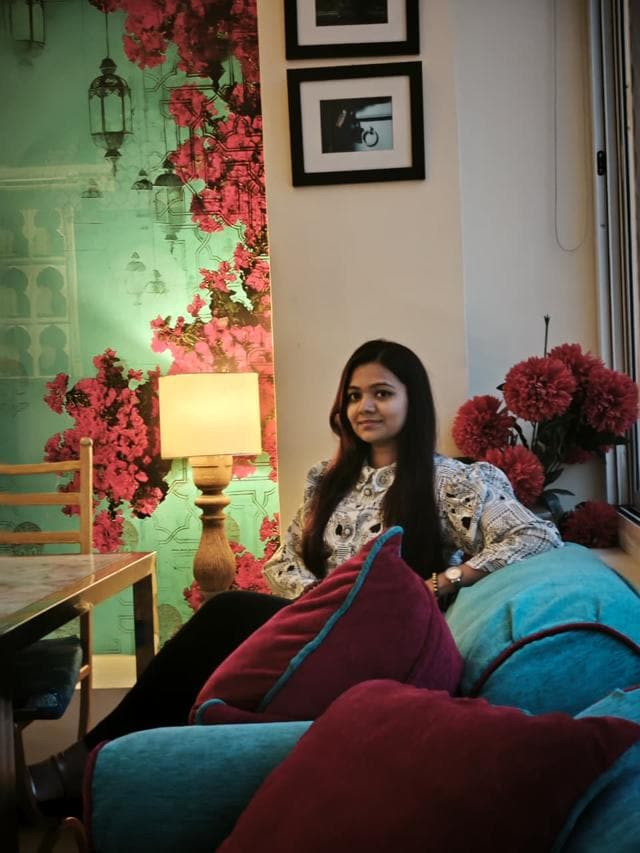
Sarojini Nagar Market, bursting with Diwali shoppers, was no place for nine-year-old Manisha. Her parents, Sunita and Michael, and elder brother Elvin had gone shopping on October 29, 2005, leaving her home with her grandparents.
Then came a call from Safdarjung Hospital that shattered her world.
“I picked up that call as a nurse informed me that we needed to rush to the hospital because there had been a blast,” recalled Manisha, now 29. It made little sense to a nine-year-old, so she rushed to her grandparents with the news.
What awaited the family at the hospital was chaos and unbearable pain. “My grandfather couldn’t find my mother for hours. Finally, he saw her half-burnt body,” said Manisha, who works at a BPO and cares for her ailing grandfather at their home in east Delhi’s Dilshad Garden.
Shrouded in grief, her grandparents held on to hope that by some luck, Michael and Elvin would have survived the blast, but that was not to be. Finally, 10 days later, Elvin’s body was found in a mortuary. Michael’s never was. “We kept searching. Every lead was a dead end. Eventually, we filed a petition to declare my father dead and not missing,” she said. “It took seven years and a DNA test before I got his death certificate and ₹8 lakh in compensation in 2020.”
Raised by her grandparents, she struggled to come to terms with the loss. Help came from unlikely corners – her school didn’t charge her tuition fee till Class 12. After school, she pursued hotel management at a college in Lucknow and began working at a luxury hotel in Hyderabad, and then Delhi. “But the working hours were so extremely long and by then, my grandparents needed me so I left that, moved back home, and began working at a BPO,” she said. Her grandmother – her closest confidant, a mother-like figure – passed away in 2022.
Each Diwali brings back the haunting memories. “It was supposed to be a simple shopping trip,” she said quietly. “Instead, it ended everything. My brother’s body came home after 10 days, and my father never came home at all… There’s no closure when your family disappears without a goodbye.”
Karan Poddar: The boy who wanted light-up shoes
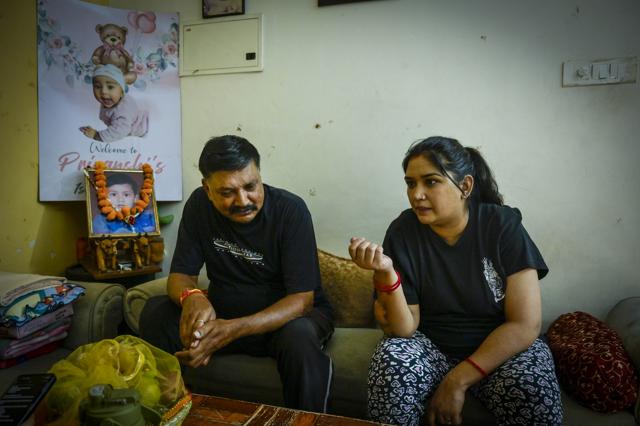
All that seven-year-old Karan wanted for Diwali was a pair of shoes that lit up with every step.
So, his father, Vinod Poddar, a senior court attendant at the Supreme Court, took him and his 12-year-old sister, Diksha, to Sarojini Nagar Market on October 29, 2005. “He was so happy that day,” Vinod recalled softly, seated beside his son’s garlanded photo.
Karan would have been 27 years old today. He was one of the many children who died in the serial blasts that ripped through Delhi that evening. Vinod hasn’t forgotten a minute of that day. As he stood with his children near a chaat and juice shop, a man pointed out a suspicious bag near a garment shop close to the chaat stall. “We saw a cooker filled with wires. Before I could tell the shopkeeper to move it away from the crowd, it exploded. That man blew to pieces. I felt immense pain. I saw my daughter – and then, everything went dark.”
Each year, he returns to Sarojini Nagar with flowers and a prayer on his lips. “The memorial board with everyone’s names is there. Karan’s too. We go each year. “We can’t forget—and maybe we shouldn’t.”
Vinod, meanwhile, had to relearn to walk. He spent 25 days in the ICU, received 27 units of blood, suffered 70% burns – and his right leg was amputated. He retired as a Grade-I Restorer (Librarian) at the SC in June 2025. “I got the first artificial limb after the incident but for the second one, I spent 15 years going from one government department to the other for compensation. In 2023, I finally received ₹52,000 and I changed my artificial limb… They gave us ₹3 lakh as compensation for Karan’s death. How can a child’s death be valued like this?” he asked.
His daughter Diksha too suffered burn injuries and a damaged ear. “My ear still hurts and I have trouble hearing. But it’s the fear that never left. I can’t visit a crowded market anymore. I still remember the sound, the smell, and the screams,” she said. “Even a small spark at home makes me freeze. They can’t bring my brother back. But the least the government could’ve done was give jobs to families like ours.”
Raghunath Sikka:In Paharganj, a son still rebuilds his lost father’s legacy
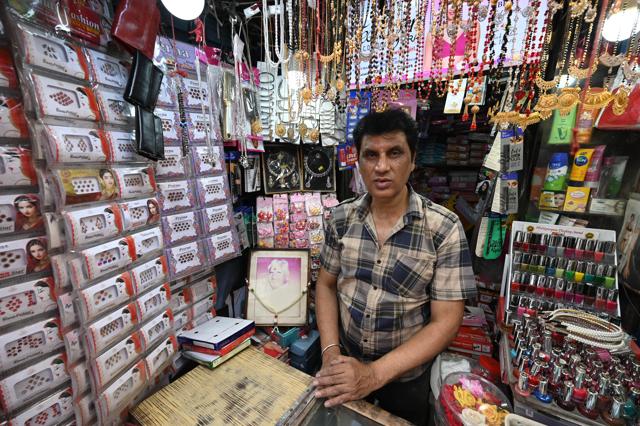
In the run-up to Diwali each year, the Sikka family’s small cosmetic shop in Paharganj transformed into a riot of colour – decorative candles and diyas stacked in neat rows, bright paper streamers, lanterns and stars spilling from the shelves. The market was busy, and so was Vijay Sikka, who ran the shop at 6, Tooti Chowk in Paharganj with his father.
At 5.38pm, a bomb tore through the market’s bustle 20 feet from his shop. “There were screams everywhere. I turned and saw a woman slumped in my father’s chair. Her body below the waist was gone,” recalled Vijay, now 55.
Little did he realise at the time that his father, Raghunath Sikka was lying with shrapnel wounds metres away. “While helping others, a local tailor told me that my father was lying wounded near a police post. I rushed there. He was still breathing when we took him to Lady Hardinge Medical College, but he died during treatment.”
The bomb, police later said, had been hidden in a bag on a rickshaw outside a nearby jewellery store – it was the first of three explosions that would rip through Delhi that evening.
This, said Vijay, was just the beginning of their family’s ordeal. “In the days that followed, politicians and officials visited our home. Some promised aid, some compensation for business losses, and others government jobs for family members. But all we got was ₹7 lakh… After some time, they all stopped answering my calls,” said Vijay.
It took him two years to rebuild the shop that his father set up in the market in 1960 after he moved to India from Pakistan post-Partition from scratch.
The entire shop was destroyed in the blast. Vijay was still new to the business. “My father handled everything. I had to start all over again,” he said.
Even today, he can’t escape that evening. “Every October 29, the sound of the blast comes back. I can still hear the screams of the people around me, and my father’s last words to me about going to the godown to store the items I had bought that day,” said Vijay.
Kaushalendra Yadav:A mistaken body, and a wound that never healed
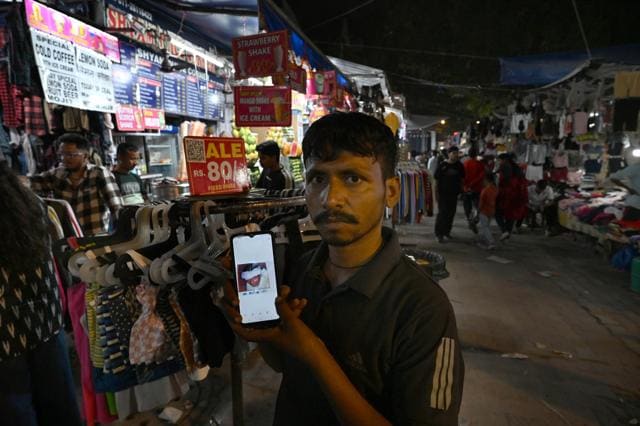
Four months after the Sarojini Nagar blast, the Yadav family were dealt another blow – the body they had cremated, believing it to be their 20-year-old son Kaushalendra’s, wasn’t his. DNA reports revealed it belonged to another victim, Salim Ahmad Ansari.
“It still haunts me that we performed the last rites of another man while my brother was buried somewhere else,” said Surender Yadav, now 36. “When the DNA report came, we were shattered. Both families went to the authorities, but the police said it was too late. The bodies had been cremated. They said exhuming the remains could cause communal tension.”
Surender still trembles recalling those days – going from hospital to mortuary to market, searching for his brother.
The bomb, police said, had been hidden in a bag left near a juice-and-chaat stall close to a garment shop. A man picked it up, asking whose it was, when it exploded, killing him instantly. The blast was so intense that it cracked nearby buildings, sparked a fire, and triggered a gas cylinder explosion that deepened the carnage.
At the time, Surender was just 15, living in Delhi with Kaushalendra, who worked at that juice stall. Their parents were in Darbhanga, Bihar. On November 1, 2005, HT had reported how Surendra – unable to find his brother – temporarily gave up searching, and waited for his parents to return. A haunting image of the teenager appeared in the paper, with Surender’s heartbreaking quote, “Mujhse jali hui laashein aur nahi dekhi jaayengi (I can’t see more charred bodies).”
“I met him minutes before the explosion,” Surender said softly. “He told me to go back home. I had barely walked 200 metres when the bomb went off. That was the last time I saw him.”