
 E-Paper



277 detained Bengali workers released after document verification: Odisha police
Over 400 labourers were detained as part of a crackdown on suspected illegal Bangladeshis and Rohingyas in Odisha’s Jharsuguda district

 Prefer HTon Google


Bhubaneswar: The Odisha police on Thursday released 277 Bengali workers who were detained in Jharsuguda district as part of a crackdown on suspected illegal Bangladeshis and Rohingyas after verifying their documents, police said.
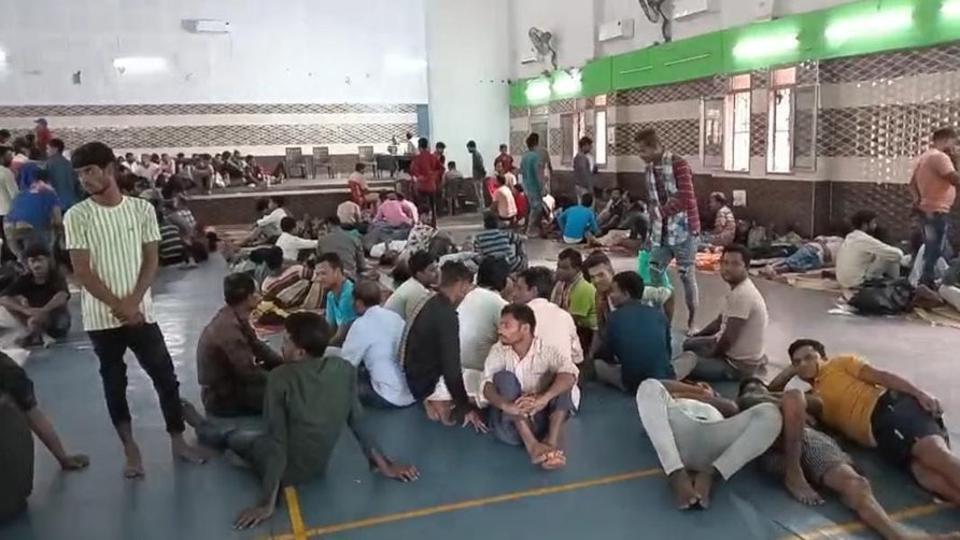
Since Monday, 444 individuals — from West Bengal’s Nadia, Murshidabad, Malda, Purba Medinipur, Birbhum, Purba Bardhaman, and South 24 Parganas — had been rounded up during raids in colonies where Bengali-speaking labourers reside, and shifted to holding centres at Black Diamond College of Engineering and Technology in Jharsuguda sub-division and Surabhi Kalyan Mandap in Brajrajnagar sub-division
Trinamul Congress (TMC) member of Parliament (MP) Mahua Moitra claimed on Wednesday that 23 of those detained were from her parliamentary constituency in Bengal and that they had the valid documents. Later, police in Jharsuguda district let 25 of those detained at holding centres to go back to their home state. On Thursday, 277 more were allowed to go after police checked their birth certificates and passports.
“Without verifiable documents, it is imperative to crosscheck records to confirm whether the persons are Indian citizens or foreign nationals. This process is critical to protect our borders and ensure the safety of our nation. Those detained are accommodated at designated facilities with access to adequate food, water, hygiene and medical care, in line with humanitarian standards,” inspector general (IG) of police, northern range, Himanshu Kumar Lal said.
However, one of the persons, who was allowed to leave, said on condition of anonymity, “There were just three toilets for more than 200 people. We slept on the floor and were served food that consisted of rice and curry. We are hardworking people and the food that was served was barely enough.”
Another person said, “Many of us don’t have birth certificates and it would be very difficult to get those at such short notice. Police should have been a little considerate.”
The verification process is being conducted by senior officers via a Joint Investigation Team (JIT) and with multiple layers of scrutiny. An official at the detention centre said the biographic and biometric data of all migrants are being captured and then uploaded on the Foreigners Identification Portal (FIP). “All 10 Fingerprints (4+4+2 manner) of both right and left hand are being scanned and saved in the FIP in an online manner. The photograph is being clicked by using a camera integrated with the desktop. Once all required demographic and biometric data is entered in the FIP system, the applicant record is to be marked as complete,” said an official.
On Wednesday, TMC MP Mahua Moitra had alleged that the workers from Bengal were being illegally detained by Odisha police under the pretext of a documentation drive though they had valid Aadhaar and EPIC cards. “Please don’t think there’s no one to fight for these workers. If they are not released immediately, we will file 23 habeas corpus petitions and I will go there myself. In 23 years of Naveen Patnaik’s BJD government, this has never happened. But in the past year, since the BJP came to power (in the state), this has become a daily occurrence,” she said in a video message posted on X.



