E-Paper



Ahmedabad crash: A month on, grieving families try to pick up shattered lives
The crash killed 169 Indian nationals, 53 British nationals, seven Portuguese nationals, and one Canadian national.


As Ahmedabad marks one month since the devastating air crash, the city’s Civil Hospital on July 8 organised the last rites for some additional body parts of 19 victims retrieved from the debris left in the wake of the Air India flight 171 crash on June 12.
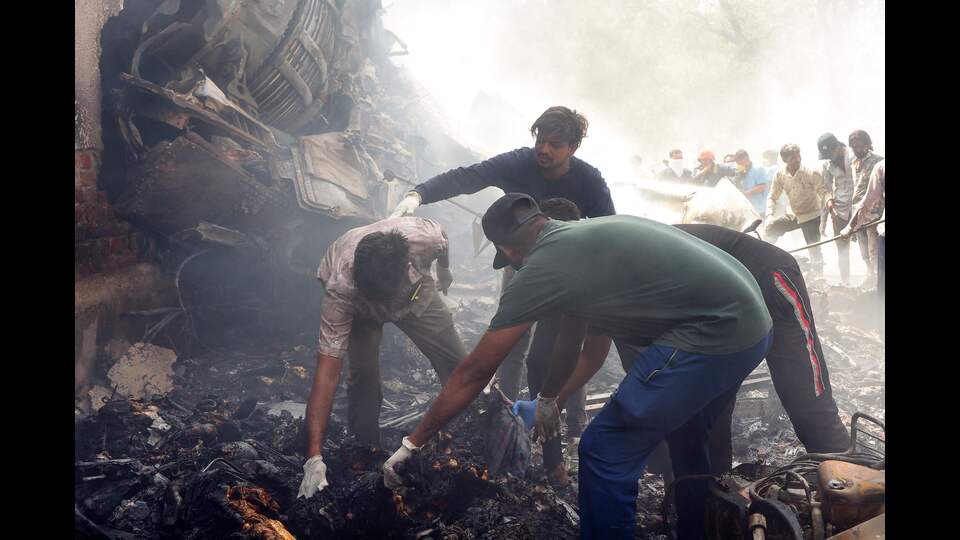
Ahmedabad Civil Hospital medical superintendent Rakesh Joshi said seven other families had opted to hold private ceremonies for their loved ones. But 19 families consented to hospital-conducted last rites when officials reached out to them to inform them about the retrieval of some more body parts of their family member.
“They had already said their final goodbyes once. To go through that agony again, to light the pyre or lower the body into the grave for the second time - it was too much for them to endure,” an official familiar with the matter said.
Eighteen Hindu victims were cremated at Vadaj crematorium, and their ashes were immersed at Naran Ghat on the Sabarmati River. One Muslim victim was buried at Musa Suhag Cemetery in Shahibaug, with Quranic recitations led by a Maulvi. Hospital staff, including the superintendent and head of the Forensic Medicine Department, oversaw the ceremonies along with police officials.
Also read: AAIB's preliminary report on Air India crash ‘very soon’: Civil Aviation Minister Naidu
The government had decided to use DNA tests to identify the body parts soon after the crash, given how the bodies were charred when the plane blew up into a ball of fire after crashing into the hostel complex for medical students.
The crash killed 241 of the 242 passengers and crew apart from 19 more on the ground. Among those killed beneath were junior doctors, hospital staff at the medical college complex, and people on the street below. Four of the 19 ground casualties died during treatment at the hospital; the rest had died on impact at the crash site.
The plane had departed from Sardar Vallabhbhai Patel International Airport at 1:38 p.m., carrying 230 passengers and 12 crew members for London Gatwick Airport.
Also read: One Mayday alert, focus on fuel control switches: What is known so far about Air India crash
The aircraft reached a little over 600 feet before losing altitude. The flight crew issued a mayday call, said an official of Airport Authority of India. Seconds later, the plane crashed into the hostel block of B.J. Medical College, causing multiple explosions.
The crash killed 169 Indian nationals, 53 British nationals, seven Portuguese nationals, and one Canadian national.
Among the passengers was a family from Gujarat’s Porbandar.
Mukesh Modha, 64, said he lost three family members who were on their way to London to perform the last rites of his brother, who recently died due to cancer.
His brother’s wife Rakshaben Modha, 55, her daughter-in-law Yesha Kamdar, 31, and Yesha’s 1.5-year-old son were among the victims.
“My brother had set up a successful catering business in London and his prayer meeting was to be held in the third week of June. My nephew Kishen Modha had decided to go on (June 12) but later cancelled his plans as he had some business to attend to in Ahmedabad. So he decided to go a few days later before the prayer meeting of his father,” Mukesh Modha said.
The last-minute change of plans saved Kishen Modha’s life.
Mukesh Modha recalled speaking to his sister-in-law at around 10.30 am on June 12, hours before they boarded their flight. “Later in the afternoon, I got a call about the incident,” he said.
The crash also left deep scars for BJ Medical College, where the plane struck. Some 150 students and resident doctors are now in alternative accommodation, said Dr Minaxi Parikh, dean of BJ Medical College.
“We have made alternative arrangements for the students and resident doctors in other blocks on the campus and have also taken some rooms on rent in a nearby hostel. In all, we have relocated 150 students and doctors. The hostel blocks of the UG students are mostly intact, but their mess has been destroyed. We have got a new place for the mess workers,” said Minaxi Parikh, dean of BJ Medical College.
She said that the impacted areas were still under the control of the investigators and the plans to decide on the buildings to be rebuilt can be worked out only after they get back possession.
To be sure, the debris has been moved from the crash site to a place near GUJSAIL near the Ahmedabad airport.