E-Paper



BJP promises ₹50,000 to each woman, ₹3,100 MSP for paddy in Odisha poll manifesto
The BJP’s Odisha poll manifesto also promises filling up 1.5 lakh vacant government posts, free breakfast scheme for students and creating 25 lakh lakhpati didis

 Prefer HTon Google


Promising 21 guarantees in its manifesto for the Odisha Assembly polls, the state unit of the Bharatiya Janata Party (BJP) on Sunday listed its assurances to the tribals, farmers, women and unemployed youth. It includes ₹50,000 cash voucher to women, ₹5,000 to each tribal student every year, filling up 1.5 lakh vacant government posts, free breakfast scheme for students, creating 25 lakh lakhpati didis, pension of ₹3,000 a month to elderly, physically challenged, widows and destitute and ₹3,100 minimum support price for paddy procurement.
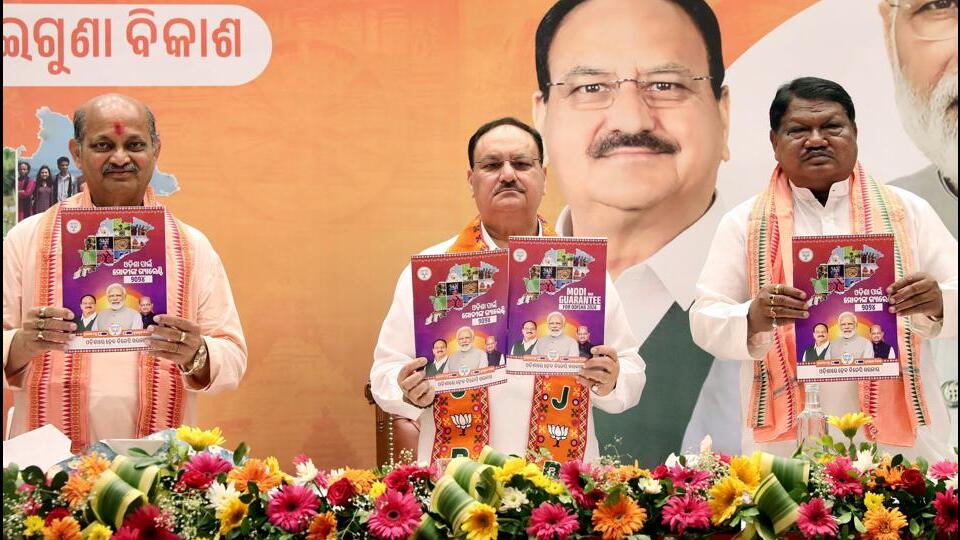
BJP national president J P Nadda, who released the party’s election manifesto for Odisha on Sunday, said while the chief minister Naveen Patnaik-led government has failed to keep its promises, the BJP manifesto will seek to fulfil the party’s commitments. The manifesto is an implementation of our programmes for the next five years, he said.
“As we embark on a journey towards the 100th year of Odisha’s formation, the BJP envisions making the state a trillion-dollar economy by 2036. Through decisive leadership and strategic initiatives, we will propel Odisha towards Utkrisht Utkal....Odisha re Odia loko paen, purna Odia shasan (Odisha is for Odia people and complete Odia governance). With this vision, we will realise the full potential of this land of abundance,” said Nadda, while mounting a stinging attack on the Naveen Patnaik government for its failure in providing irrigation to the farmlands and creating a situation that led to collapse of the education system.
For the farmers, the BJP manifesto promised to start the Sammruddha Krushak Niti, under which the rate of paddy procurement would be hiked to ₹3,100 per quintal. Procurement will be done through electronic weighing machines in all mandis, eliminating the present practice of katni-chhatni. “Payment will be transferred to farmers within 48 hours through DBT (direct benefit transfer). Annual lean period allowance of ₹10,000 will be given to every fisherman and fishing industry would be revolutionised by upgrading fishing harbours, setting up cold warehouses and processing houses for fisheries,” it promised.
For the women, the party in its manifesto promised to launch the Subhadra Yojana under which every woman will receive a cash voucher of ₹50,000 that can be redeemed over two years. The party promised ₹2 lakh assurance certificate to each below poverty line (BPL) girl student under Mo Medhabi Jhia Yojana that can be redeemed at the age of 21 years. It also promised one day menstrual leave for women government employees.
The manifesto said the party will try to create 25 lakh Lakhpati Didis in Odisha by 2027 and create industrial clusters for every 500 self-help groups (SHGs).
For the tribal students, the manifesto promised to provide ₹5,000 annually to them under Madho Singh Haath-Kharcha scheme to encourage them to attend schools and reduce dropout rates.
To arrest the rising malnutrition among kids, the BJP in its manifesto said it will start a breakfast scheme called Apoorti in addition to the existing mid-day meal scheme.
The party also promised to launch the ‘Mukhyamantri Sahayata Jojana’ to provide pension of ₹3,000 per month for all elderly, divyang, widows, and destitute and pension of ₹3,500 for elderly above 80 years and divyang with 80% disability.
In the health sector, the party promised to implement the Ayushman Bharat-Pradhan Mantri Jan Arogya Yojana which the Naveen Patnaik government has been resisting and added that it would launch the ‘Mission Swasthya Odisha’, under which 36,000 new beds in the community health centres (CHCs) and public health centres (PHCs) would be added. Besides, every CHC would be modernised by 2027 with ICUs, dialysis units and operation theatres while 100 CHCs would be upgraded into Sub-Divisional Hospitals.
Slamming the state government over Odisha’s unemployment rate being as high as 22.8% in 2019, making it higher than the national average, the manifesto promised to fill up all the 1.5 lakh vacant government posts of which 65,000 would be done in next two years.
Promising complete implementation of PM Awas Yojana, the manifesto said 10 lakh houses will be built in rural Odisha and another 5 lakh in urban areas.