
 E-Paper



BJP tries to woo Dalits, backwards to bolster poll chances in 2023
Bengaluru After overcoming a threat by its core support base, the Lingayats, the Bharatiya Janata Party (BJP) is now looking to intensify its outreach to Dalits and backward classes so as to get a majority on its own in the 2023 assembly elections in Karnataka, the party’s moves indicate


Bengaluru
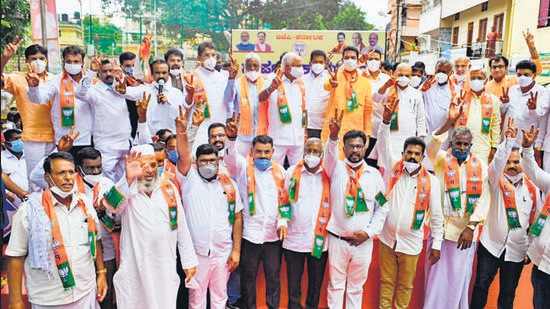
After overcoming a threat by its core support base, the Lingayats, the Bharatiya Janata Party (BJP) is now looking to intensify its outreach to Dalits and backward classes so as to get a majority on its own in the 2023 assembly elections in Karnataka, the party’s moves indicate.
Lingayats had opposed the BJP move to remove BS Yediyurappa as chief minister. The BJP replaced Yediyurappa with Basavaraj Bommai, a Lingayat, to contain the resentment in the community.
Three ministers from scheduled castes (SC) and one from the scheduled tribe (ST) have been inducted into the Bommai cabinet. On Thursday, the BJP inducted N Mahesh, a Dalit activist and the sole legislator of the Bahujan Samaj Party (BSP) from Kollegala in Chamarajanagar, into the party fold, indicating its resolve to get the backing of the marginalised communities in the state.
The three ministers from SC communities are Govind Karjol, who was a deputy chief minister in Yediyurappa’s cabinet, Prabhu Chauhan and S Angara. B Sriramulu is from the Valmiki community, classified as an ST.
Despite the dropping of Arvind Limbavali from the Bovi community, the BJP is attempting to approach backward groups to join its fold as a way to undercut the Congress and retain power on its own in 2023.
In Karnataka’s caste-centric politics, it is not uncommon for communities to back a leader or a party en masse, experts say.
Analyses of voting patterns indicate that Dalits largely back the Congress or some Left parties. The BJP enjoys the backing of Lingayats and Brahmins, while the Vokkaligas, another dominant community, are largely seen to back former prime minister HD Deve Gowda-led Janata Dal (Secular).
“The joining of Mahesh is an indication that the SC/ST communities want to come over to the BJP in a big way,” Yediyurappa said on Thursday. Though Yediyurappa was forced to step down last week, the 78-year-old remains the face of the BJP in Karnataka and has a high degree of acceptability across communities unlike his peers.
The Narendra Modi-led central government also inducted A Narayanaswamy, a Dalit and member of parliament from Chitradurga, into the union cabinet.
The move to get the backing of marginalised communities in Karnataka is to undercut the Congress, particularly Siddaramaiah, who had stormed into power in 2013 on the back of AHINDA (Kannada acronym for minorities, backward classes and Dalits).
The BJP is also looking at making inroads in the Old-Mysuru region, where its presence is limited to Bengaluru and a few isolated seats.
On Friday, V Srinivas Prasad, the BJP member of Parliament from Chamarajanagar, decided that he would not contest the 2024 Lok Sabha elections. Prasad, a prominent Dalit activist and former confidant of Siddaramaiah, had joined the BJP after he was shunted out of the Congress cabinet in 2017.
In 2018, just before the Karnataka assembly elections, then national president and present union home minister Amit Shah had visited the Madara Channaiah Guru Peetha, a spiritual headquarters of the backward Madiga community, in a bid to get the backing of groups that had traditionally sided with the Congress.
The BJP is also trying to blur caste lines to get the backing of backward communities. Analysts say induction of seven ministers from backward communities in Bommai’s cabinet is a move in that direction.


