
 E-Paper



Delhiwale: The mannequin anthropology
Observing mannequins in Paharganj and Gurugram reveals contrasting lifestyles: carefree backpackers in vibrant attire vs. family-oriented, traditional styles.

 Prefer HTon Google


One may try to understand a neighbourhood market by observing its humans. One may also do the same by observing the market’s mute, fibreglass dwellers — the showroom mannequins. Indeed, it is fun to compare the mannequins of two vastly different destinations: Main Bazar in Paharganj and Sadar Bazar in Gurugram.
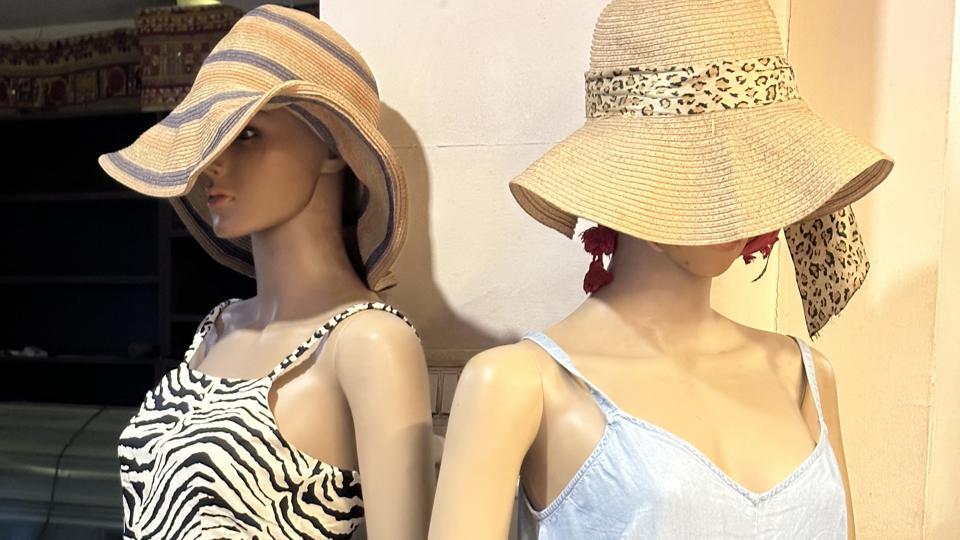
In Paharganj’s Main Bazar, mannequins lean decisively westward. Some shops have them attired in the so-called “cocktail dress.” Many other mannequins flaunt a less formal wardrobe that veers towards a bohemian style, in which patchworks of colour and fabric are interstitched with studied randomness. Baggy and airy, some of these mostly cotton dresses prominently bear sacred symbols of spirituality. The shirt, or top, might be printed with a finely calligraphed “Om,” or with the two lines of a Tibetan mantra.
One aspect common to all the Main Bazar mannequins is the blonde wig. The non-black hair symbolises the intended buyers, who happen to be the western backpackers boarding briefly at Paharganj’s budget hotels (before embarking to hippie havens of Manali, Pushkar and Goa). Indeed, it is tempting to assert that the sartorial style of Main Bazar mannequins suggests a carefree life unmoored from obligatory bonds. As if these people have no middle-class Mummy Papa, no day-job boss, who might have slowed down their seemingly uninhibited intercontinental mobility.
On the other hand, the Sadar Bazar mannequins in Gurugram enact an entirely different soap opera. The shopfronts often exhibit an entire family. Mother, father, son, daughter, posing together in a homely “Hum Saath Saath Hain” bonhomie. The men wear suits, kurta-pyjamas, or embroidered sherwanis. The women’s attire ranges from saris and lehengas, kurtis and leggings, to palazzos, skirts, trousers, and nightwear. One shop displays a young couple in coordinated nightwear: the man in a T-shirt and track pants, the woman in a nighty.

Evaluated side by side, the Paharganj’s Main Bazar mannequin appears to be heading to a rave party in the Parvati Valley, and the mannequin in Gurugram’s Sadar Bazar appears to be heading to the wedding reception at the local banquet hall. To be sure, some readers may interpret these observations as mere generalisations, which is true up to a point. But it is simultaneously true that at least these particular generalisations have been partly borne out of longtime societal trends existing in both these places.
As for you, dear reader, do consider observing the mannequins in the market nearest your home. In them, you may glimpse the sociology of your own hyperlocal society.


