
 E-Paper



Greater Noida fire:Why local retrofitting can turn bus into death traps
Greater Noida: While the expansion of high-speed expressways has opened up more opportunities for inter-city travel, experts said the safety standards for long-distance vehicles, such as overnight and sleeper-bus services, have not kept pace, in addition to a lack of preparedness for emergencies

 Prefer HTon Google


Greater Noida: While the expansion of high-speed expressways has opened up more opportunities for inter-city travel, experts said the safety standards for long-distance vehicles, such as overnight and sleeper-bus services, have not kept pace, in addition to a lack of preparedness for emergencies.
Road-safety expert Rohit Baluja, president of the Institute of Road Traffic Education (IRTE), said the higher-speed environment of expressways needs to be matched by appropriate safety standards for long-distance buses. “The issue is are the buses adequately equipped to handle small emergencies?”
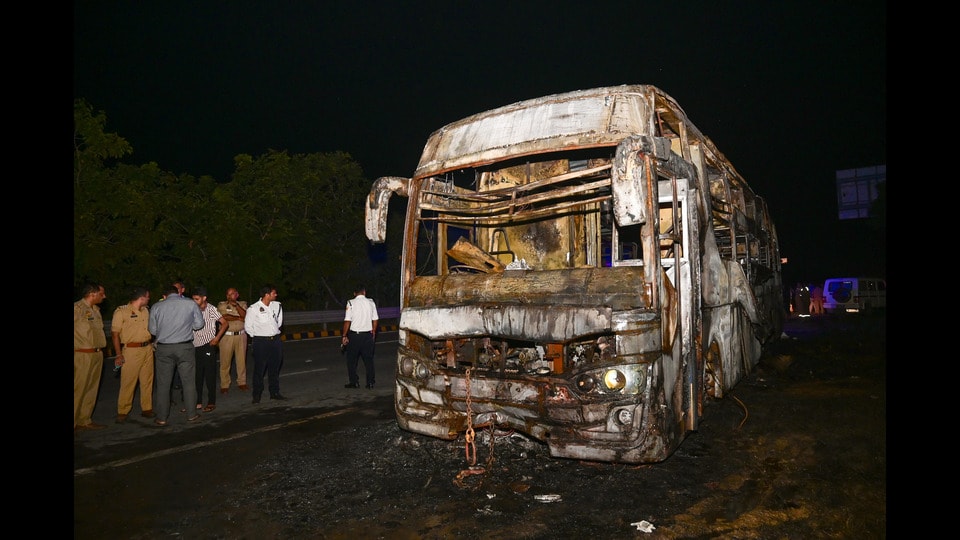
Late Wednesday night, nine people were killed after an air-conditioned (AC) bus caught fire while travelling on the Yamuna Expressway near Greater Noida. According to a preliminary investigation, the fire erupted following a short circuit or blast in the AC, which caused the engine lubricant oil and diesel tank to catch fire.
Experts have pointed out that these non-impact fires are mostly seen in non-premium AC sleeper buses, with many of them not factory-built sleepers but standard coaches retrofitted locally after registration.
“A large number of sleeper bus fires are non-impact fires. They start due to electrical overload and are entirely preventable,” Anil Chhikara, former deputy transport commissioner of Delhi and currently faculty at Asian Institute of Transport Development, has previously told HT. “These retrofitted AC sleeper buses are uniquely vulnerable.”
Unlike original equipment manufacturers that use multiplex wiring to distribute electrical load safely, local bus body builders often rely on cheaper components sourced from informal markets.
What also turns such fires into mass fatality events is the sleeper coach layout itself. Narrow aisles, stacked berths and limited headroom severely restrict movement during emergencies. Technically, sleeper buses are required to have multiple emergency exits, but in practice rear exits are often blocked after registration to add extra berths in many of the custom built buses.
“These sleeper buses actually—there are no definitive codes of practice. They are supposed to have four doors, but they just keep two, and for the other two they have put seats so that you can carry more passengers,” said Baluja.
India’s private inter-city bus market carried more than 140 million passengers between April and September 2025, according to popular online bus aggregator RedBus’s estimate, with sleeper and hybrid services accounting for 85% of journeys.
However, there is no official national count of sleeper buses or sleeper-only passengers, nor any centralised national data of increase in sleeper buses due to expressways.
In India, the Automotive Industry Standards such as AIS-052 (bus body code), AIS-119 (sleeper bus code) and AIS-134 (fire detection and suppression systems) lay down requirements for construction and fire safety.
But, SN Dhole, head of technical secretariat at Central Institute of Road Transport (CIRT), had earlier said enforcement has failed to keep pace. “Standards exist, but compliance is largely document-based,” he said.
A key regulatory shift between 2022 and 2024 allowed accredited body builders to self-certify. Routine physical inspections by Regional Transport Offices (RTOs) were diluted, with authorities relying increasingly on uploaded certificates. But, Dhole said even though this rule was reversed, the flaws go undetected or ignored.
RTOs are expected to issue fitness certificates every two years and flag malpractices in vehicle design. “There is an acute shortage of trained engineers who can actually assess electrical systems and fire safety. In many states, clerical staff have been assigned inspection duties because technical posts remain vacant,” explained Chhikara.
Baluja said enforcement ultimately remains with state authorities, even as expressways carry vehicles and operators across state boundaries. “The jurisdiction of enforcement and making sure that the goals are met is of the state,” he said, adding states often prioritise collecting revenues ignoring safety standards.


