
Sign in

Gurugram: Liquor shop owners protest curtailed business hours

Liquor shop owners in the city on Tuesday protested outside the excise office in Sector 34, demanding that they should be allowed to keep their shops open till 11pm instead of 5pm under the current Covid-19 guidelines

Updated on: Jan 5, 2022, 00:55:06 IST
Share
Share via
  • facebook
  • twitter
  • linkedin
  • whatsapp
Copy link
  • copy link

Liquor shop owners in the city on Tuesday protested outside the excise office in Sector 34, demanding that they should be allowed to keep their shops open till 11pm instead of 5pm under the current Covid-19 guidelines.
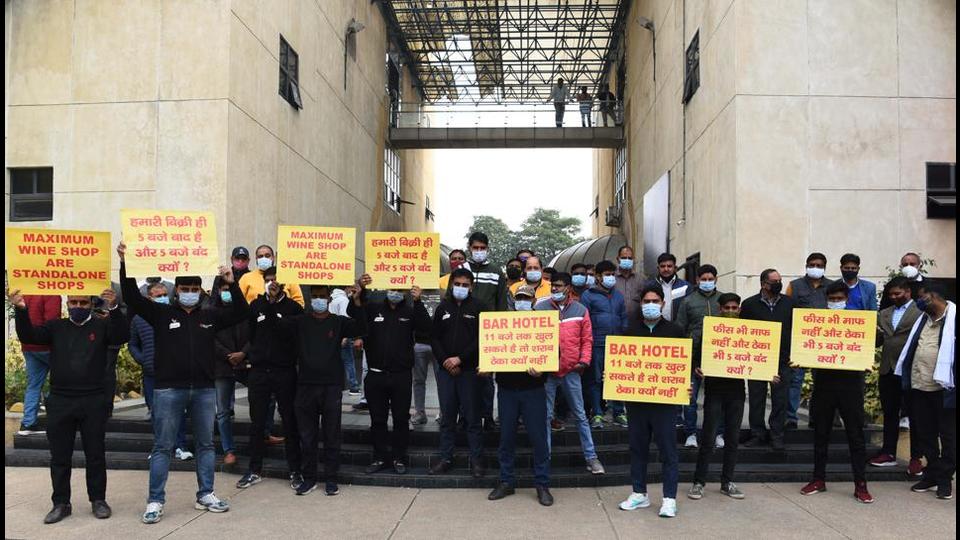
Liquor traders protest outside the excise office against the fresh Covid guidelines directing closure of wine shops by 5pm, at Sector 34 in Gurugram on Tuesday. (Vipin Kumar/HT PHOTO)

The Haryana government on January 1 announced several restrictions in five districts, including Gurugram and Faridabad, where liquor shops were asked to operate between 9am and 5pm, while bars, pubs and restaurants were asked to operate with 50% seating capacity.

The members of the Allied Liquor Association met the deputy excise and taxation commissioner (DETC) and handed over a memorandum requesting change of timings and to waive off the liquor licence fees.

Subhash Bansal, general manager of Discovery Wines and a member of the association, said that 80% of liquor sales is achieved from 6pm to 11pm. “Due to the present timings, we will have to incur a heavy loss. Besides, we will find it difficult to submit the license fees which are paid in advance,” he said.

Sujan Singh, another member, said, “It was illogical to give permission to bars/restaurants to open till 11pm and put restrictions only on us.”

The protesters said that the government should also waive off their licence fees and just charge them 10% with the restrictions.

Rohit Yadav, a shop owner, said that the liquor shops are the highest revenue generators for the state. “The new restrictions will lead to smuggling of liquor, and people involved in illegal trade of liquor will flourish. We are ready to follow all Covid-19 protocols, but please don’t ruin our business,” he said.

There are 280 liquor shops across the city, most of which are situated on MG Road, Golf Course Road, Sohna Road and Golf Course Extension Road, according to an official data.

Anirudh Sharma, deputy excise and taxation commissioner (west), said the department agreed that the timings should change and forwarded their memorandum to the headquarters in Panchkula. “People usually visit liquor shops post 6pm. The timings of these establishments should be considered till 11pm. Since liquor shops in Delhi are open till 8pm, people will buy from the national capital leading to the loss for Gurugram shops,” he said.

Haryana deputy chief minister, Dushyant Chautala, who also holds the portfolio of excise and taxation, said, “We have received their representation and are trying to help them in every possible way.”

Chautala further said that the liquor shop owners should appeal before the deputy commissioner also who will send recommendations to the government.

  • Leena Dhankhar
    ABOUT THE AUTHOR
    Leena Dhankhar

    Leena Dhankhar is Senior Editor and Bureau Chief, Gurugram, at Hindustan Times, where she has spent over 17 years chronicling the transformation of one of India's fastest-growing urban regions. From starting her career as a crime reporter to leading the Gurugram bureau, her journalism has been defined by investigative reporting, in-depth storytelling and an unwavering focus on public interest. Over nearly two decades, she has reported extensively across crime, politics, civic governance, elections, real estate, environment, courts, sports, education and entertainment, covering Gurugram, Faridabad, Nuh and Palwal. Her reporting has exposed several major scams and systemic failures, including insurance frauds, waste management irregularities, illegal arms manufacturing units in Nuh, illegal mining in the Aravallis, organised crime networks and governance lapses affecting millions of residents. Known for her investigative work and exclusive stories, Leena has reported on high-impact national issues, including the Nicaragua charter flight carrying Indian migrants that was turned back amid allegations of human trafficking, exposing the growing network of illegal immigration rackets. Her work has also focused on gang wars, prison administration, juvenile crime, women and child protection systems, the functioning of the Juvenile Justice Board and Child Welfare Committee, and environmental challenges such as pollution, waterlogging and deteriorating civic infrastructure. Beyond hard news, Leena has extensively documented Haryana's rich heritage, forests and wildlife, bringing attention to the state's historical landmarks, biodiversity, conservation efforts and ecological challenges through immersive reportage and feature writing. Her journalism has consistently gone beyond breaking news. She has documented Gurugram's rapid urbanisation through long-form narratives and enterprise reporting on issues ranging from pothole-ridden roads, flooding and waste management to the changing social fabric of India's Millennium City. She also writes widely read feature columns, including The Outsider, Changemaker, and Concern for Gurugram, profiling people, places and ideas shaping the city's identity. Leena is the author of Gurugram School Murder, published by Juggernaut Books, a deeply reported account of one of India's most high-profile school murder investigations. She is currently working on her second book, an investigative work exploring some of India's most significant scams and fraud investigations. Beyond print journalism, she has expanded her storytelling through public speaking and digital media. She is a TEDx speaker and has produced podcasts exploring Gurugram's transformation, civic challenges and untold stories. Her work reflects a commitment to narrative journalism that combines rigorous reporting with compelling storytelling. A law graduate with an MBA in Human Resources, Leena brings a multidisciplinary perspective to her reporting, particularly on governance, public policy and legal affairs. She has travelled extensively across India to pursue investigative assignments, often reporting from remote locations and conflict-prone areas in search of stories that matter.Read More