
 E-Paper



Ludhiana: 26 young innovators display their ideas at Inspire Awards
The ideas that were on display by innovators at the district-level exhibition and project competition — Inspire Awards, held in Ludhiana, included an in-farm power plant using stubble, LEDs with adjustable brightness, google-enabled pencil cases, a plan for roads with the ability to absorb rains and a project to clean the Buddha Nullah


During the peak of the second wave of the Covid-19 pandemic, when oximeters became a rare commodity, Arvie Chopra, then a Class 9 student and science enthusiast used his learnings to develop an oximeter at home for his grandmother using minimum resources.
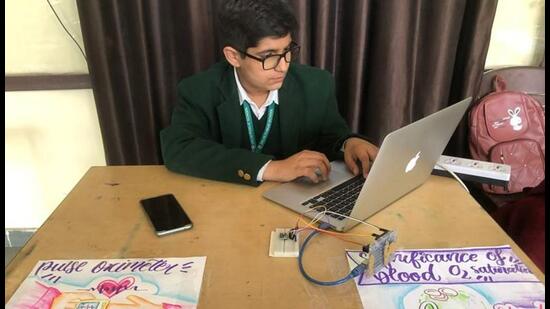
Chopra was among the 26 budding innovators who displayed their innovative ideas at the district-level exhibition and project competition — Inspire Awards, held at the Government Smart School, Punjab Agriculture University, on November 21-22.
The ideas that were on display included an in-farm power plant using stubble, LEDs with adjustable brightness, google-enabled pencil cases, a plan for roads with the ability to absorb rains and a project to clean the Buddha Nullah.
As many as 26 innovators from the district were selected under the Inspire Awards - Manak scheme of the department of Science and Technology, Government of India.
Students from both government and private schools were invited to register their ideas on the online portal of Innovation in science pursuit for inspired research (Inspire).
As many as 1,00,000 unique ideas across the country, with the potential to address societal needs, were shortlisted and were provided with a cash award of ₹10,000 each. Students utilised the funding to create models to represent their ideas. Around 10% of the participating students will be shortlisted for the state-level competition.
While describing his idea, which he has named Arduino oximeter, Arvie said by using his technique, the price of the oximeter can be brought down to as low as ₹100. He said, “As I am asthmatic, I am developing a wearable gadget for asthma patients which will automatically go on alert mode as they will enter the hazardous atmosphere and start recording their vitals.”
“Through a mobile application, it will also send notifications to the emergency contacts,” he said, adding that he spent the leisure time during the lockdown learning coding and is using them in his projects.
Mehakpreet Singh, who is a Class 10 student at GSSS, Punjab Agricultural University presented an in-house model to use the paddy residue to generate electricity, ethanol and as a fuel in brick kilns.
Through the model — “From Pollution to Power”, he displayed that instead of openly burning the stubble in the fields, the same can be used to create energy through turbines and thermal plants. He said farmers can increase productivity by using straw in mushroom farming and poultry farms.
Arvie Chopra and Mehakpreet Singh bagged first and second positions in the district level competition.
Anju Soni, a chemistry lecturer who was among the judges said, “The students have been selected on the basis of originality and uniqueness of their ideas, he said after qualifying the state and national round, the government will help 60 such ideas for further development.”


