
 E-Paper



Manipur: Displaced families return ₹11.7 lakh, reject ₹84 daily allowance
Protesters at Sajiwa said that despite repeated assurances of rehabilitation, “no concrete step” had been taken by the government.


At least 446 internally displaced persons (IDPs) staying at the prefabricated housing complex in Sajiwa, Imphal East, on Wednesday returned ₹11,74,320 to the authorities, rejecting the government’s daily allowance of ₹84 per person, which they termed as “meagre and inadequate”.
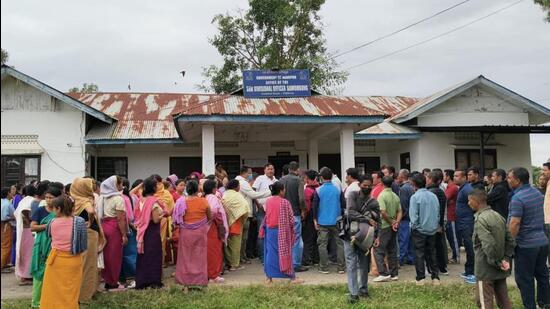
The displaced persons, who have been living in relief camps since the ethnic violence broke out in Manipur on May 3, 2023, marched to the Sub-Divisional Office (SDO) in Imphal East and deposited the amount, expressing their anger over what they described as an “insulting” compensation.
According to an official statement, the returned amount represents one month’s financial aid distributed under the new Direct Benefit Transfer (DBT) system — ₹2,520 per person, calculated as ₹84 per day for 30 days for 466 inmates.
“The ₹84 daily allowance is insufficient to meet even the basic daily needs of a person,” an IDP leader told reporters. Protesters at Sajiwa said that despite repeated assurances of rehabilitation, “no concrete step” had been taken by the government.
The state government had earlier announced that rehabilitation of displaced persons — over 60,000 people affected by the ongoing conflict — would be completed by December in a phased manner. However, according to camp residents, there has been “no visible progress” on the ground.
Protests were also reported from several other relief camps across the state capital. In Imphal West, displaced families demonstrated against the cash allowance, while those in Imphal East demanded immediate rehabilitation in their native villages.
The protesters alleged discrepancies in the government’s calculation of ration-to-cash conversion. “When the government provides rice grains, they charge ₹20 for 400 grams. But when converted to cash, we receive only ₹1-4 for transport and ₹3 for rice. Why this disparity?” questioned one protester outside the SDO office in Imphal East.
Residents from Ekou Saduyengkhoman, Dolaithabi, Leitanpokpi, and Mairenpat villages, currently housed at the Sajiwa pre-fabricated site, submitted a 10-day ultimatum to the government through the SDO office, demanding safe resettlement in their original villages. They warned of intensified agitations if their demands were not met within the deadline.
“The government should bear the responsibility for any unwanted incidents if they occur during our agitation,” said Koijam Sarat Meitei, one of the protesters.
During the early months of the conflict, relief had come jointly from the state government, local legislators, ministers, and community groups. Camps received rice, dal, vegetables, milk, and firewood, and several had cooks and priests arranged by local representatives.
However, dissatisfaction grew over the lack of dietary diversity and autonomy under the common kitchen system. Following multiple appeals, authorities in Imphal East introduced a cash-based system allowing displaced families to receive ₹80 per person per day in lieu of 400 grams of rice. Imphal West later adopted a similar approach, supplementing the ration with bananas and eggs for breakfast.
By October, after pressure from IDPs across several districts, including Bishnupur and Thoubal, the Manipur government standardised the rate at ₹84 per person per day across all relief camps. The move, however, has sparked renewed protests, with displaced families calling it “unrealistic” amid rising food prices and prolonged uncertainty about their rehabilitation.


