E-Paper



NDRF jawans undergo counselling to avoid trauma after Odisha train tragedy
Over 300 jawans of the local battalions of NDRF were engaged in rescuing the accident victims for nearly 48 hours after last Friday’s train tragedy


Less than a week after the Coromondel Express tragedy in Odisha’s Balasore district that resulted in death of at least 288 people and injury to nearly 1,000 passengers, the jawans of the National Disaster Response Force (NDRF), who played a crucial role along with other agencies in rescuing the victims, are being counselled by mental health professionals to avoid any post traumatic stress disorders (PTSD), said people familiar with the matter.
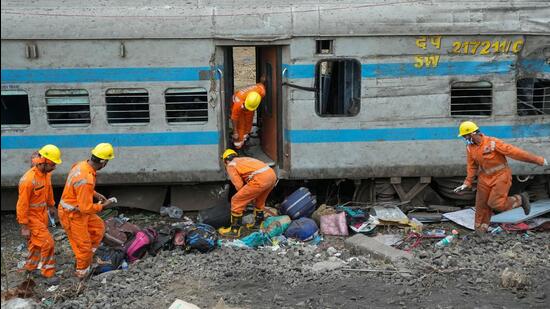
Over 300 jawans of the local battalions of NDRF were engaged in rescuing the accident victims of Chennai-bound Coromondel Express as well as the Yeshwantpur-Howrah superfast express for nearly 48 hours after last Friday’s train tragedy. Using plasma cutters and several other equipments used in search and rescue operations, the NDRF personnel managed to rescue hundreds of injured passengers and extricate scores of bodies trapped inside the mangled coaches.
After the gruelling operation that earned them plaudits from Prime Minister Narendra Modi as well Odisha chief minister Naveen Patnaik, several jawans of NDRF 3rd Battalion have undergone psychological counselling under the expert supervision of the counsellors of Mental Health Institute of SCB Medical College and Hospital in Cuttack over difficulties in sleeping.
A three-member team led by Mental Health Institute’s clinical psychologist Prasanta Kumar Sethi, who counselled the rescuers early this week, said a severity assessment of the rescuers showed that many of them suffered from near PTSD. “At least 25 rescuers complained of witnessing nightmares, flash images of the screaming passengers and the blood-stained bodies of the victims. If they continue to experience sleep disorders for next 4-5 days then we have suggested them for more consultation,” said Sethi, adding that in the last two days some witnesses of the train tragedy have visited the mental health institute disturbed over the recurring images.
“Some rescuers faced olfactory hallucination, which makes one detect smells that are really not there in the environment. A few others revealed they were not able to sleep during nights,” said Sethi, adding the NDRF jawans were counselled to adopt different approaches so as to forget the tragedy.
“Our personnel need to be mentally and physically fit and hence we have included various physical and mental fitness programmes. Counselling sessions are being conducted to ensure the good mental health of the rescuers,” said NDRF director general (DG), Atul Karwal. NDRF inspector Dhananjay Kumar, however, said the counselling was part of the standard operating procedure (SOP) of NDRF, which is done after any such operation. “Our jawans are raring to go for the next operation,” he said.
The fire services personnel, who were the first responders, have displayed PTSD with many of them unable to sleep or eat. “I did not anticipate that I would see so many bodies. There were countless bodies with severed heads and limbs. I am still having recurring images of blood. I am unable to forget the scene when I was trying to rescue passengers with my clothes totally soaked with their blood. I have been unable to eat properly since then,” one of the fire services personnel said.
“The scenes of that night when we reached the accident spot still haunt me. Even last night I dreamt of a lady’s body which did not have limbs below her torso. I could not sleep the whole night,” said firefighter Anand Patra.
Another firefighter said, “I cannot go into the dark now. The horrific scenes of that night makes me weary of the darkness. I can even smell the blood and see the headless bodies in my sleep. I am sleeping with lights on in the night.”
DG fire services, Sudhansu Sarangi, said no such counselling of fire services personnel has been planned.