E-Paper



Odisha to conduct RT-PCR tests on servitors four times ahead of Rath Jatra
In a bid to next month’s Rath Jatra in Puri free of Covid-19 infection, the Shree Jagannath Temple Administration (SJTA) on Thursday decided that all the servitors participating in various rituals of the deities will undergo multiple rounds of the Covid-19 test (RT-PCR) 48 hours before the festival, SJTA chief administrator Dr Krishan Kumar said


In a bid to next month’s Rath Jatra in Puri free of Covid-19 infection, the Shree Jagannath Temple Administration (SJTA) on Thursday decided that all the servitors participating in various rituals of the deities will undergo multiple rounds of the Covid-19 test (RT-PCR) 48 hours before the festival, SJTA chief administrator Dr Krishan Kumar said.
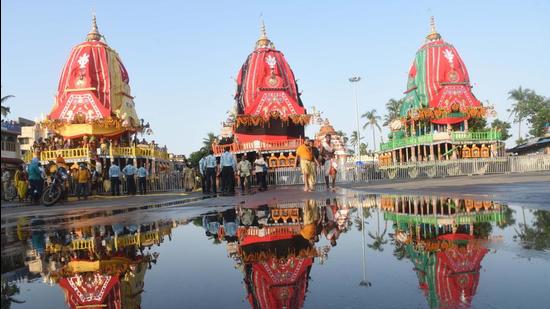
“A detailed micro-plan is being made for setting up of special medical posts during Ratha Jatra. Apart from the servitors, police personnel and temple officials involved in the Ratha Jatra arrangements will also be tested. The focus will be on the servitors who will pull the three chariots in view of the Covid-19 restrictions,” said Dr Kumar.
Kumar, who headed a meeting in this regard, said the testing will be done in four stages - before Snana Yatra, before Gundicha Yatra, before Bahuda Yatra and finally, 15 days after Niladri Bije. The Ratha Jatra is scheduled for July 11.
Considered as part and parcel of the social, religious and cultural ethos of the people of Odisha, the Ratha Jatra is one of the main festivals of Odisha that commemorates the annual journey of Lord Jagannath and his siblings from the 12th century Jagannath temple to their aunt’s abode in Gundicha temple, 2.5 kilometres away in Puri town.
During the Ratha Jatra, a million devotees come to Puri town believing that they would attain salvation by touching the ropes attached to the 3 chariots of Lord Jagannath, Lord Balabhadra and Goddess Subhadra. After staying in Gundicha temple for 9 days, the three deities come back to Jagannath Temple on the 10th day in a return journey called “Bahuda Yatra”.
The SJTA chief administrator said a nodal officer will be appointed by the SJTA, Puri district administration and the CDMO office for close coordination on a day-to-day basis. An adequate number of masks would be distributed among the servitors during Snana Jatra and Ratha Jatra. To promote hand hygiene like last year, sanitisers would be distributed amongst families of servitors. Meetings will be held with members of various Nijogs to sensitize the servitors on do’s and don’ts to be followed during the conduct of the rituals.
Earlier this month, the state government said that the Ratha Jatra will be held on July 11 without the presence of devotees as per the guidelines issued by the Supreme Court last year. After refusing to allow it, the apex court, last year, permitted the Rath Yatra to happen on the condition that there is no public attendance and all entry points into Puri will remain closed. The state government said each chariot would not be pulled by more than 500 persons and social distancing should be maintained as far as possible.
However, the state government’s decision to stop Ratha Jatras in other towns of Odisha amid the pandemic has been opposed by political parties and local people.
The Kendrapara district unit of BJP on Friday requested the Odisha government and the Centre to take necessary steps to allow the conduct of the upcoming Rath Yatra at Baladevjew temple in Kendrapara town. A team of the Kendrapara BJP staged a protest in front of the office of the district collector and before the temple seeking fulfilment of their demands. The party workers and leaders also demonstrated in front of the offices of all the Tehsildars.
The Kendrapara district unit of BJP on Friday requested the Odisha government and the Centre to take necessary steps to allow the conduct of the upcoming Rath Yatra dedicated to the Siddha Baladevjew in Kendrapara. The national vice president of the BJP, Baijayant Panda, also demanded that the government should take all necessary steps as there are a lot of similarities in the rituals, religious practices between the shrine of Siddha Baladevjew and Puri Jagannath temple.
On Thursday, people in Baripada town demanded permission to conduct Ratha Jatra at Haribaldev Jew temple in Baripada, also known as Dwitiya Sreekhetra, the second most important shrine of Lord Jagannath after Puri.