
 E-Paper



Releasing freshwater into Buddha Nullah: Amid criticism, cabinet minister Ashu claims satisfactory results
Says the drain’s chemical oxygen demand and biochemical oxygen demand levels had reduced by nearly 70-80%


With the authorities and state government facing flak over the release of freshwater into Buddha Nullah, cabinet minister Bharat Bhushan Ashu on Wednesday claimed that the project had started showing results with the nullah’s biochemical oxygen demand (BOD) and chemical oxygen demand (COD) levels reducing by nearly 70-80%.
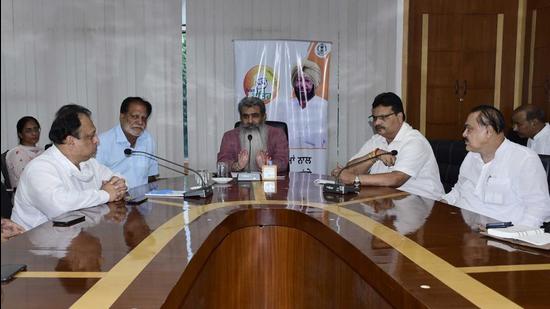
The minister was conducting a meeting to review the ongoing project of rejuvenating the nullah at the municipal corporation’s (MC) Zone D office on Wednesday.
Ashu said after freshwater was released from the Neelon drain of Sirhind canal on August 22, the BOD and COD levels of the nullah dropped from 1,124 and 2,157 to 61 and 256, respectively, on Wednesday.
The officials of the special task force constituted for cleaning the nullah, Punjab Pollution Control Board (PPCB), and the civic body were present in the meeting. The industrialists, who are a part of the monitoring committee formed under the rejuvenation project, also participated.
The officials stated that while 200 cusecs of freshwater had to be released into the nullah in a phased manner, as of now 100 cusecs was being released daily. The officials stated that the BOD and COD levels will further improve after more water was released.
Ashu said, “There are some apprehensions in the minds of residents and activists, but we want to ensure that everything is being done with transparency. Releasing freshwater into the nullah is one component of the ₹650-crore project to rejuvenate the nullah and efforts are also being made to deal with sewer and dairy waste.”
Ashu stated that they had also invited some environmental activists including Col (retd) JS Gill, who is also a member of the STF for cleaning the nullah, and CM Lakhanpal, for discussions regarding apprehensions, but they were not available due to personal reasons.
He said that work had also commenced on two new sewage treatment plants (STPs) for treating domestic waters of total 285 MLD (Jamalpur 225 MLD and Balloke 60 MLD) capacity; rehabilitation of existing STPs with a treatment capacity of 418 MLD; two common effluent treatment plants (CETPs) for treatment of 6 MLD wastewater from two dairy complexes in Tajpur and Haibowal; six intermediate pumping stations; laying of 10-km pipeline and 10 years of operation and maintenance of entire infrastructure, which will be completed by December 2022.
Experts, environment activists raise concern
Experts and environment activists had earlier raised questions over the release of freshwater into the highly polluted nullah without eliminating the major sources of pollution.
Col (retd) JS Gill said, “We are not against the project as it was needed to be undertaken but the timing is not good. The MC should have first dealt with the pollution.”
“As there are still pollutants in the drain, releasing freshwater has sped up the process of polluting the Sutlej river. Pollutants including heavy metals will enter the Sutlej at a faster rate. The river is a source of drinking water for various districts of Rajasthan and southern parts of Punjab.”


