
 E-Paper



Revitalising traditional Goan music, one home concert at a time
Away from the milling crowds and neon lights, specially curated micro concerts help traditional Goan music find a new platform and new takers


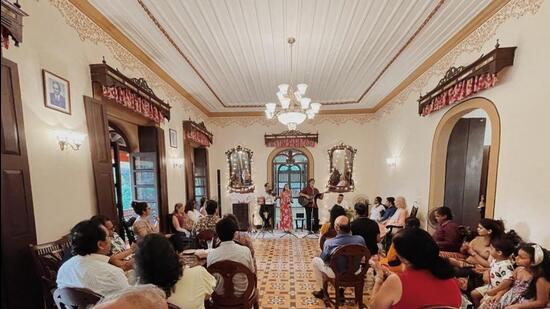
It was a soaking wet afternoon at the Villa 52 at Assagao in North Goa as guests began to trickle in past the mossy earth and into the warm confines of the 300-year-old Goan home. From outside, this is just another Indo-Portuguese house -- one of many that dot the villages of Goa. But, the melodious voice inside as Nádia Rebelo floats through the air rendering the soulful notes of the fado, a form of music or Portuguese origin characterised by mournful tunes and lyrics, draws some among the two-dozen odd members of the audience to tears.
Not far away from Assagao and on the banks of the River Mandovi, hidden amidst the neon lights that beckon tourists to the glitzy life on board Goa’s offshore casinos bobbing about in the River Mandovi, is the easily missable narrow doorway that leads to the Centre for Indo Portuguese Arts that hosts Madragoa, the world’s only Casa do Fado and Mando (Home of Fado and Mando). Insulated from the din outside, Sonia Shirsat’s riveting voice floats in the air accompanied by the Portuguese plucking of the mandolin and Portuguese guitar.
Welcome to the world of the micro-concerts of Goa, a unique and carefully curated music experience meant to be savoured as a small group, which unlike a conventional concert, within a touching distance of the performing singers and musicians gives a real “touch and feel” experience.
The performances take place in select settings like heritage homes and feature exclusively traditional and Portuguese influenced music that encompasses forms like the Dulpod, Dekhni, Mando and the Portuguese form -- the Fado.
“I always wanted to do something with music, the way it is played and consumed. In the conventional way music is performed either in restaurants where the clientele is more interested in conversing with each other or in their food and is not at all bothered about music that is being played,” said Schubert Fernandes, a Goa born public relations professional in Mumbai who set up Sounds from Goa that has ‘pioneered’ micro heritage concerts in the state.
“We wanted to offer music -- those distinct sounds, songs and experiences from our tiny culturally rich state of Goa in which the importance and quality of music can be touched, felt and savoured, complemented by the ambience offered by a heritage home and traditional savouries,” Fernandes added.
“Our larger objective is to preserve and further folk and traditional music from Goa. With this very inclusive experience, we aim to have our guests not only listen, but also touch and feel these authentic sounds,” he said.
The group of musicians -- Omar Loiola Pereira, Selwyn Menezes and Nadia Rebelo offers visitors a taste of Goan folk and traditional music ranging from the purely Goan tribal to the “purely” Portuguese ‘fado’ -- emotive poems set to a soulful tune describing longing and nostalgia -- encompassing the entire spectrum of uniquely Goan music that isn’t commonly found elsewhere.
In part, the micro concert has been spurred on by the pandemic -- a time when large gatherings were banned and a difficult time for the hospitality and music industries in particular.
Just as movie theatres have struggled to draw audiences back to the physical theatre, music events in Goa too have taken time to rebound after the pandemic.
According to co- founder, Omar Loiola Pereira, the music interest in the ‘micro concert’ has helped him showcase a ‘different’ side of Goa to the discerning visitor.
For Orlando de Noronha, who runs Madragoa, it was pure passion for preserving and propagating the Goan music, particularly the fado and Mandó, folk songs and dance.
“We at Madragoa are the first Casa do Fado (house of fado) and Mandó- there are several Casas do Fado across the world especially in Portugal, but here in Goa we showcase both the mando and fado in this part of the world.
“Fado is a unique form of music which you have to play live. It can’t be sequenced and it has to come straight from the heart,” he said.
“Mando is our music, it is also dying. It is our duty to preserve these art forms,” Noronha explained.
“At Madragoa nothing is amplified. This is a 200-year-old house -- you can feel the acoustics and get to listen to music in its purest form,” said Noronha, who plays the Portuguese guitar and the Mandolin.
The trend has picked up now with shows now much sought after especially among well heeled tourists, with interest in niche exclusive experiences just picking up and has begun to attract clientele like Bollywood music director Sulaiman Merchant, Derek O’Brien among others.
“We hope to preserve and keep alive these traditional forms of music and pass it on to the next generation of singers and listeners as a living heritage of what our way of life once was,” Noronha concludes.


