
 E-Paper



Sarnath to be developed as global Buddhist tourism hub: Min
The state government aims to provide world-class facilities to domestic and international tourists visiting Sarnath and give fresh momentum to tourism activities in the area, he said.

 Prefer HTon Google


: Tourism and culture minister Jaiveer Singh said the Uttar Pradesh government is giving top priority to the tourism development of Sarnath. He said efforts are being made at various levels to showcase the historical and spiritual heritage of the Buddhist site to the world.
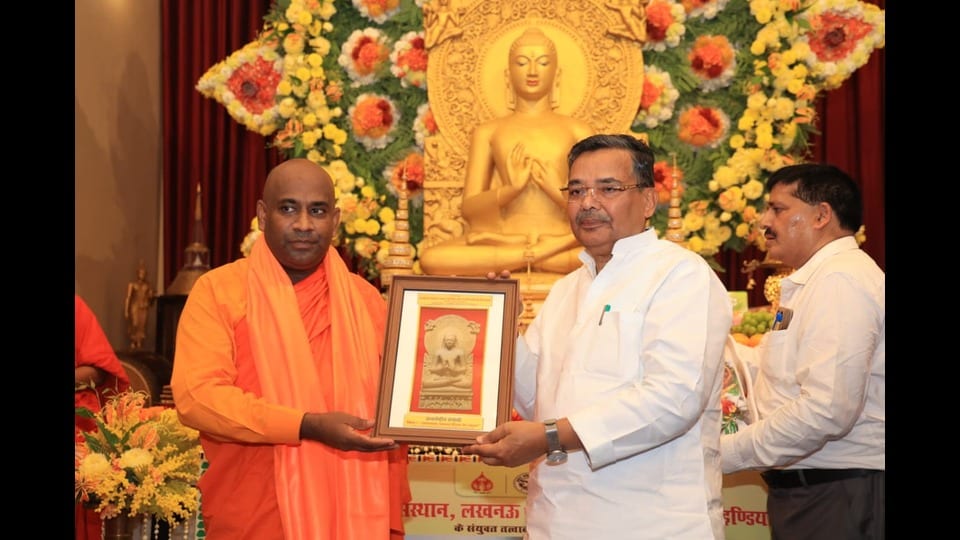
The state government aims to provide world-class facilities to domestic and international tourists visiting Sarnath and give fresh momentum to tourism activities in the area, he said.
Singh said Sarnath has now become India’s 45th and Uttar Pradesh’s fourth World Heritage Site. The recognition, achieved after nearly 28 years, has given a new identity to the cultural and Buddhist heritage of Uttar Pradesh.
Earlier, the state’s world-famous heritage sites, including the Taj Mahal, Agra Fort and Fatehpur Sikri, were confined to the Agra region. With Sarnath’s inclusion, Uttar Pradesh’s World Heritage footprint has now expanded to the Purvanchal region, he said.
The minister was speaking at the inaugural ceremony of a two-day international seminar organised on the occasion of Ashadha Purnima and Dhammachakka Pavattana Day at Mulagandha Kuti Vihara in Sarnath, Varanasi. Buddhist monks, scholars and devotees from India and abroad participated in the seminar, which focused on the theme, “Significance of Dhammachakka Pavattana Day”.
While honouring the Buddhist monks present at the event, Singh said the state government was making continuous efforts to develop Sarnath into a global Buddhist tourism hub.
Buddhist scholars gather in Sarnath
The seminar was organised under the joint aegis of the International Buddhist Research Institute, Lucknow, under the Department of Culture, and the Mahabodhi Society of India, Sarnath. It featured discussions on the historical, religious and cultural significance of Dhammachakka Pavattana Day.
Several Buddhist monks and scholars, including Ven R Sumittananda Thero, president of the Mahabodhi Society of India (Sarnath), attended the event. The seminar aims to spread Lord Buddha’s first sermon and his message of Dhamma among the masses on a wide scale.
Singh said strengthening Sarnath’s global profile would bring new international recognition to tourism in Uttar Pradesh. He said the achievement would not only showcase the state’s rich Buddhist heritage on the global stage but also create new opportunities for religious and cultural tourism.
He expressed confidence that Sarnath would emerge as a major attraction for Buddhist pilgrims and tourists from across the world. He also said it would play an important role in spreading Lord Buddha’s message of peace and compassion worldwide.
During the event, the Dhammapada, translated from the original Pali into Sanskrit by Mahapandit Rahul Sankrityayan, and Yugpurush Kosetsu Nosu ko Smaran Karte Hue (Remembering the Great Figure Kosetsu Nosu), authored by prof Siddharth Singh, were launched.
Prof Vimalendra Kumar presented the outline of the seminar. Those present included Dr Rakesh Singh, director of the International Buddhist Research Institute, Lucknow; Ven K Siri Sumedha Thero, a member of the institute; prof RM Pathak, president of Mahabodhi Vidya Parishad, Sarnath, and former vice-chancellor of Dakshina Bharat Hindi Prachar Sabha; Tarunesh Bauddh, a member of ABSS Lucknow; Prof. Ujjwal Kumar from the department of Buddhist Studies, University of Calcutta; and the vice-chancellor of Nava Nalanda Mahavihara, Nalanda. Siddharth Singh also shared his views.
During three technical sessions on the second day of the seminar, July 30, scholars, researchers and Buddhist monks from India and abroad will present research papers on the significance of Dhammachakka Pavattana Day and various aspects of Buddhist philosophy. Scholars from institutions including Banaras Hindu University, University of Delhi, Swami Vivekananda Subharti University, Nava Nalanda Mahavihara, the Central Institute of Higher Tibetan Studies (CIHTS) and the Mahabodhi Society of India (Sarnath) will present their views. At the end of each technical session, the respective chairperson will offer remarks and summarise the discussion. At the end of the programme, Dr. Rakesh Singh will express gratitude to all participants and guests.


