
 E-Paper



Sutradhara’s Tales: Parvati hill bears witness to ups and downs of Peshwa rule in Pune
Parvati hill temple complex still stands as a symbol of Peshwa rule in Pune and speaks of their religious ethos. It also stands as a fine example of Maratha architecture of the 18th century

 Prefer HTon Google


The Parvati hill temple complex has been the recipient of sustained attention and patronage of the Peshwa family since its inception. It still stands as a symbol of Peshwa rule in Pune and speaks of their religious ethos. It also stands as a fine example of Maratha architecture of the 18th century.
Nanasaheb Peshwa appointed his personal affairs’ clerk, Bajirao Baburao Dike and Ravaji Keshav Dike who look after the temple construction. They were supervised by sardar Khajgiwale.
The five pinnacles of the Devdeveshwar temple were fitted with gold in 1760-61 - 10.20kg of gold was utilised. The interesting phenomena of “Kirnotsarga” or sunrays illuminating the shivalinga of the Devdeveshwar complex takes place for two-three days during the cycle of Uttarayana (movement of sun between Winter Solstice and Summer Solstice). A similar phenomenon is observed in the case of the temple of Vishnu, established in 1758, where the idol of Madhava Vishnu is illuminated during Dakshinayana (movement of sun between Summer Solstice and Winter Solstice).
Nanansaheb Peshwa was heartbroken due to the severe loss suffered by the Marathas during the battle of Panipat and passed away on June 23, 1761, at Peshwa wada on Parvati. His death anniversary is still observed with pensive remembrance.
Raghoba Dada Peshwe, younger brother of Nanasaheb, had constructed a temple dedicated to Kartikeya swami, which was damaged during the Nizam’s attack. It was later reinstalled by Madhavrao Peshwa, which again suffered damaged in various unfortunate events. The present kartikeya idol was consecrated on June 28, 1869.
Peshwas were very concerned about the safety of idols and in case of an emergency, such as an attack on Pune, they would move the idols along with the treasury to fort Sinhagad. For the same reason, the idols were kept safe at fort Sinhagad from November 17, 1751, to March 1, 1752, during the Hyderabad Nizam’s first attack.
When the Hyderabad Nizam attacked Pune shortly after the demise of Nanasaheb Peshwa in 1763, considerable damage happened to the idols and temples of Parvati. Almost half of Pune was ransacked. The Nizam cut the golden pinnacles as he looted Parvati and city of Pune. The stone idols were severely destroyed.
However, Madhavrao Peshwa restored the temples back to their glory. He also reinstated the idol of lord Vishnu in March 1766. Similarly, the six-faced Kartikeya idol was reinstated around the same time. He fitted the temple pinnacles with gold.
Later, the idols were moved to fort Sinhagad during the attack of the Bhosales of Nagpur on Pune, in 1768- 69, and during Sawai Madhavrao’s period.
The Dike family remained in service of the upkeep of complex till 1803, when Bajirao II took charge. After the Treaty of Vasai, Bajirao II removed the Dike family and Khajgiwale and appointed his own personal affairs’ clerk, Baburao Ganesh Katre.
The lack of a proper pathway made it difficult for the Peshwa paraphernalia to climb the hill. Hence, Bajirao II commissioned 103 broad stairs to be built to access Parvati hill. The stairs were so wide, that camels and elephants could ascend without difficulty.
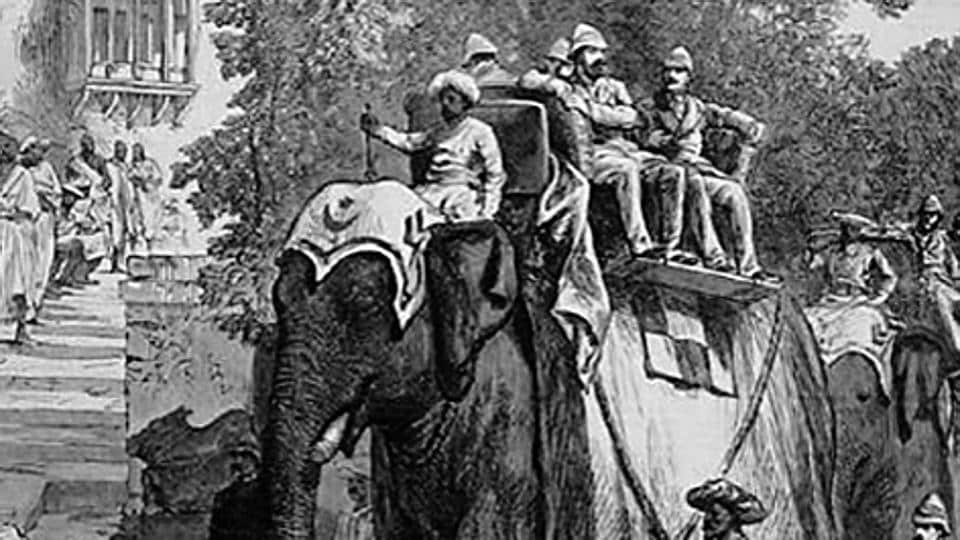
In fact, when Albert Edward the VII, the Prince of Wales, visited Parvati in 1875 on an elephant, the pachyderm tripped at stair number 56 causing the Prince to have an embarrassing fall.
During the famous battle of Khadki between the Peshwas and the British in 1817, Bajirao II made sure that the idols were shifted to Sinhagad. Maratha troops, on November 1817 gathered at Khandoba maal near Khadki, the location of the present Deccan College, under the command of Bapu Gokhale,. Bajirao II instead of leading the battle chose to watch it helplessly from the northern arched pavilion of the Devdeveshwar complex of Parvati hill through a telescope gifted to him by the East India Company in 1803. Thus, the once glorious Parvati hill silently watched the downfall of the Marathas, who lost the battle to the British on November 16, 1817.
The British governor, however, returned the idols retrieved during capture of fort Sinhagad and reinstated them, fearing public outrage.
Subsequently, the temple of Vitthal Rukmini was built in 1931. As we climb the stairs, the sacred platform of Vetal, the Mangirbabba shrine, the remains of Math, and the Sati memorial in the form of Tulsi Vrundavan are seen. A lone Nandi is installed at stair number 75. A room nearby known as the talim room housed two cannons which were fired on special occasions. These cannons were moved in 1879 as a matter of precaution, during the rebellion of freedom fighter Vasudev Balwant Phadke.
Two nearby rooms are the clock room and drum room, which are next to the sajja, a viewing gallery. The Vitthal temple is situated at the end of stairs, while the newly built Peshwa museum is to the left.
The museum originally was a two-storeyed spacious wada of the Peshwas and was equipped with a pooja room, kitchen, storage room, maajghar, a room to make prasad, hom shala (ritual room) and sahanechi kholi (pooja preparation).
Every year, auspicious Mondays of the Shravan month and the Mahashivratri festival are celebrated at the Devdeveshwar temple.
Vaikunth Chaturdashi is observed at Vishnu temple and Ashadh-Kartik Ekadashi are observed at the Vitthal temple. The full moon day of the Kartik month is celebrated at the Kartikeya temple. Peshwas were keen on conducting various family rituals such as the Upanayana ceremony of Sawai Madhavrao Peshwa, at the Parvati temples.
Till the year 1929, entry of dalits was prohibited at the Parvati temples. Inspired by similar movements led by Dr Babasaheb Ambedkar, progressive activists planned a protest to allow entry of dalits into the temple complex of Parvati hill on October 13, 1929.
The protest was led by progressive activists such as NV Gadgil, SM Joshi, Keshavrao Jedhe, Vinayak Bhuskute, Shivram Kamble, SS Thorat and others. However, a group of orthodox people attacked the protesters with sticks and threw stones at them as protesters climbed the stairs. NV Gadgil, Deshdas Ranade and Rajbhoj were severely injured.
Entry was opened at all temples in Maharashtra after the Kalaram temple protest in Nasik by Dr Ambedkar and the Vitthal temple protest by Savarkar.
Thus, all throughout the 18th century, the religious complex of Parvati flourished and expanded. Various attacks, natural disasters and thefts were unfortunate, but they could not overshadow the luminance of the Peshwa legacy and grandeur.
Even today, Parvati hill is flocked to by health conscious Punekars who climb the hill and relive the Peshwa heritage as they glance at the town of Pune from the arches of “Devdeveshwar”.
Saili Palande-Datar is an indologist, environmentalist, history researcher and farmer. She can be reached @ sailikdatar@gmail.com


