
 E-Paper



Who is Soman Rana? Army boxer who survived a mine blast before becoming India's Commonwealth shot put gold medallist
Army boxer Soman Rana survived a mine blast, rebuilt his career and became India's Commonwealth shot put champion at 43.

 Prefer HTon Google


Soman Rana’s journey to the top of the Commonwealth podium did not begin inside an athletics circle. It began in a boxing ring, continued through years of service in the Indian Army and appeared to have been brought to an abrupt end by a mine blast that cost him his right leg.
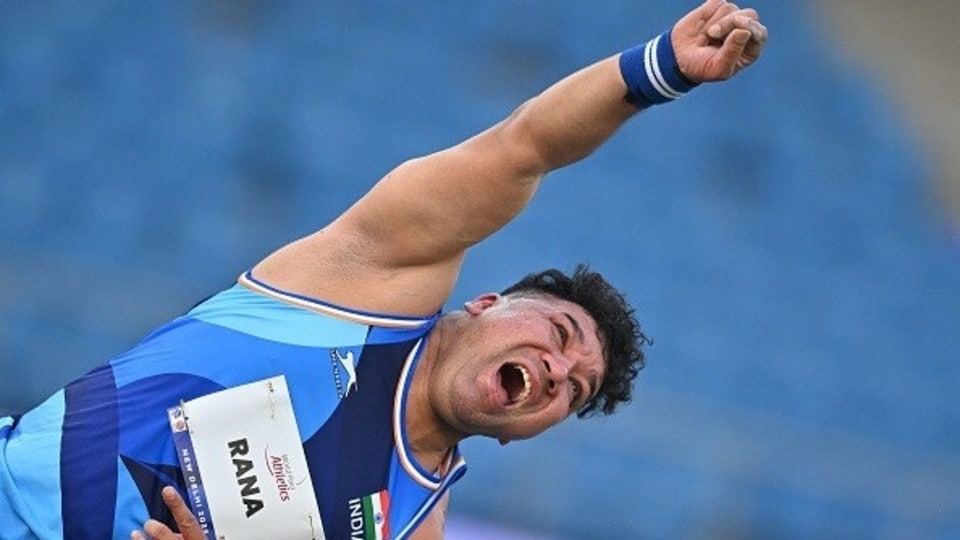
Nearly two decades after that life-changing injury, Rana stood as a Commonwealth champion. The 43-year-old won the men’s F57 shot put gold at the 2026 Commonwealth Games in Glasgow with a throw of 13.40 metres. Compatriot Shubham Juyal registered 13.28m to claim silver and complete an Indian one-two in the event.
The winning distance was not Rana’s personal best, but the medal carried the weight of everything that had come before it: his first sporting career as a boxer, the trauma of the 2006 blast, an unusually late entry into para athletics and years spent finishing agonisingly close to the biggest international podiums.
From an Army boxer to a para-athlete
Rana served with the 2nd Battalion of the 8 Gorkha Rifles. Before his injury, he was a middleweight boxer who competed at the national level for around five years. The strength he developed through boxing, particularly in his upper body, back and core, would eventually provide the foundation for his second sporting career.
On December 1, 2006, while serving in the Poonch sector of Jammu and Kashmir, Rana was caught in a landmine blast and lost his right leg. He survived, underwent rehabilitation and eventually returned to his unit, where he took up administrative responsibilities. Competitive sport, however, was no longer at the centre of his life.
That changed in 2017 when Rana visited the Artificial Limb Centre in Pune to obtain a new prosthetic limb. During the visit, he learnt about the Army Paralympic Node at the Bombay Engineering Group and Centre in Kirkee. Encouraged to explore para sport, Rana chose seated shot put and began training seriously at around 34—an age by which most elite athletes have already spent years competing at the highest level.
His boxing background proved invaluable. Athletes in the F57 shot put category compete from a secured throwing frame and rely heavily on upper-body power, trunk movement and balance. Rana’s coaches worked on his flexibility, strengthened his throwing arm and refined the final movement of his hand and fingers to help him generate greater distance.
Rana soon established himself among the world’s leading competitors. At the Tokyo Paralympics, he finished fourth with a best throw of 13.81m, narrowly missing out on a medal at his first Games.
He subsequently won silver at the Asian Para Games and raised the national record to 15.02m. At the Paris 2024 Paralympics, Rana produced 14.07m and finished fifth, once again leaving a major global competition without the medal that his consistency appeared to merit.
The long-awaited breakthrough arrived on home soil at the 2025 World Para Athletics Championships in New Delhi. Rana threw a season-best 14.69m and was listed as the bronze medallist in the final official medallists’ record, securing the first global championship medal of his career at the age of 42.
Less than a year later, Glasgow delivered another landmark. His 13.40m effort was enough to make him a Commonwealth champion on his Games debut.
Rana’s story is not simply one of returning to sport after an injury. He had to build an entirely new athletic identity long after his original career had ended. He went from national-level boxer to soldier, from mine-blast survivor to seated thrower, and from repeated near-misses to World Championships medallist and Commonwealth gold medallist.
At 43, Rana has also challenged the conventional timeline of elite sport. He entered para athletics only in his mid-30s but became a two-time Paralympian and one of India’s finest F57 shot-putters.
His Glasgow gold was therefore about far more than six throws on one afternoon. It was the reward for nine years of technical reinvention, discipline and persistence - and the defining title of an extraordinary second sporting life.


