E-Paper



With only 9 days of sitting, Odisha Assembly adjourned amid ruckus
Amid continuing ruckus by the opposition demanding the resignation of minister of state for home and energy Dibya Shankar Mishra, alleging his proximity to the main accused in the case of murder of a woman schoolteacher in Kalahandi district, the winter session of the Odisha Assembly came to an end on Friday, twenty days ahead of its scheduled conclusion


Amid continuing ruckus by the opposition demanding the resignation of minister of state for home and energy Dibya Shankar Mishra, alleging his proximity to the main accused in the case of murder of a woman schoolteacher in Kalahandi district, the winter session of the Odisha Assembly came to an end on Friday, twenty days ahead of its scheduled conclusion.
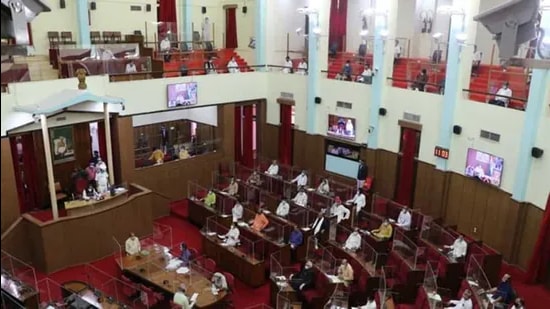
Government chief whip Pramila Mallick moved an adjournment motion in the House seeking an end to the winter session, following which Opposition BJP and Congress members staged a walkout. The House was adjourned sine die by Speaker Surya Patro after passing of the supplementary budget of ₹19,833 crore.
Earlier in the day, the Speaker had to adjourn the proceedings of the House twice with opposition BJP and Congress creating ruckus holding placards and beating gongs to demand the resignation of Mishra in Mamita Meher murder case. Meher, 26, was allegedly killed by Gobind Sahu, president of the managing committee of Sunshine English medium school in Mahaling grampanchayat of Kalahandi district on October 8 after she allegedly threatened to expose her extramarital affairs. Though Sahu was arrested, the opposition has been stridently demanding Mishra’s sacking from the Naveen Patnaik ministry alleging his complicity with Sahu.
BJD MLAs too resorted to sloganeering in the House over alleged negligence by the Centre over allocation of houses under Pradhan Mantri Awas Yojana, fuel price hike and inflation.
Since December 1 when the winter session began, no significant business has been undertaken in the Assembly amid protests, sloganeering, blocking of the Assembly gate, beating gongs and bells and the sprinkling of gangajal and cow dung-laced water for ‘purification’ of the premises. The House ran for less than two hours during the last 9 days of the session and all-party meetings convened by the Speaker to end the deadlock did not succeed as opposition leaders boycotted it.
Deputy Leader of Opposition, Mohan Majhi said the opposition wanted the chief minister to come to the House and not make a statement through video conference.
“But his indifference to our demands compelled us to protest in the House to make our voices reach to the CM. He can travel all over Odisha to distribute Biju Swasthya Kalyan Yojana cards, but cannot attend the Assembly session and take our questions,” Majhi said. “He should have suspended Dibya Shankar Mishra over his involvement in the Mamita Meher murder case. But he did not respond to any of our demands.”
Though the Assembly is supposed to sit for 60 days in a calendar year, during the 21-year rule of the BJD, the Assembly has completed the 60-day sitting only three times - during 2006, 2010 and 2012. In the remaining years, it has convened for anything between 41 days and 58 days. This year, the Assembly sat only for 30 days. In 2020, the Odisha Assembly’s winter session was adjourned after sitting for only 10 days.
After the first pre-independent assembly was formed on February 3, 1937, the Odisha assembly fulfilled the 60-day-a-year norm only a dozen times - 1952, 1957, 1958, 1959, 1960, 1962, 1964, 1965, 1972, 2006, 2010 and 2012. When the first pre-independent assembly was dissolved on September 14, 1945, it had held a total of 188 sitting days.
The highest-ever sittings in a calendar year was achieved in 1955 when the Assembly sat for 103 days over two sessions.
...