
 E-Paper



Beggars continue to throng Pune streets
As per official records, there are only around 471 beggars across Maharashtra. However, Pune itself has more than 12,000 beggars


PUNE While Pune is moving towards becoming a smart city, the problem of begging has compounded with the number of beggars having increased over the past two years of the Covid-19 pandemic.
Vikas Kuchekar, president of Human Rights’ Protection and Awareness, a social group that demanded information on this issue under the right to information (RTI), said, “As per official records, there are only around 471 beggars across Maharashtra. However, Pune itself has more than 12,000 beggars.”
While the Bombay Prevention of Begging Act 1959 considers begging a crime, it has become something of an industry in the city. “Although the police remove them when someone registers a complaint, there is no permanent solution. They are back at the same spot within hours,” Kuchekar said.
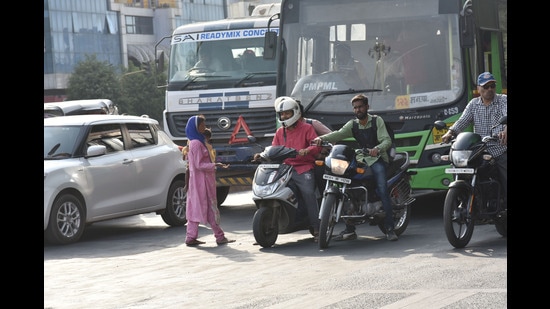
Beggars throng a majority of traffic signals, areas of worship and markets across the city. The beggar hotspots in Pune include nurse stop, Kondhwa, Shaniwarwada, Swargate, Budhwar peth and Koregaon park among others.
Rajesh Puranik, head of the social security cell, Pune police, said, “Begging is a social crime that has been going on for years. It is a never-ending problem. The Pune police register on an average 32 to 35 cases every month but as it is a bailable offence, they easily bail themselves out by paying a ₹5,000 fine.”
According to the social security cell, the beggars earn ₹800 to ₹1,400 every day, making it a business for many. “The syndicates are strong. We have also registered cases under the Juvenile Justice Act. Many children are dragged into this by groups,” said Puranik.
The Bombay Prevention of Begging Act 1959 gives police the authority to arrest anyone who is found begging but hardly any action is taken against the handlers. Qaneez Sukhrani, a social activist who has been actively pursuing the issue with the government for the last five years, said, “One can find the handlers every morning at different spots bringing the beggars. Most handlers steal children, the beggars’ limbs are cut and they are handicapped. The police need to imprison these handlers. Action must be taken against them.”
The central government runs homes for beggars and rehabilitation centres for providing them vocational training with the aim of making them skilled and independent. Pune has a rehabilitation shelter located in Phulenagar, Yerawada. “However, very few beggars are actually taken to the centre,” said Kuchekar.
Puranik added, “Even when we take them to the centres, they run away. Many a time, the beggars become aggressive. The problem gets complicated, especially in case of children, women and transgenders.”
“There needs to be a joint effort by the Pune Municipal Corporation (PMC) and the police to provide proper training to these beggars and improve the condition of the welfare state. Night shelters are not the solution,” said Sukhrani.
While the legal means of dealing with beggars have failed to bring about change, Puranik said, “It is the society which needs to understand and stop encouraging them. Many times in the name of religion or sympathy, people tend to give alms thus encouraging this social crime. There needs to be a general awareness among people regarding this issue as well.”


