
 E-Paper



Civic Sanskriti: Parking the problem in a no-parking zone in Pune is not the answer
We don’t have to be nostalgic for the good ol’ times before Covid


We don’t have to be nostalgic for the good ol’ times before Covid. They are back again, with a vengeance. Our streets are again full of parked vehicles leaving little space to walk, cycle or even drive.
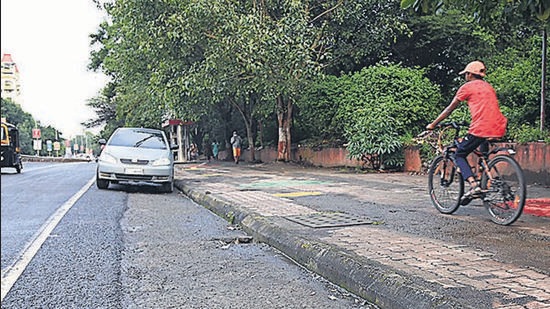
Parking is a problem in Pune – too many parked vehicles spilling onto footpaths and carriageways, and no prioritisation of spaces for people with disabilities, emergency needs and public transport. Instead of clamouring for more parking, we need to stop and ask for managing existing parking spaces well.
The issue
A vehicle typically needs three different parking spaces – at the owner’s place, at the workplace, and other places a person might drive to. The increase in private vehicles implies that parking-space demand also increases.
However, city- and street-space is precious and limited. It meets many other needs – mobility of people using environment-friendly travel modes, street vendors’ livelihoods, vegetation, and civic services like waste management.
PMC is implementing excellent street designs, such as in Aundh and on JM road. But, the beautiful public space created for walking and cycling is quickly taken over by parked vehicles.
We cannot first build huge parking lots and then try to manage parking space. There will never be enough space and money to build parking lots. Parking lots occupy land that could have been playgrounds and gardens, woefully in short supply.
Pune’s progressive parking policy
A progressive approach is already detailed out in Pune’s Parking Policy, approved by the PMC General Body in 2016, but not yet implemented. It recognises parking as an essential component of the transportation system that if not managed properly, can create a public nuisance.
The policy has three crucial components. The first is designation of three parking zones based on the current demand for parking: A – high parking demand; B - medium parking demand; and C - low parking demand. The second component is fixing parking charges in these zones, and the third is creation and management of parking facilities with a view to reducing parking demand and dependence on personal motor vehicles.
A basic fee for different vehicle types and parking duration is recommended. Over and above the base rate, dynamic pricing is suggested. Short-duration parking is to be cheaper. Commodities are cheaper if you buy in bulk, but good parking management works the other way. You should pay at a higher rate if you are parking longer – this encourages you to vacate your slot quickly.
People who need to park their vehicle for the whole day, say when they drive to work, could use cheaper parking which may be a short walk from their offices. Where off-street parking is available, on-street parking should be significantly more expensive, to encourage people to use parking structures.
The idea is that folks who want to use personal motor vehicles must pay the full value of the parking space they occupy. In turn, revenue from parking fees, expected to be several crores of rupees a year, must be used to improve public transport facilities.
Special parking plans are supposed to be created for hospitals, railway stations, bus stations and tourism sites. Areas with extensive freight movement may also need special plans.
PMPML buses, ambulances, school buses are exempt from parking charges. Autorickshaw stands are already designated in some areas, and the Parking Policy supports the demarcation of such stands where needed. And yes, since Pune was and aims to be a city of cycles, if you pedal, you may park for free!
A Pune parking app is expected to be developed to let drivers know about parking availability and charges.
Apart from these provisions, attention is needed for managing parking needs of residents in localities with older houses, apartments, and informal settlements without their own parking spaces. In addition, delivery vans, autos, and cabs may also need special space allocation.
Further, in the Development Control Rules, presently, residential and commercial buildings are required to provide a certain minimum amount of parking – as if the city confesses that it cannot provide good public transport, so people should fend for themselves and hence, will need ample parking.
Progressive cities around the world put an upper limit on parking space and use precious urban space for better facilities for walking, cycling and public transport.
Urgent, systematic implementation needed
With rising congestion, poor air quality, concerns about road safety and difficulty of parking when really needed in an emergency, the public is facing the consequence of non-implementation of the parking policy.
In the core city and many segments of the arterial roads, there is a crying need to prioritise de-congestion, mobility, and efficient use of road space. However, if a limited stretch of road is designated as a no-parking zone, the adjoining areas become clogged with parking.
Instead of a piecemeal approach, the city authorities must initiate a structured approach of area-based parking management plans with stakeholders’ participation as recommended in the parking policy. These plans should include user communication mechanisms, strengthening public transport and non-motorised transport facilities as required, clear definition of parking and no-parking spaces, parking charges, and enforcement.
What can you do?
The first thing is to recognise that “parking is not a right”. Those who drive should try to locate off-street parking and be prepared to pay the fee.
As citizens and neighbourhood groups, we need to demand that our elected representatives implement the already-approved, forward-looking Pune Parking Policy. We should participate in processes to organise and regulate parking spaces. Alongside, we should assess public transport and demand for better services, universal accessibility, and last-mile connectivity, where ever needed.
The sooner we, individually and as a city, limit the occupation of our streets with parked vehicles and shift to walking, cycling, and public transport, the better it is for our collective good.
Sanskriti Menon is senior programme director, Centre for Environment Education. She writes on urban sustainability and participatory governance. Views are personal. She can be reached at civic.sanskriti@gmail.com


