
 E-Paper



Credibility of coop sector at risk, time to introspect: Amit Shah
Shah also cited examples of cooperative banks shutting down their business or in some cases administrators had to be appointed


PUNE Union Minister for Home Affairs and Cooperation Amit Shah has asked Maharashtra’s cooperative sector, especially among sugar mills and district cooperative banks, to introspect for losing credibility.
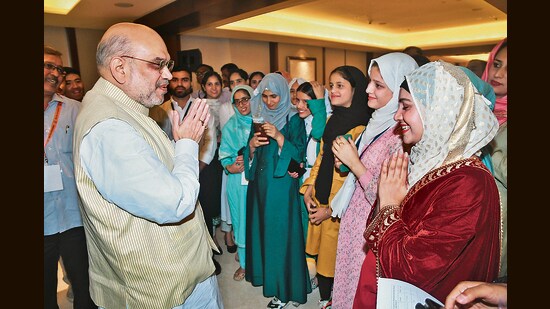
Shah, while speaking in Pune on Saturday during the cooperative conference, asked cooperative sector to deliberate on why the number of cooperative sugar mills came down to 101 from 202 a few years ago.
“There is a need for cooperative sector to introspect on why this number came down when private sugar mills number went up from 22 to 93,” said Shah.
Shah also cited examples of cooperative banks shutting down their business or in some cases administrators had to be appointed. “Because of the problems in running these institutions, administrators had to be appointed at multiple places. There were instances where urban cooperative banks closed down. We have an example of Rupee Bank from Pune closing down or banks from Solapur, Nagpur, and Kolhapur facing irregularities,” he said.
At the same time, Shah asked cooperative sector to improve its functioning so as to get the assistance from ministry.
Shah said his ministry is in the process of forming a National Cooperation Policy and the committee constituted under Suresh Prabhu for this will be submitting the draft in the next few months.
“Once the report is submitted, suggestions and objections will be invited before finalising the policy for the cooperative sector for the next 20 years,” he said.
Earlier Shah had told parliament last year that formulation of the new National Cooperation Policy will help in realising the vision of ‘Sahakar se Samriddhi’, promoting the cooperative-based economic development model, strengthening the cooperative movement in the country and deepening its reach up to the grassroots.
Shah further said the Union government has allowed exports house to be set up and with the help of primary agriculture credit societies, even smaller farmers will be able to export their produce.
Shah said that currently if the farmers have to export their products, they have to rely on traders because export houses do not allow the farmers’ entry. “The farmer has to sell its products to a trader, and the trader will sell it to the big trader, and that big trader will give them to the export house, and the export house will get the maximum benefits by exporting the produce,” he said.
“We are going to make an export house on the basis of a cooperative, which will take the farmers’ produce through the PACS, and after exporting the farmers’ produce, the export house will transfer the revenues into the farmers’ accounts through the PACA.
“Even the smallest of the small farmers could sell his produce in the global market through this platform,” he said.


