
 E-Paper



Curtain Call: Travelling through time on stage
There were three time periods in the play – one was 2016, the other was 1942 and the third was 1976. I wanted different colour palettes for every era. 1942 was to be black and white, 1976 in sepia and the present was supposed be more colourful

 Prefer HTon Google


A few of my friends had made it big on television with their hit series in Marathi – “Dil Dosti Duniyadari”. After nearly a year of working on that series, they were surprisingly bidding it goodbye. Surprising because when something is doing well usually it is milked as much as possible; to a point that it becomes unbearable to watch anymore.
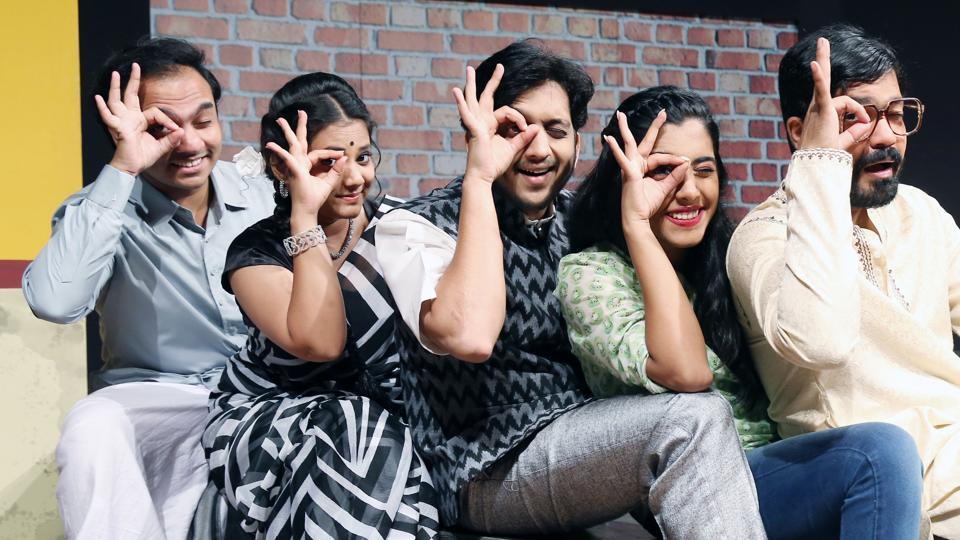
Anyway! So, all the six protagonists of the series had enjoyed working together and wanted to take it forward. And I am glad they chose the medium of theatre. They had been receiving offers for films left, right and centre. Everybody wanted a piece of them. But they stood their ground, mostly because they wanted to do something that appealed to them.
Interestingly, they came up with a creative concept. And after meeting with Sunil Barve, who is a renowned Marathi actor and a theatre producer with a successful track record, they took the rare decision of becoming producers themselves and to drive the project. As things progressed, two of them departed from the project amicably and another decided not to produce, but be a part of it as an actor. But the remaining three went ahead with the idea and formed their own company – “Kalakaarkhana” – which loosely translates as “art factory”.
The new producers – Sakhi Gokhale, Suvrat Joshi and Amey Wagh – then started to put their plan in motion, with the blessings of Barve. They approached a writer – Manaswini Lata Ravindra. Manaswini, or Manu as she is fondly called, who was one of the lead writers of the aforementioned series. She has started her journey with experimental theatre too. They zeroed on me as a director and I was more than happy to work with them.
I heard the concept and found it fun and felt it had a lot of potential. They wanted to explore the concept of time-travel, a subject which, to my knowledge, had not been attempted in Marathi theatre before. Sakhi has a formal education in photography and added an element of using the flash of camera as the medium of time travel, which was exciting.
Manu and I met to discuss the possibilities and she had some wonderful ideas. We were deciding the eras of time travel and felt that the times of “Quit India” movement and the “Emergency” could provide the characters with natural conflicts. After a week or so she read out a basic flow of scenes and there were many innovative incidents in it that left us excited! We also had a name for the play – “Amar Photo Studio”. I realised how much I had missed working on a play right from the concept level. For nearly a decade I had directed plays that had bound scripts and most of them were nearly a century old. So. a discussion with the writer was out of question!
With whatever scenes we had in hand, we decided to begin rehearsing. With no deadline in mind, we started meeting every day at a friend’s place. Looking back, I realise how simple these things were. The actors and I started discussing the characters, their inter-personal relationships, pivotal incidents that might have shaped the way they think, their mannerisms, amongst other things. Once we felt that we had a strong grasp on individual characters, we started rehearsing scenes and tried to go above and beyond the written word.
Since the play was based on time-travel, we decided to try and create something magical. In fact, we approached the renowned magician Jitendra Raghuvir with our queries and he provided ample support too. We approached a set designer who made hydraulic sets. I was hoping the set changes would look fantastical and in sync with the idea of creating magic on stage. We worked on it for nearly a month, but unfortunately it was not logistically and financially feasible.
In came Pradeep Mulye, one of the most respectable and well-known names in set design. There were three time periods in the play – one was 2016, the other was 1942 and the third was 1976. I wanted different colour palettes for every era. 1942 was to be black and white, 1976 in sepia and the present was supposed be more colourful. Pradeep dada came up with a wonderful, but simple set design that delivered on all fronts. We missed making motorised sets, but realised that most theatres in Maharashtra weren’t equipped for that.
The continuous discussions with all heads of departments, including costumes, make-up, hair and of course the actors, helped me understand the logistical problems that we might face while transitioning from one scene to the other. All of the actors were playing multiple roles and had to change their costumes and make-up really quickly between scenes, sometimes within scenes too! This helped me come up with creative solutions for each problem. But there were still two things that I hadn’t figured out – there was supposed to be a change in the era while a particular scene was playing out and the other was that two characters played by the same actor were supposed to be on set at the same time!
These two problems were really starting to trouble me. The simple solution was to rewrite the scenes and make them more direction-friendly. But I would have completely killed off the magical elements in the play.
We had rehearsed for nearly two months and were now looking at opening the play. I realised that I had little over three weeks to find a solution for these problems.
Do not miss the next article for more on that...
Nipun Dharmadhikari is a storyteller and looks forward to telling them on stage, in front of the camera or in person.


