
 E-Paper



Pune: Rise in river pollutants during Ganesh festival in last 4 years
According to a MPCB official, as rivers in Pune do not have a strong flowing current, decomposition of immersed idols takes a long time

 Prefer HTon Google


The various efforts by Pune and Pimpri-Chinchwad municipal corporations to prevent water pollution during the 10-day Ganesh festival have failed to provide the desired results, as per the data released by the Maharashtra Pollution Control Board (MPCB).
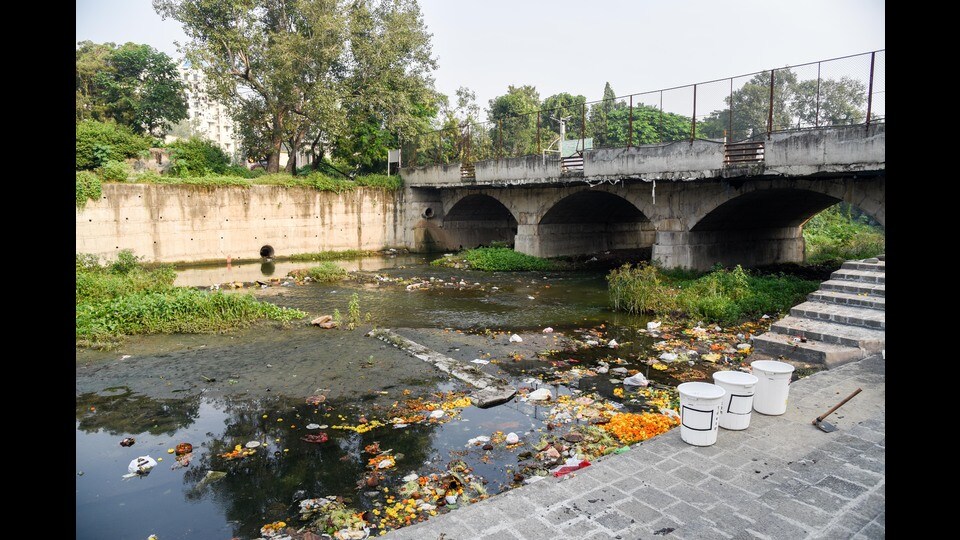
The MPCB data between 2019 and 2022 shows a constant rise in pollutant levels across water bodies in both the cities.
The water sample tests showed that both stretches of almost all rivers — Mula, Mutha, and Pavana - in both cities recorded an increase in chemical oxygen demand (COD) and biochemical oxygen demand (BOD) during the festival. COD and BOD indicate the amount of waste in a waterbody.
While the recorded level is below the standard limit set by the Central Pollution Control Board (CPCB), the data shows a constant rise of pollutants in rivers over the years.
According to a MPCB official, as rivers in Pune do not have a strong flowing current, decomposition of immersed idols takes a long time due to stagnant waters and its harmful colour chemicals gets released in the waterbody.
Dissolved oxygen (DO), COD and BOD are among the prominent elements, considered for water quality criteria. For good water quality, the DO level is required on the higher side than the said limit, while the BOD and COD levels are required on the lower limit.
As per the CPCB standards, the DO level in water resources like rivers, lakes, and Nallah should be above 2 milligrams per litre (mg/l), and the limit set for BOD and COD is 30 mg/l and 150 mg/l respectively.
Considering the higher pollution level during the Ganesh festival, MPCB started collecting water samples from around 20 river stretches in Pune Municipal Corporation (PMC) and Pimpri Chinchwad Municipal Corporation (PCMC) areas almost a decade ago.
“The samples have been collected from various river stretches before, during, and after the festival between a gap of 3-4 days. The samples are sent to our laboratories for tests,” said Nitin Shinde, sub-regional officer, MPCB, Pune.
As per the water sample testing data, in 2019, the majority of river stretches recorded DO levels between 5.3 and 6.6 mg/l, BOD between 2.8 and 9 mg/l, and COD was found in the range of 8 and 24 mg/l.
In 2022, the city rivers recorded a DO level between 3.4 and 5.3, BOD between 8 and 14.5 mg/l, and COD level between 27.7 and 67.7 mg/l.
Standard limit
CPCB defines the standard limit for water quality in various sources like rivers, lakes, and nullahs as well as groundwater. As per the previous guidelines, the standard limit for DO, BOD, and COD was 5, 10, and 20 mg/l respectively. In 2021, CPCB introduced new guidelines for water quality parameters and limits for BOD and COD were 30 and 150 mg/l respectively. Therefore, the current level of these elements is considered below the set limit.
Nine-year-data
The water sample testing during the Ganesh festival data in 2014 revealed that the DO level in said year was between 5.79 and 8.10, BOD between 3.3 and 5, and COD between 8 and 16 mg/l. There were variations in the data in the following years due to rainfall conditions.
To curb water pollution during the festival, PMC has been promoting use of clay (shadu) idols instead of PoP and distributing ammonium bicarbonate for residents to immerse the idols at home. The civic body has also set up artificial immersion ponds and arrange moving vehicle ponds.
Mangesh Dighe, environment officer, PMC said, “I won’t be able to comment on the MPCB data. Our monthly water quality check shows a rise in BOD and COD levels in rivers, but it is not significant. However, we require more sewage treatment plants (STP) for the city.”
Shailaja Deshpande, founder member, Jeevitnadi Living River Foundation, said, “Although the BOD and COD levels are among the crucial components of water quality, fertilisers and pesticides are more important when it comes to water quality data. During monsoons, Ganpati comes, same time huge agricultural run-offs come too. During immersion, huge amounts of toxic paint enter the waters, so chemical analysis of water needs to be provided by the authorities.”


