
 E-Paper



Former IISER Bhopal faculty challenges global assumptions on Deccan sedimentary history
Tandon said that he was “overwhelmed with emotion,” remembering how Indian geologists often saw their contributions diminished when foreign teams took over key geological terrains


Senior sedimentologist and former faculty at the Indian Institute of Science Education and Research (IISER), Bhopal, professor S K Tandon, on Monday strongly challenged foreign interpretations proposing a massive marine incursion deep into the Deccan Volcanic Province (one of Earth’s largest flood basalt regions covering central India with thick layers of basalt lava formed due to massive volcanic eruptions) on grounds that such models exaggerate limited evidence and undermine decades of Indian field-based sedimentological work. Tandon was speaking at the inaugural session of the 41st annual conference of the Indian Association of Sedimentologists (IAS) at the Savitribai Phule Pune University (SPPU) on Jan 19.
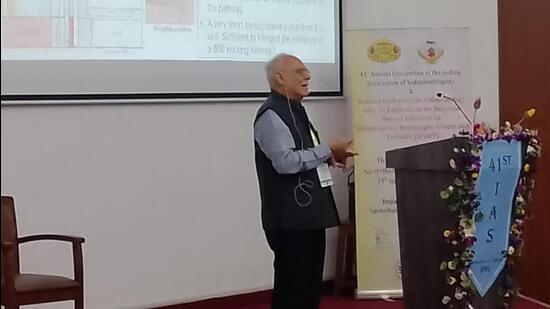
Tandon said that he was “overwhelmed with emotion,” remembering how Indian geologists often saw their contributions diminished when foreign teams took over key geological terrains.
Marine versus non-marine controversy
Tandon explained that while some schools of thought, particularly from Lucknow university, advocated a marine origin for the Lameta (key geological layer in India known for its dinosaur fossils) and infratrappean (older layers below the first Deccan volcanic flows) sediments, vertebrate palaeontological (related to the scientific study of ancient life on Earth) evidence, including dinosaur nesting sites, did not fit a marine model.
Tandon identified the 1987 paper by professor S Sahni and professor Michael Brookfield on palaeosols (soil formed in past geological age/s) as a turning point, which highlighted semi-arid terrestrial conditions and questioned prevailing marine interpretations.
Critique of the ‘800 km marine incursion’ claim
Tandon pointed to the widely cited Chilmili section, a 14 metres’ thick intertrappean (younger sedimentary layers between successive lava flows) deposit inside which marine foraminifera (single-celled planktonic animal/s) occur in a mere 60-centimetre interval, alongside freshwater and brackish indicators. “To infer an 800-kilometre marine transgression from 60 centimetre of mixed-faunal (relating to the animals of a particular region) sediment is scientifically unsound,” Tandon argued, noting that no continuous marine strata exist between Indore and Jabalpur to support such a claim.
He pointed out that definitive marine deposits of the Turonian age (a geological period within the late Cretaceous epoch) such as fossil-rich coralline (derived or formed from coral) limestones occur only west of Indore, reinforcing the view that central Indian marine occurrences are localised, episodic and tectonically controlled.
Questioning foreign interpretations
Without disputing the quality of foreign fieldwork, Tandon questioned the interpretations proposed by international groups, including the Princeton team, stating that conclusions were often driven by preconceived global models rather than regional sedimentological realities.
Tandon called for renewed confidence in Indian sedimentology, stressing that sedimentological interpretation must remain grounded in stratigraphy (a branch of geology concerned with the order and relative position of strata), palaeosols, fossil assemblages, and basin architecture rather than isolated geochemical or palaeontological indicators.
The conference, organised by the department of geology, SPPU; in collaboration with the IAS; focuses on the impact of Deccan volcanism on sedimentation, stratigraphy, climate and tectonics.
The inaugural session was presided over by professor G N Nayak, president of the IAS; while Manish Shukla, chief general manager, ONGC attended as the chief guest, highlighting the applied significance of sedimentological research.
The three-day conference includes technical sessions, poster presentations and panel discussions, bringing together senior scientists and young researchers to reassess India’s volcanic-sedimentary history.


